15 Minutes
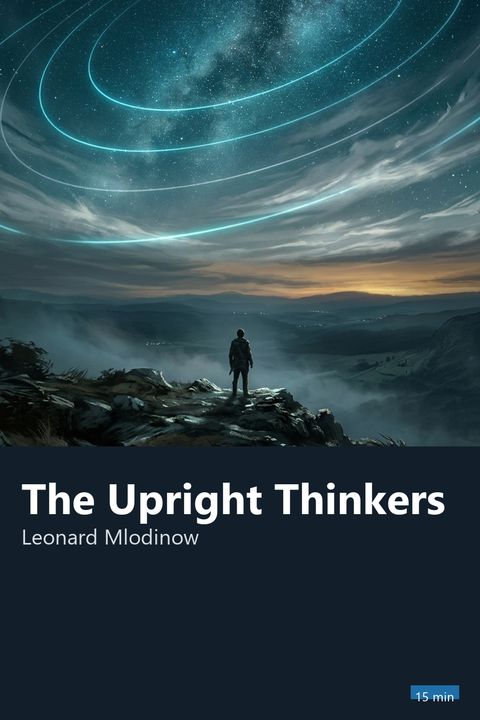
Cover of The Upright Thinkers

Science · 15 min

The Upright Thinkers

Leonard Mlodinow · 2015

Who it's for

For anyone who enjoys science and history and wants an overview of how humanity learned to understand the world.

Read it in the app

⚡ Free to download • 🎁 One full book free every day

🎧 Listen to this summary in the app

Every summary has audio narration. Open the app to read it or listen to it.

3 ideas to take with you

1

In the book's account, many advances grew out of practical needs, such as measuring land and predicting rain, before becoming theories.

2

Observation and mathematics accomplish more together than either does alone, as Eratosthenes showed when he estimated the size of the Earth using shadows.

3

The same idea of gravity that explains a falling apple also explains the Moon's orbit, and that unification gave science an enormous boost in confidence.

“
Science advances when someone has the courage to test a famous idea.
An idea from The Upright Thinkers, in the words of 15 Minutes

Preview

Start reading now

A Primate Looking Up at the Sky

Leonard Mlodinow tells the story of human knowledge as a single journey, from a species of tree-dwelling primate to people capable of calculating a spacecraft's trajectory. The question guiding the book is both simple and profound: how did an ordinary animal's curiosity eventually turn into science?

The answer doesn't follow a straight line. The book traces a path full of detours, mistakes, rivalries, and chance events, in which a handful of people and ideas changed how everyone understood the world. That's why reading it feels more like following an adventure story than studying a school textbook.
Standing Upright, with Hands Free

The original title refers to upright thinkers, and that image is no accident. By standing up, our ancestors freed their hands to carry, make, and manipulate objects. This is one of the steps that evolutionary science connects to the development of larger brains and increasingly complex abilities.

Experts still debate the details of why and when this happened, and any simple explanation deserves a cautious reception. But the general idea helps clarify the author's point: before there was science, there was a body that could explore and a brain that liked trying again. Curiosity wasn't born in a laboratory. It emerged in the daily lives of people who needed to survive.

Language, Art, and the First Science of Everyday Life

Long before books and universities, human groups were already paying close attention to their surroundings. Noticing the cycle of the seasons, animal migrations, and plant growth was a matter of survival. Language made it possible to pass this knowledge from person to person, and cave art shows that symbolic thinking already existed.

Over this long period, small innovations, such as controlling fire and refining stone tools, steadily added up to an advantage. The book suggests that the habit of teaching and copying was just as important as brain size, because it allowed each generation to begin where the previous one had left off.

Think of the knowledge of a fisherman along a riverbank who can tell from the wind and the water's color when fish will appear. It isn't formal science, but it is careful observation and collective memory. The book values this starting point because it shows that modern science grew out of the same attentiveness to the world, just with more demanding rules.

12 more sections and the quiz

Continue in the app

Read the whole summary, finish with the The Upright Thinkers quiz and follow the guided Journeys. No ads in the app.

About Leonard Mlodinow

Leonard Mlodinow is an American physicist and writer who earned his doctorate at the University of California, Berkeley, and taught at Caltech. He has written several popular science books and coauthored A Briefer History of Time and The Grand Design with Stephen Hawking. He has also written for television, including episodes of Star Trek: The Next Generation. The Drunkard's Walk is another of his books.

Explore

Category:
Science