15 Minutes
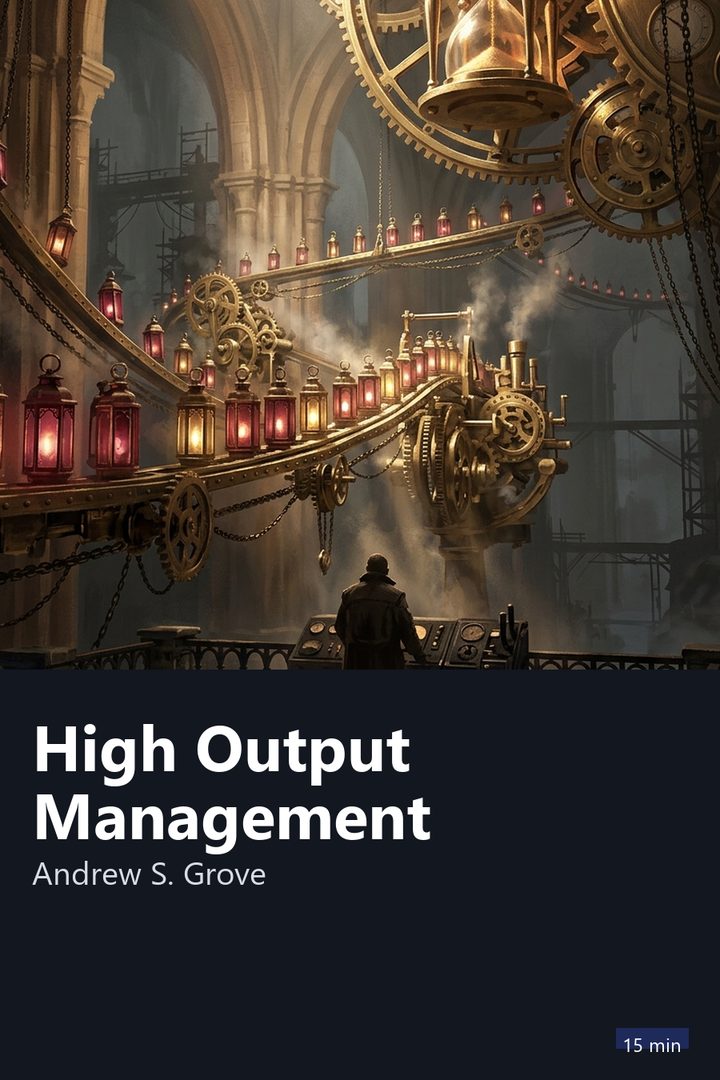
Cover of High Output Management

Leadership · 14 min

High Output Management

Andrew S. Grove · 1983

Who it's for

For anyone who just became a team leader and realized that being a great specialist does not automatically make you a manager. It also works for people who already manage others and want to turn meetings, delegation, and performance reviews into real output.

Read it in the app

⚡ Free to download • 🎁 One full book free every day

🎧 Audio coming soon in the app

Narration for the English summaries is on its way. Meanwhile you can read the full summary in the app.

3 ideas to take with you

1

Your time goes further when it is spent on the few activities that multiply other people's work.

2

Disagreeing with data on the table protects the decision and preserves the relationship, as long as the criticism stays focused on the idea rather than the person.

3

For the author, deciding with enough information and reviewing later usually pays off more than waiting for a certainty that rarely arrives.

“
A manager is measured by what the group delivers, not by the hours they personally spend working.
An idea from High Output Management, in the words of 15 Minutes

Preview

Start reading now

A manager produces through others

When someone leaves a technical role and becomes a manager, the yardstick changes. Before, your value came from what you did with your own hands. Afterward, it comes from what the group delivers. Grove starts from this shift to say that a manager needs to learn how to produce through other people, not alongside them.

That sounds obvious, but plenty of people bring their old routine into the new job. They keep solving everything themselves, answering every request, and putting out fires, while the team waits for their approval to move forward. The result is a bottleneck wearing a boss's badge.

Think of a neighborhood diner with a cook who wants to wait on every table himself. While he runs back and forth between the stove and the dining room, the line out the door grows. A good owner organizes the kitchen, trains the prep cook, and keeps an eye on the whole operation. Management works the same way: you gain scale when other people can get things done without you in the middle.

What measures a manager's output

Grove uses the word output to talk about the result that comes out of a work unit, whether it is an assembly line, a sales team, or an engineering department. For him, the useful question is not how much time the manager spent in the office, but what came out of there.

The book proposes a simple formula: a manager's output is what their own group delivers plus what neighboring groups under their influence manage to deliver. That means an operations manager is also accountable for the results of people who depend on their decisions, even without having direct reports doing that work.

In practice, this changes your calendar. If your metric is the team's delivery and you only look at completed tasks, you miss the signs that the process is stalling. Every month, it is worth asking what changed in what comes out of the group, not just how many things got done.

Leverage: where time pays off the most

If a manager's time is limited, the real question becomes where they invest it. Grove uses the term leverage for the ability to put energy into an activity that multiplies the results of many people, instead of adding one more task to your own list.

Everyday examples: clearly explaining a method to the entire team pays off far more than redoing ten deliverables yourself. Training a supervisor to make decisions on their own frees up hours every week. Personally answering every small question, on the other hand, is work only you do, so it multiplies nothing.

There is a hidden cost here: time spent on something with low impact is time that does not go toward high-leverage work. It is what economics calls opportunity cost, applied to a leader's schedule. Before taking on a new task, ask what it takes away from you.

11 more sections and the quiz

Continue in the app

Read the whole summary, finish with the High Output Management quiz and follow the guided Journeys. No ads in the app.

About Andrew S. Grove

Andrew S. Grove (1936-2016) was born in Hungary, left the country after the 1956 revolution, and earned a degree in chemical engineering from the University of California, Berkeley. In 1968, he helped found Intel alongside Gordon Moore and Robert Noyce, and led the company as chief executive officer from 1987 to 1998. Besides this book, he wrote Only the Paranoid Survive, published in 1996.

Explore

Category:
Leadership