15 Minutes
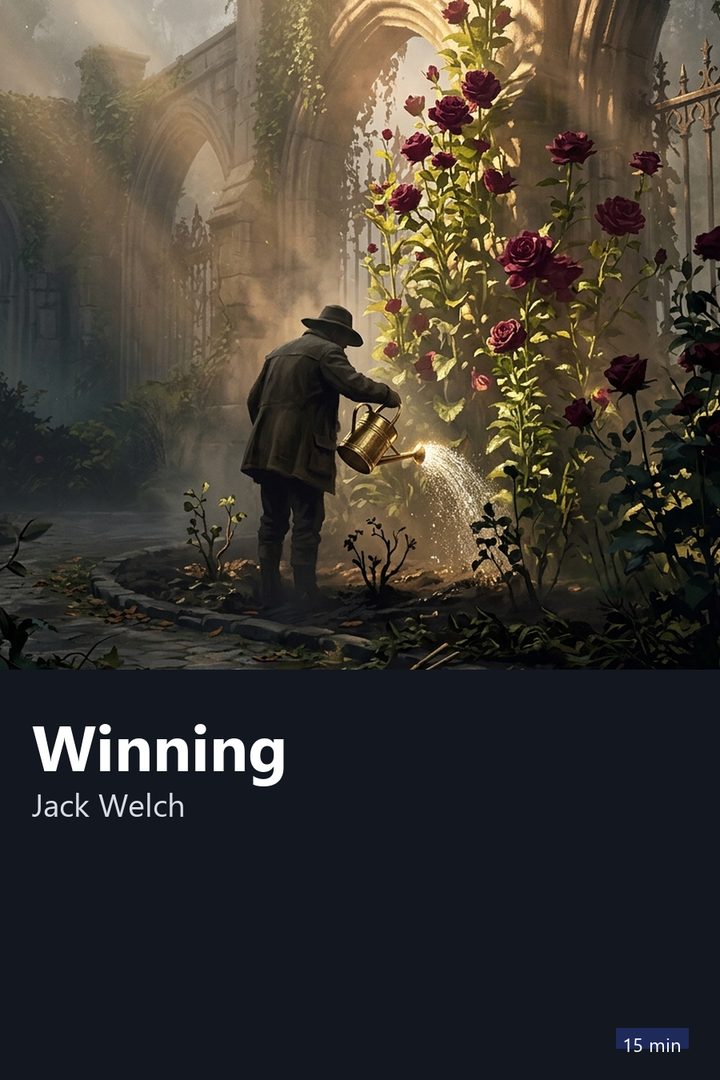
Cover of Winning

Leadership · 15 min

Winning

Jack Welch · 2005

Who it's for

For you who lead a team, run a small business, or want to understand how big-company executives think about results. Read it with a critical eye, because much of the method was born inside a giant corporation with resources most companies simply don't have.

Read it in the app

⚡ Free to download • 🎁 One full book free every day

🎧 Audio coming soon in the app

Narration for the English summaries is on its way. Meanwhile you can read the full summary in the app.

3 ideas to take with you

1

For the author, separating those who deliver from those who don't is the leader's job, not a task to be pushed off onto HR.

2

A meeting that ends without an owner, a deadline, and a next step is just another conversation, not a decision.

3

A beautiful plan that never becomes a weekly routine is just an intention stored in a notebook.

“
A team that's afraid to tell the boss the truth ends up hiding the problem until it becomes a crisis.
An idea from Winning, in the words of 15 Minutes

Preview

Start reading now

Winning as discipline, not luck

Jack Welch spent two decades running General Electric and turned the word winning into a management vocabulary. For him, winning was not a stroke of luck or a rare talent reserved for geniuses. It was a daily discipline, made of repeated choices, hard conversations, and obsessive attention to what actually moves results.

The book starts from a simple premise: companies that win consistently have leaders who know what they want and can communicate it. Good ideas in the boardroom are not enough. They need to reach the people running the factory floor, the bank teller window, or the mall store, in language that makes sense there.

In practice, winning begins with clarity about what the team needs to do differently tomorrow. Anyone who can say that in one sentence is already halfway there, because they no longer depend on guesswork. That is the discipline the book tries to teach, with examples drawn from the author's own career.

The four Es and one P

The core of Welch's method appears as a list of qualities that, according to him, every good leader must bring together. There are four traits that start with E, plus one the author calls passion. The idea is that none of them is enough on its own, and that missing any one of them drags down the whole set.

The first E is energy, the capacity to keep up the pace without losing focus. The second is energize, meaning transmitting that energy to others and making people want to get in the game. The third is edge, which the book describes as the courage to make tough calls, including saying no or letting people go.

The fourth E is execute, the ability to turn intention into concrete results on deadline. Passion, which closes the list, works as fuel: without a real desire to win, the other qualities fade fast. The framework is easy to memorize, but it demands honesty to be applied to yourself.

Candor is the foundation of any good decision

For Welch, candor is what keeps a company from fooling itself. When people are afraid to tell the boss the truth, problems stay hidden until they become a crisis. The leader needs to create an environment where saying what is wrong is safer than pretending everything is fine.

That means listening before deciding and giving direct feedback, without beating around the bush and without humiliation. The author argues that generic praise helps no one, and that specific criticism, delivered with respect, makes people grow. Candor changes the mood of a meeting because it removes the weight of what went unsaid.

The hard part is that candor requires courage from the person speaking and humility from the person listening. Bosses usually have more power to silence the team than to receive the truth, and the book demands from the leader the discipline of seeking out bad information before it reaches the customer.

11 more sections and the quiz

Continue in the app

Read the whole summary, finish with the Winning quiz and follow the guided Journeys. No ads in the app.

About Jack Welch

Jack Welch (1935-2020) was a chemical engineer with a doctorate from the University of Illinois, and he led General Electric as CEO from 1981 to 2001. He became known for restructuring the company and for popularizing management practices such as the vitality curve. Winning was written in partnership with journalist Suzy Welch and published in 2005. After leaving GE, he became a speaker and writer on leadership.

Explore

Category:
Leadership
Part of the Journeys:
The Leader Who Inspires