15 Minutes
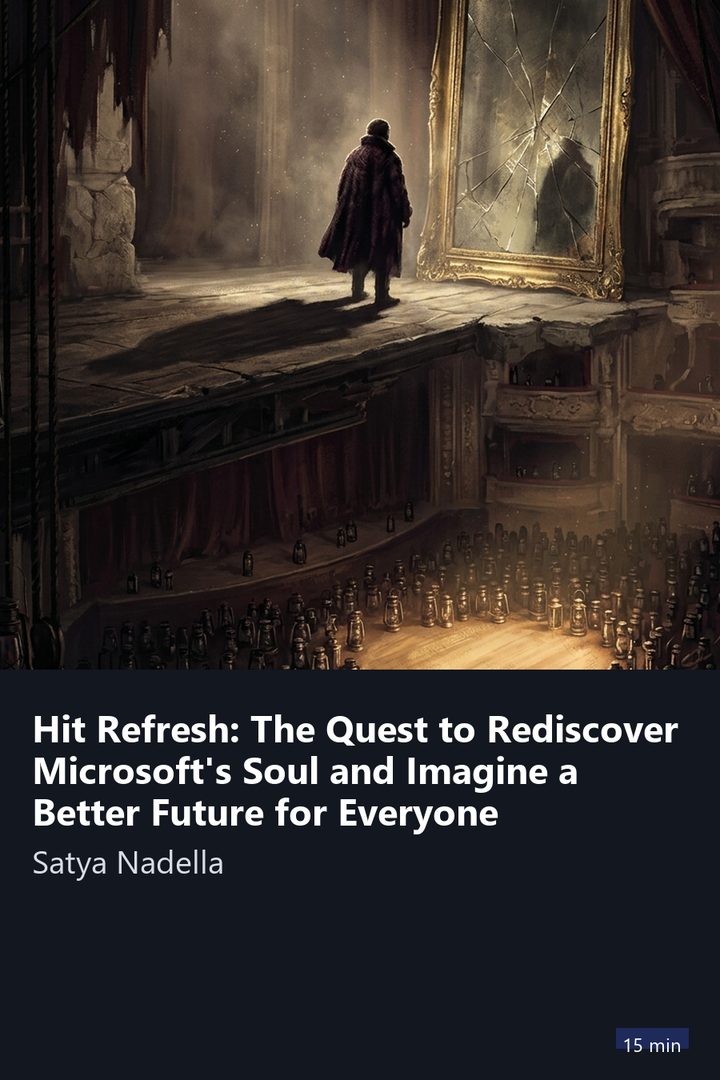
Cover of Hit Refresh: The Quest to Rediscover Microsoft's Soul and Imagine a Better Future for Everyone

Leadership · 15 min

Hit Refresh: The Quest to Rediscover Microsoft's Soul and Imagine a Better Future for Everyone

Satya Nadella · 2017

Who it's for

For leaders, entrepreneurs, and professionals who need to guide deep cultural transformations in discouraged or stagnant teams. A masterclass on how empathy and humility can save major corporations from irrelevance.

Read it in the app

⚡ Free to download • 🎁 One full book free every day

🎧 Audio coming soon in the app

Narration for the English summaries is on its way. Meanwhile you can read the full summary in the app.

3 ideas to take with you

1

Authentic empathy emerges when we let go of selfish self-pity and begin to see the needs and pain of the people around us.

2

Putting the user experience above historic commercial rivalries opens up valuable markets that blind pride kept blocked.

3

Features and products developed to serve people with severe disabilities end up making life simpler and more functional for all of society.

“
The most effective leadership is not the kind that seeks to shine alone, but the kind that empowers every member of the team to give their best.
An idea from Hit Refresh: The Quest to Rediscover Microsoft's Soul and Imagine a Better Future for Everyone, in the words of 15 Minutes

Preview

Start reading now

Roots in Hyderabad and the lessons of cricket

Satya Nadella begins his memoir by looking back on his childhood and youth in the southern Indian city of Hyderabad. Raised in a middle-class family, with a father in the civil service and a mother who taught Sanskrit, he found in his athletic passion for cricket his first great lessons on leadership, collective discipline, and overcoming adversity.

Cricket taught Nadella that a leader is not necessarily the star who scores the most runs, but the person who brings out the best performance in every member of the team. In one memorable match from his youth, his captain chose to encourage a player who had been struggling rather than criticize him in public, restoring the confidence he needed to clinch the match in the final innings.

That welcoming attitude and appreciation for people stayed with the engineer when he immigrated to the United States in the 1980s in search of academic and professional opportunities. Arriving on American soil with little money in his pocket and a suitcase full of dreams, the future executive carried the conviction that united, generous teams outperform any group of arrogant, disjointed geniuses.

The pain of fatherhood and the awakening of deep empathy

The most defining moment in Satya Nadella's personal life happened in 1996, with the premature birth of his first son, Zain. Due to severe complications during delivery, the baby suffered in utero asphyxiation and was born with severe cerebral palsy, requiring round-the-clock medical care and breathing support for the rest of his life.

The executive admits that his initial reaction was one of self-pity and selfish anger: he constantly asked himself why this tragedy had happened to him and how his family plans had been ruined. It was by watching the quiet, generous, and tireless devotion of his wife, Anu, that Nadella realized the pain was not about him, but about the needs of his helpless son.

This intimate transformation gave birth in Nadella to a deep empathy for the suffering of others and for human vulnerability. He realized that empathy is not a soft virtue for Sunday chats, but a rigorous existential skill that allows you to see the world from the perspective of those who most need care and support, a lesson that years later would redefine product design priorities at Microsoft.

The silent decline of an arrogant empire

In the early 2010s, Microsoft looked like an impregnable financial fortress, bringing in billions of dollars from Windows operating system and Office suite licenses. Yet beneath that mountain of quarterly profits, the company faced a devastating existential crisis fueled by creative stagnation and institutional hubris.

The company had embarrassingly missed the two biggest technological revolutions of the decade: the rise of smartphones, easily dominated by Apple and Google, and internet search. Worse still, the internal culture was deeply sickened by tribal warfare between departments, where directors sabotaged projects in neighboring divisions just to protect their own budgets and individual bonuses.

In the hallways of the Redmond headquarters, the mood was one of cynicism and constant defensiveness. A famous corporate cartoon circulating at the time depicted the company's structure as separate org charts pointing guns at one another. The tech giant had forgotten why it existed and was in imminent danger of becoming a corporate museum piece.

10 more sections and the quiz

Continue in the app

Read the whole summary, finish with the Hit Refresh: The Quest to Rediscover Microsoft's Soul and Imagine a Better Future for Everyone quiz and follow the guided Journeys. No ads in the app.

About Satya Nadella

Satya Nadella is an Indian-American engineer and business executive who became Chief Executive Officer of Microsoft in 2014, leading one of the greatest corporate turnarounds in modern history. He earned a bachelor's degree in electrical engineering in India, a master's degree in computer science from the University of Wisconsin-Milwaukee, and an MBA from the University of Chicago. Before stepping into the top role at the Redmond giant, he led the successful development of its enterprise cloud services division.

Explore

Category:
Leadership