15 Minutes
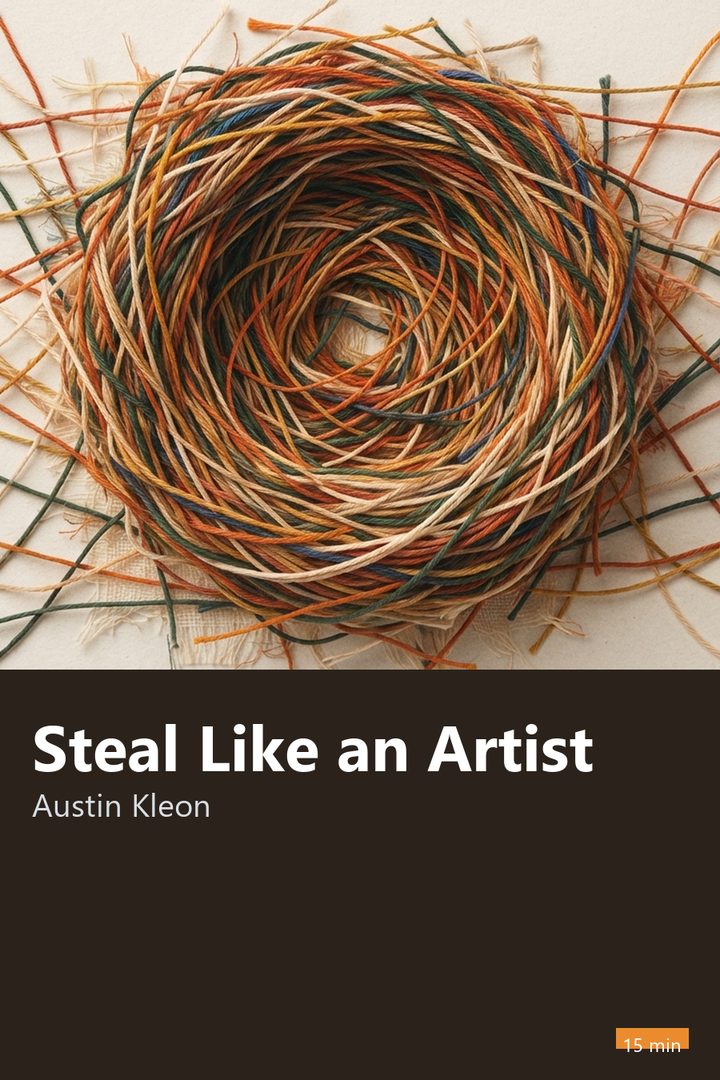
Cover of Steal Like an Artist

Personal Development · 16 min

Steal Like an Artist

Austin Kleon · 2012

Who it's for

For people who freeze up waiting for the perfect idea before starting any project, and for people who think they can only create after discovering their own style. It's a quick nudge to get out of theory and start making things with what you already have in hand.

Read it in the app

⚡ Free to download • 🎁 One full book free every day

🎧 Audio coming soon in the app

Narration for the English summaries is on its way. Meanwhile you can read the full summary in the app.

3 ideas to take with you

1

Nobody creates from scratch: all work comes from mixing many influences, not from inspiration that appears out of nowhere.

2

A boring, repetitive routine supports interesting work far more than fleeting motivation does.

3

Asking for help and acknowledging who contributed doesn't take anything away from anyone's merit. It raises the odds that the work turns out good.

“
Doing it well solves half the road, showing it to the right person solves the other half.
An idea from Steal Like an Artist, in the words of 15 Minutes

Preview

Start reading now

Nobody is born knowing, everyone copies first

Kleon opens the book by taking apart an idea that freezes a lot of people before they even try: the notion that creating something is only worthwhile if it's one hundred percent original. In practice, nobody creates out of nothing. Every singer listened to another singer before writing a first song, and every cook tasted someone else's recipe before inventing their own. The originality we admire always comes from a mix of influences that the creator isn't always consciously aware of.

This isn't an excuse to copy outright. It's an invitation to stop waiting for inspiration to come out of nowhere before you start. People who freeze up waiting for the perfect, unprecedented idea usually produce nothing, because that idea doesn't exist. Those who accept that they'll build on top of what has already been done get ahead.

Think of a cook at a neighborhood diner who learned to make her stew from her mother, adjusted the seasoning after a customer's feedback, and now has her own recipe with her name on the menu. Nobody calls that plagiarism. They call it a repertoire, the collection of references a person accumulates and mixes until it becomes their own way of doing things.
Steal like a real artist: from many sources, never from just one

The phrase that gives the book its title has a catch. Stealing like an artist doesn't mean snatching an entire idea from a single person and putting your name under it. It's the opposite: it means going after dozens of different references, from different fields, and letting them blend until what's left no longer belongs to any one of them alone.

Copying from a single source has an ugly name, and it's a fair one: plagiarism. Copying from a hundred sources at once, without quoting any one in isolation, becomes style. The difference isn't in the amount of copying, it's in the number of sources mixed and the work of turning them into something that carries your mark.

A practical example: a hip-hop artist who listens to a lot of country, salsa, and trap at the same time doesn't become any of the three. He becomes a new mix that only exists because he drank from sources that rarely crossed paths. The same goes for anyone who cooks or starts a small business: the more sources you seek out, the less your result resembles anything that already existed.

The myth of the lone genius who never existed

The image of the artist locked in a studio, creating alone without anyone's help, sells well in movies, but it doesn't match the reality of almost any real creator. Every work we admire had an editor, a partner, a friend who offered an opinion, or a competitor who pushed it to get better. The lone genius is, most of the time, a marketing character created after the work was already done.

This changes how you see your own process. If nobody does anything alone, asking for help stops being a sign of weakness and becomes a natural part of doing anything right. Bouncing ideas off someone before finishing a project usually makes the final result more polished than insisting on deciding everything in isolation.

This shows up all the time in everyday life: the hairstylist who swaps cutting tips with another one from the salon next door, the rideshare driver who learns a new route in the drivers' group chat. Nobody takes merit away from anyone when the help is acknowledged.

11 more sections and the quiz

Continue in the app

Read the whole summary, finish with the Steal Like an Artist quiz and follow the guided Journeys. No ads in the app.

About Austin Kleon

Austin Kleon is an American writer and visual artist, author of Steal Like an Artist, published in 2012 and a New York Times bestseller. He became known for creating blackout poetry, a technique in which he blacks out words on newspaper pages with a marker until a new poem is left. He lives in Austin, Texas, and later wrote other books focused on creativity and work routines, such as Show Your Work! and Keep Going.

Explore

Part of the Journeys:
Creativity Without Blocks