15 Minutes
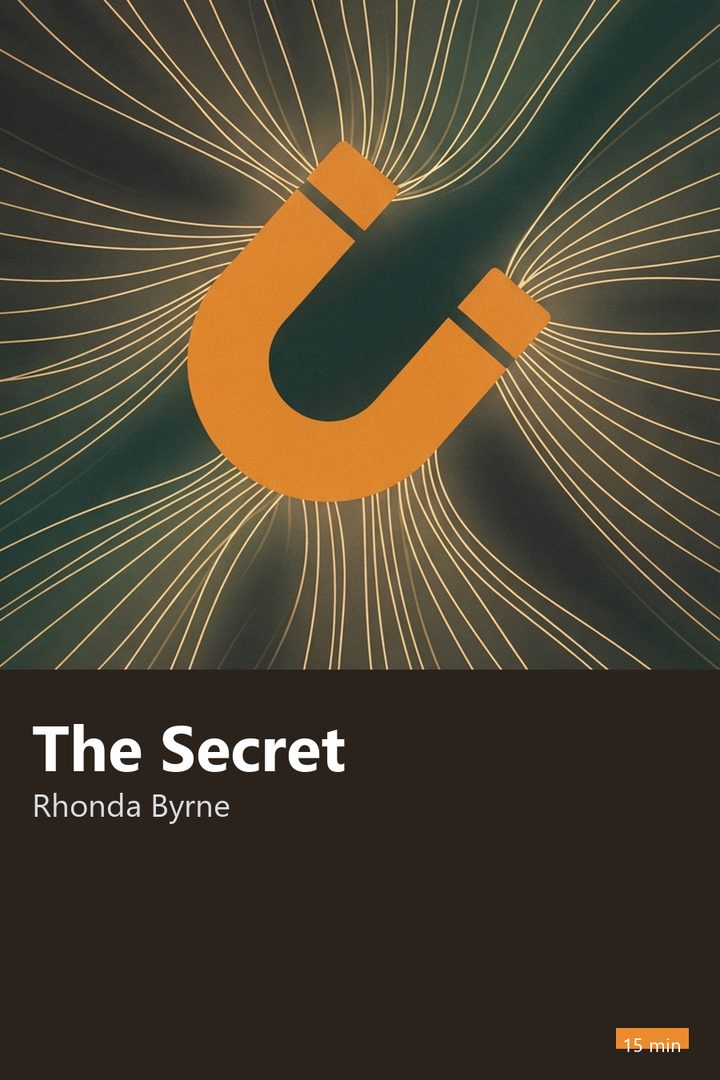
Cover of The Secret

Personal Development · 16 min

The Secret

Rhonda Byrne · 2006

Who it's for

For anyone who has heard of the law of attraction and wants to understand what in it is common sense and what is an empty promise, without giving up simple habits like gratitude and focus. It also works for people who tried to just think positive to fix a debt or an illness and felt something was missing.

Read it in the app

⚡ Free to download • 🎁 One full book free every day

🎧 Audio coming soon in the app

Narration for the English summaries is on its way. Meanwhile you can read the full summary in the app.

3 ideas to take with you

1

Feeling like you already have the result before you act only helps when it is followed by a concrete action that same day; on its own, it is just a nice movie in your head.

2

Blaming your own thoughts for an illness, a robbery or a layoff is a cruel way to add to the suffering of someone who is already hurting, with no real basis.

3

Daily gratitude changes what you notice in your own day, not because it attracts good things from outside, but because it trains your attention to see what is already working.

“
Calling a belief a law does not turn it into physics; it only lends a credibility it has not really earned yet.
An idea from The Secret, in the words of 15 Minutes

Preview

Start reading now

The core idea: thoughts become things

The Secret starts from an idea that is simple to state: the thoughts you hold most often would attract, according to the book, similar experiences into your life. Rhonda Byrne calls this the law of attraction and treats it almost like a law of physics: your focus would work like a magnet, pulling back whatever you think and feel the most.

The book's promise is big: money, relationships, health and career would all run through the same mechanism of asking clearly, feeling as if you already got it, and expecting to receive without anxiety.

It is worth separating right away two things the book mixes up all the time. The psychological part, that focusing on what you want improves your attention and your willingness to act, has real backing in behavioral research. The part about a physical law of the universe pulling outside events toward you has no scientific proof at all. Keeping that distinction in mind helps you take what works without buying the whole package.
Ask, believe, receive: the three steps of the method

The method described in the book has three stages. First, ask: define clearly what you want, like someone placing an order, with no halfway and no maybe. Second, believe: act and feel as if the request had already been granted, without doubting along the way. Third, receive: allow the thing to arrive, feeling in advance the joy of already having the result.

In everyday practice this turns into a guided imagination exercise: closing your eyes and mentally living the scene of the higher salary hitting your account, the test that will go well, the job offer confirmed. The book argues that a clear request keeps the universe from sending the wrong thing, as if a vague request always produced a vague delivery.

The weak point here is the phrase believe without doubting. Applied to areas like health or money, this idea can push someone to abandon medical treatment or an organized budget, trading concrete action for emotional certainty. Further on we set aside a whole section just for this risk.

The radio metaphor: frequency and vibration

Byrne uses the image of a radio station: each thought would emit a frequency, and the universe would send back programming on the same wavelength. Thoughts of lack would attract more lack, thoughts of abundance would attract more abundance. It is an easy metaphor to picture.

The problem is that a metaphor is not a proven mechanism. A real radio transmits measurable electromagnetic waves; a human thought does not emit any frequency or vibration capable of reorganizing events in the physical world outside your own head and your own choices.

What does exist, with backing, is the effect of selective attention: when you decide you want to buy a car of a certain color, you start noticing that car on the street much more often, not because it appeared more, but because your brain started filtering for it. That explains a good part of what the book calls coincidence, with no physics needed.

11 more sections and the quiz

Continue in the app

Read the whole summary, finish with the The Secret quiz and follow the guided Journeys. No ads in the app.

About Rhonda Byrne

Rhonda Byrne is an Australian writer and television producer. She became known worldwide in 2006 when she released first the documentary and then the book The Secret, based on the idea of the law of attraction. The work became a publishing phenomenon, translated into dozens of languages and sold in the tens of millions of copies around the world. In the following years, Byrne released follow-ups such as The Power and The Magic, deepening the same principles presented in the first book.

Explore

Part of the Journeys:
Positive Mind and Success