15 Minutes
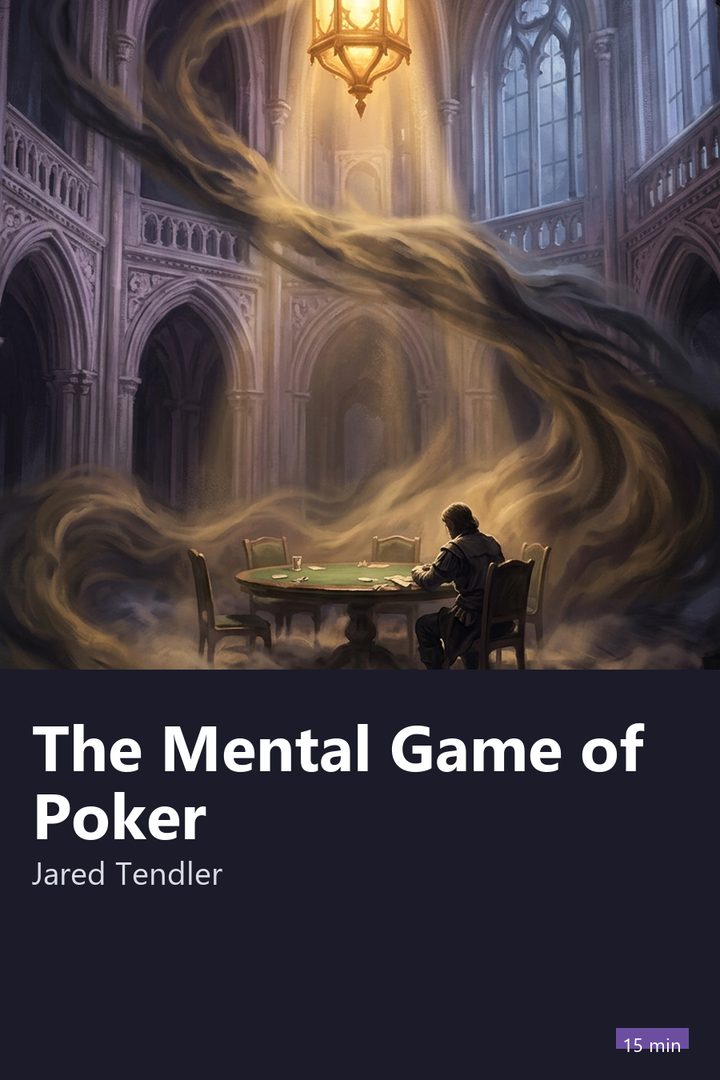
Cover of The Mental Game of Poker

Psychology · 14 min

The Mental Game of Poker

Jared Tendler · 2011

Who it's for

For anyone who plays poker, or takes part in any competitive activity, and feels like they lose their head just when they need it most. It is also for anyone who wants to better understand how emotions affect decisions under pressure.

Read it in the app

⚡ Free to download • 🎁 One full book free every day

🎧 Audio coming soon in the app

Narration for the English summaries is on its way. Meanwhile you can read the full summary in the app.

3 ideas to take with you

1

The book argues that uncovering the belief hidden behind an emotion does more good than trying to control yourself through sheer willpower.

2

The damage done on your worst days can affect your average performance more than the brilliance of your best days.

3

Writing down what happened, what you thought, and what you did turns a vague feeling into a pattern you can work on.

“
A good outcome can hide a bad decision, and a bad outcome can hide a good decision: learn to ask about each one separately.
An idea from The Mental Game of Poker, in the words of 15 Minutes

Preview

Start reading now

A Card Game Played with Your Head

The Mental Game of Poker, by Jared Tendler, starts with an observation anyone who plays at a poker table will recognize: many costly mistakes do not come from a lack of knowledge. They come from knowing what to do and not doing it. You study hands, memorize charts, understand probability, and still, after three straight losses, play a hand you would never recommend to a friend.

Tendler is a mental game coach with a background in psychological counseling, and the book grew out of his work with professional and amateur players. His approach treats a player's mental game like any other skill: something with distinct parts, identifiable weaknesses, and room for practice. Instead of motivational slogans, he offers a way to investigate what is happening inside your head.

This summary explains the central ideas and shows how to take them beyond the green felt, into your Saturday soccer game, monthly sales target, or civil-service exam. One caveat up front: playing poker for money carries a real risk of financial loss and addiction, and nothing here is an encouragement to gamble.


The Central Idea: Emotions Have Causes, and Causes Can Be Addressed

The book's turning point is its rejection of the idea that losing your head is a personality trait. For Tendler, when you explode, freeze, or become timid, there is a flaw in your reasoning behind it, almost always hidden, and that is what you need to find. Calling the problem a lack of discipline does not help, because it does not tell you what to change.

The method is detective work. First, you name the problem precisely, such as irritation after losing a strong hand. Then you ask why it happens, and the answer is usually a belief, such as thinking that playing well guarantees winning. Finally, you replace that belief with a more realistic understanding and practice it until it becomes a habit.

Notice what this changes. Instead of promising to control yourself tomorrow, you now have a hypothesis to test. It is the same reasoning you use when taking your car to a mechanic: no one fixes a noise by telling the engine to behave. You have to find out which part is loose.

Variance: Why Results Can Mislead You

Variance is the part of an outcome that depends on luck rather than the quality of the decision. In poker, it is enormous. You can make the best possible decision, put your money on the table with a huge advantage, and still lose because the card your opponent needed came up. The opposite happens too: bad decisions sometimes win.

The book insists that players need to learn to separate two questions. One is whether the outcome was good. The other is whether the decision was good. If you confuse them, you start punishing yourself for unlucky good decisions and praising yourself for lucky mistakes, and you end up adjusting your game in the wrong direction.

An everyday comparison helps. Think of someone who bets on the same lottery number every week and becomes convinced their pick has special power just because it came up once. Or a salesperson who happened to close a deal when the customer was in a good mood and starts copying everything they did that day. An isolated outcome is a terrible teacher.

10 more sections and the quiz

Continue in the app

Read the whole summary, finish with the The Mental Game of Poker quiz and follow the guided Journeys. No ads in the app.

About Jared Tendler

Jared Tendler is a mental game coach with a background in psychological counseling who works with both poker players and financial traders. The Mental Game of Poker was published in the United States in 2011, cowritten with Barry Carter. He later published follow-up books focused on poker and trading. His work centers on helping people perform under pressure.

Explore

Category:
Psychology