15 Minutes
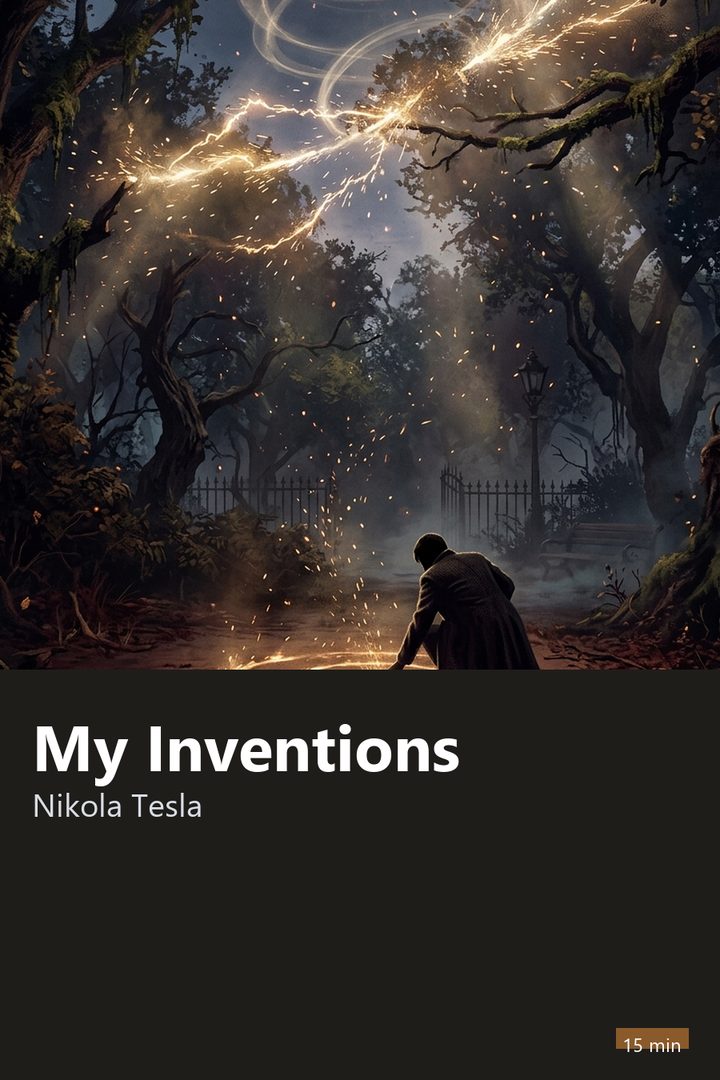
Cover of My Inventions

Biographies and Memoirs · 14 min

My Inventions

Nikola Tesla · 1919

Who it's for

For you if you're interested in science, invention, or extraordinary life stories. It's also for anyone who works on projects and wants to understand the value of planning an idea before putting it into practice.

Read it in the app

⚡ Free to download • 🎁 One full book free every day

🎧 Audio coming soon in the app

Narration for the English summaries is on its way. Meanwhile you can read the full summary in the app.

3 ideas to take with you

1

Questioning the part everyone considered indispensable was the starting point for the motor without a commutator.

2

According to Tesla's account, a verbal agreement with a powerful boss ended in a fight, and agreements that aren't put in writing are fertile ground for this kind of dispute.

3

Having a working invention doesn't guarantee funding: convincing the people with money is another stage of the job.

“
When you imagine a machine in detail before assembling it, you find the mistakes while they're still cheap to fix.
An idea from My Inventions, in the words of 15 Minutes

Preview

Start reading now

An Inventor Tells His Own Story

My Inventions began as a series of articles published in 1919 in an American electrical magazine and only later became a book. Its author is Nikola Tesla, now over sixty, famous, in debt, and aware that the press treats him as an eccentric. He decides to tell, in his own way, how he got there.

This isn't a conventional autobiography filled with dates and gossip. It's the story of a mind: how ideas emerged, how he tested them without putting them on paper, and what he felt while doing it. The tone is solemn, sometimes vain, and full of conviction that an inventor's job is to transform the world through the power of disciplined imagination.

Since Tesla died in 1943, the text is in the public domain in Brazil, which makes it easy to find there. Still, here's a summary in our own words, organizing the story around the different stages of his life.
Childhood in Smiljan: His Parents and a Lost Brother

Tesla was born in 1856 in Smiljan, a village in the Lika region, then part of the Austrian Empire and now in Croatia. He came from a Serbian family. His father, Milutin, was an Orthodox priest who enjoyed writing and reciting poetry. His mother, Đuka, could barely read, but invented household tools and had a remarkable memory, a trait her son says he inherited.

His father insisted on mental exercises for the children, such as guessing thoughts and correcting their own errors in reasoning. Tesla believed this trained his memory and critical thinking, qualities he would later use to design machines in his head.

One event left a deep mark on this period: his older brother's death in a horse accident. His family considered that son the more brilliant one, and Tesla describes feeling that he could never measure up to his brother's ghost. Much of his drive to prove his worth came from that loss.

Images That Appeared Uninvited

From childhood, Tesla says he suffered from flashes of light before his eyes, followed by vivid images that disturbed him. They appeared in connection with words or ideas and seemed real. With effort, he learned to control the flow and replace unwanted scenes with others.

Out of this inner struggle came an ability he considered crucial: visualizing a device in such rich detail that he could turn it on, watch it work, and find flaws without touching anything. He said he would let an imaginary machine run for weeks, then check its parts for wear.

Whatever the explanation, the method is interesting for anyone who works on projects. Thinking through the details before spending money on construction is a cheap way to make mistakes, something we learn the hard way when we start a renovation without a plan.

12 more sections and the quiz

Continue in the app

Read the whole summary, finish with the My Inventions quiz and follow the guided Journeys. No ads in the app.

About Nikola Tesla

Nikola Tesla was born in 1856 in Smiljan, in what is now Croatia, and died in New York in 1943. An engineer and inventor, he worked on alternating current motors, high-frequency transformers, and remote control. He moved to the United States in 1884 and became an American citizen. The unit used to measure magnetic fields, the tesla, bears his name.

Explore