15 Minutes
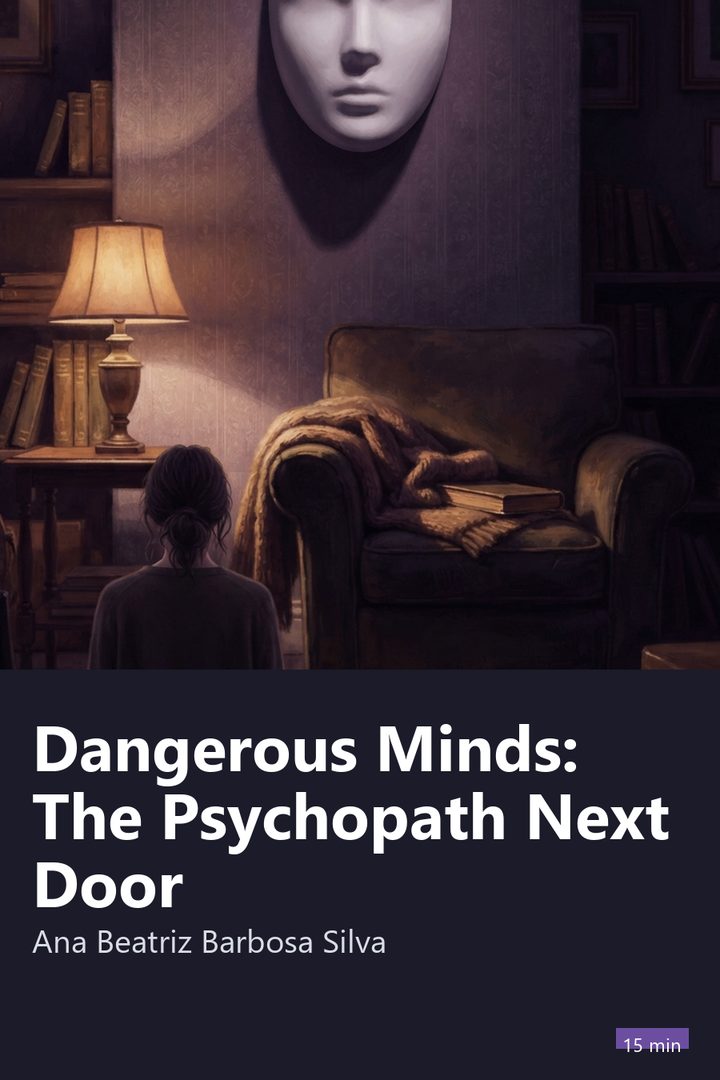
Cover of Dangerous Minds: The Psychopath Next Door

Psychology · 16 min

Dangerous Minds: The Psychopath Next Door

Ana Beatriz Barbosa Silva · 2008

Who it's for

Original title (Portuguese): Mentes Perigosas: O Psicopata Mora ao Lado. For anyone who has ever sensed that someone nearby, at work, in the family or in a relationship, lies with strange ease and never seems rattled by anything, and who wants to understand that pattern without falling into the trap of labeling everyone around them a psychopath.

Read it in the app

⚡ Free to download • 🎁 One full book free every day

🎧 Audio coming soon in the app

Narration for the English summaries is on its way. Meanwhile you can read the full summary in the app.

3 ideas to take with you

1

Charm that is too strong too early in a relationship is not a compliment. It is something to watch closely over the following weeks.

2

Real empathy feels along with the other person. Understanding someone only to calculate your next move is something else, and the book teaches the difference.

3

Diagnosing a personality disorder is the job of a professional using a validated instrument, not a conclusion you reach on your own after a fight.

“
The book reminds us that psychopathy is not a synonym for movie killer: the traits can show up in ordinary people, at work or at home.
An idea from Dangerous Minds: The Psychopath Next Door, in the words of 15 Minutes

Preview

Start reading now

What psychiatry calls psychopathy

When psychiatrist Ana Beatriz Barbosa Silva wrote Mentes Perigosas in 2008, she set out to take the word psychopathy out of the movies and bring it into real life. Psychopathy is not a formal diagnosis in the psychiatry manuals. The closest thing in there is antisocial personality disorder, a lasting pattern of disregard for rules and for the rights of others that shows up early in a person's life.

This matters because many people use the word psychopath as a synonym for monster, someone isolated, strange, easy to spot from far away. The book shows the opposite: the central trait is not violence, it is the absence of two feelings most people take for granted, guilt and remorse.

Without those two internal brakes, a person can make choices that hurt others without carrying the emotional weight that would stop any of us before acting. That cold engine, not the knife or the gun, is what the book puts at the center of its explanation.

Superficial charm: the first way in

The first contact with a psychopathic person rarely causes suspicion. On the contrary: superficial charm is the trademark, that instant friendliness, the compliment in just the right amount, the easy conversation that makes the other person feel special within minutes.

This charm does not come from genuine affection. It comes from a sharp social read. The person observes what the other wants to hear and hands exactly that back, adjusting the speech the way you change clothes for each occasion.

The problem shows up later, when the shallowness of the initial bond does not hold up in practice. Whoever was seduced by the charm takes a while to notice the gap between what was said and what was delivered, because the early enchantment already bought trust in advance.

No guilt, no remorse: the engine inside

An ordinary person who hurts someone feels the weight of it afterward, even unintentionally: they replay it in their head, apologize, try to make amends. The book describes the psychopath as someone who simply skips that step.

It is not that the person holds the remorse in and hides it very well. It just does not appear. Without that internal warning signal, behavior that hurt someone does not become a lesson. It becomes just a closed episode, ready to be repeated at the next opportunity.

This explains why apologies, when they exist, tend to sound too rehearsed: they are words learned to produce an effect on the listener, not pain felt on the inside.

13 more sections and the quiz

Continue in the app

Read the whole summary, finish with the Dangerous Minds: The Psychopath Next Door quiz and follow the guided Journeys. No ads in the app.

About Ana Beatriz Barbosa Silva

Ana Beatriz Barbosa Silva is a Brazilian psychiatrist whose work also focuses on mental health and on science communication outside the clinic. She became known to the public for writing about mental health topics in accessible language, far from technical jargon. Before Mentes Perigosas, she had already published Mentes Inquietas, about attention deficit and hyperactivity, and she would later release Mentes Ansiosas, about anxiety disorders. Mentes Perigosas was originally published in 2008 and became one of the best-selling psychology books in Brazil.

Explore

Category:
Psychology
Part of the Journeys:
Why We Act This Way