15 Minutes
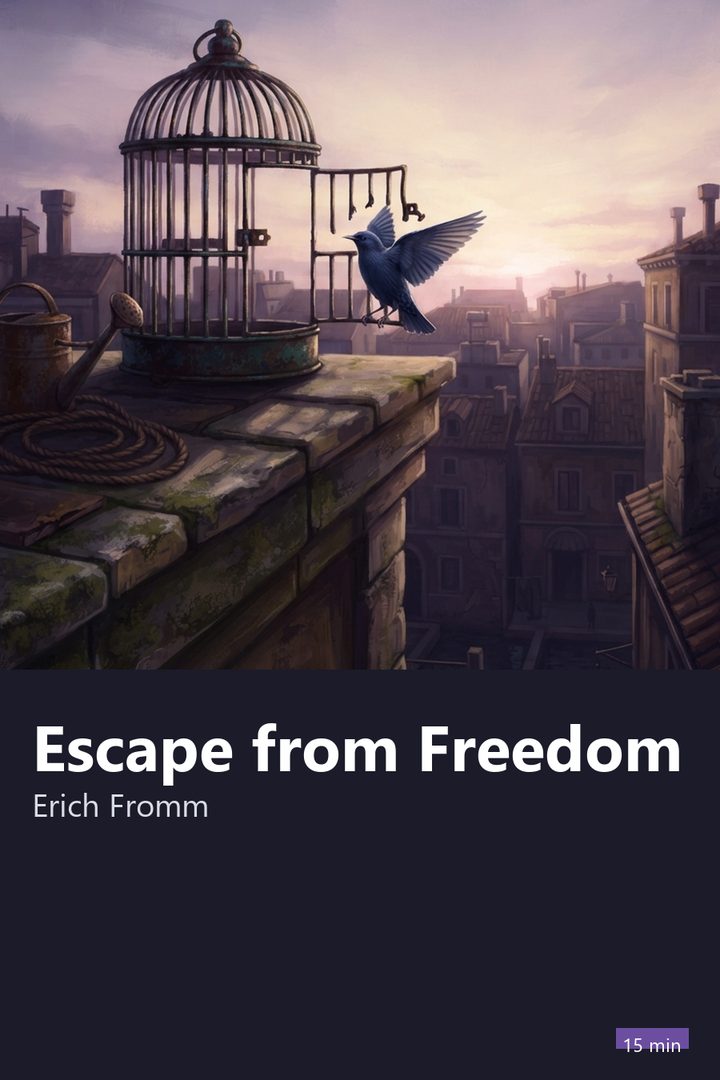
Cover of Escape from Freedom

Psychology · 15 min

Escape from Freedom

Erich Fromm · 1941

Who it's for

For anyone who feels that freedom of choice has become more of a burden than a relief, whether in their own life or while watching the world around them. A summary for those who want to understand why so many people trade freedom for certainty, without even realizing they are making that trade.

Read it in the app

⚡ Free to download • 🎁 One full book free every day

🎧 Audio coming soon in the app

Narration for the English summaries is on its way. Meanwhile you can read the full summary in the app.

3 ideas to take with you

1

Freedom without direction becomes a burden: getting free of an authority is the easy part, and deciding what to do with that freedom is the work almost no one learns on their own.

2

For Fromm, the urge to boss someone around and the urge to obey blindly can spring from the same feeling of powerlessness in the face of the world.

3

For Fromm, the freedom worth having is not just the kind that removes shackles, it is the kind you build by loving and working in a way that carries the mark of who you are.

“
For Fromm, belonging without having chosen weighs less than choosing alone, which is why so many people miss a place where they never had to decide who to be.
An idea from Escape from Freedom, in the words of 15 Minutes

Preview

Start reading now

Why freedom also weighs on you

We learn that freedom is always good news, but Erich Fromm wrote an entire book asking the opposite question: what does a person do when freedom arrives and they don't know what to do with it? Think of someone who leaves a salaried job to work for themselves: in the first few days there's the relief of having no boss, but soon comes the vertigo of deciding everything alone.

Fromm wrote these pages in the United States, during the Second World War, trying to understand how an entire people gave up its own political freedom and willingly embraced a regime that crushed it. His answer doesn't stop at politics: too much freedom, with no bond to hold a person up, produces a loneliness so great that some of us would rather trade that loneliness for obedience to something bigger.

Primary ties, the security of being born bound

Fromm starts at the beginning: a child is born completely dependent, tied by what he calls primary ties, the bonds with mother, family, tribe, none of which were chosen. These ties smother individual freedom, but in exchange they guarantee the certainty of belonging, of having a place in the world without having to prove anything.

It's like a neighborhood where everybody knows each other, and the football team and the father's religion put a person inside a group before they've even thought about it. There's no need to decide who to be, because the answer comes ready-made. As history moves forward, according to Fromm, these ties break one by one, and each cut is a victory for freedom and also the loss of a net that held you up without asking for anything in return.

Cutting the cord, the birth of the modern individual

Fromm uses a simple image: it's like cutting the umbilical cord. A baby attached to its mother, fed without any effort of its own, has to breathe on its own at some point. It's necessary in order to become a person, but it's also frightening, because on one side there is growth and on the other total exposure to the world. Fromm calls this process individuation: the price of becoming a separate individual is precisely this new insecurity.

A medieval person was born knowing their trade, their rank, their church, with almost no choice, but also without the anguish of inventing who to be. The modern world swapped that certainty for choice: today you can change jobs, cities, religions, but every choice charges a price in insecurity that medieval life never charged. It's like leaving a house full of your parents' rules to live alone: the rules were tight, but they also shielded you.

11 more sections and the quiz

Continue in the app

Read the whole summary, finish with the Escape from Freedom quiz and follow the guided Journeys. No ads in the app.

About Erich Fromm

Erich Fromm was born in 1900 in Frankfurt, Germany, and studied sociology at the University of Heidelberg. He was a psychoanalyst and social psychologist connected to the Institute for Social Research in Frankfurt, and he left Germany before the Second World War because of Nazi persecution, settling in the United States. He wrote Escape from Freedom in 1941, already on American soil, and decades later published The Art of Loving, one of the most widely read psychology books of the twentieth century. He died in 1980, in Switzerland.

Explore

Category:
Psychology
Part of the Journeys:
Philosophy for Today