15 Minutes
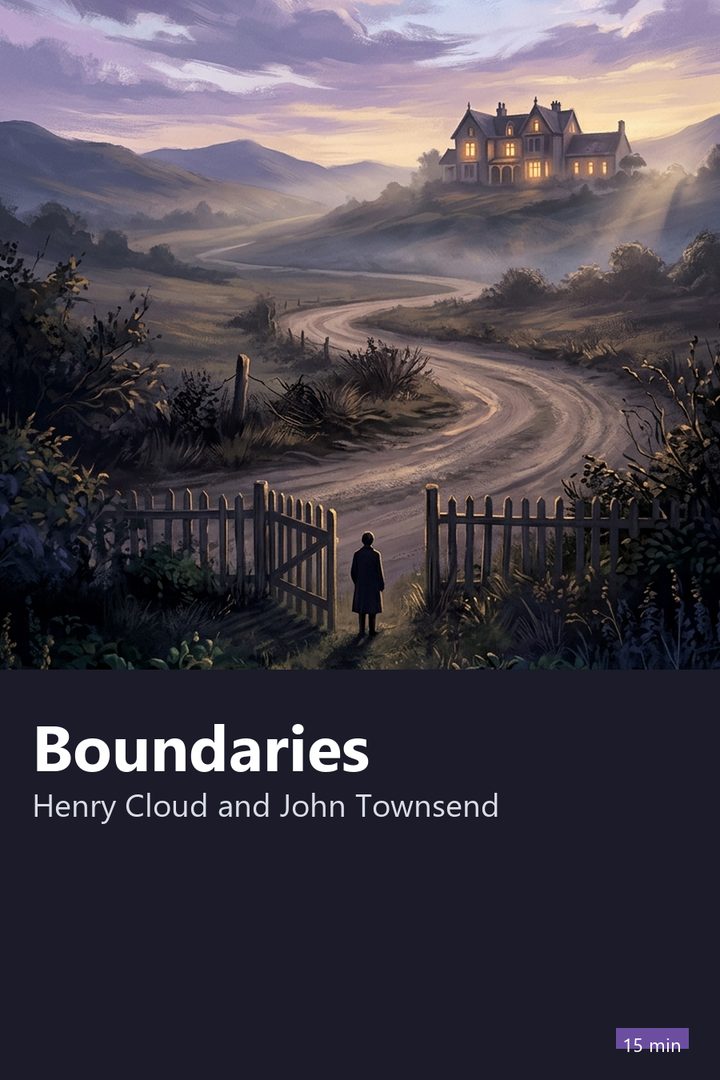
Cover of Boundaries

Psychology · 15 min

Boundaries

Henry Cloud and John Townsend · 1992

Who it's for

For you if you say yes out of fear, wear yourself out caring for others, or feel guilty about protecting yourself. It's also for anyone who realizes they put too much pressure on the people around them.

Read it in the app

⚡ Free to download • 🎁 One full book free every day

🎧 Audio coming soon in the app

Narration for the English summaries is on its way. Meanwhile you can read the full summary in the app.

3 ideas to take with you

1

A healthy boundary works like a fence with a gate: it protects what's yours and lets you choose what comes in and goes out.

2

A consequence is different from punishment: it reveals reality without the intention of hurting someone or proving them wrong.

3

According to the book, you can love your family and still turn down a request, separating affection from obedience.

“
Helping is love, but doing what someone can do for themselves becomes disrespect disguised as kindness.
An idea from Boundaries, in the words of 15 Minutes

Preview

Start reading now

The Fence Around Your Property

Imagine you own a piece of property with no fence or wall. Anyone can walk in, park, dump trash, and take whatever they want. Now imagine the opposite: a towering wall with no gate, where no one can enter and you can't leave. Psychologists Henry Cloud and John Townsend use this image to explain personal boundaries. A healthy boundary is like a fence with a gate: it defines where what's yours ends and what's someone else's begins, while letting you choose what comes in and goes out.

For the authors, boundaries are about responsibility. What's mine is mine to care for: feelings, attitudes, choices, time, money, values. What belongs to someone else isn't mine to carry. When those boundaries become blurred, you start feeling responsible for other people's happiness or blaming others for your own problems, and relationships suffer.

Published in 1992, the book became a Christian self-help classic and has been translated into several languages. Its goal is to teach you to say yes and no clearly while preserving love and honesty in your relationships. It's worth noting from the start that the book has a religious foundation, which shapes its examples and language.

Helping Isn't the Same as Carrying Someone's Load

A central distinction in the book is between carrying burdens and carrying everyday loads. Drawing on a biblical teaching, the authors explain that some situations are crushing weights no one can carry alone, while others are daily tasks each person needs to handle. Helping someone through a crisis is love. Doing what they can and should do for themselves is disrespect disguised as kindness.

Think of an adult brother who keeps borrowing money and never pays it back. Helping him through a one-time emergency is one thing. Covering the gap between his spending and his income every month takes away his chance to learn. Help becomes a rescue, and that rescue can keep the problem going for years.

This idea reframes generosity. Giving of yourself requires freedom, not pressure. If you help out of guilt or fear of disappointing someone, you end up building resentment. The authors maintain that genuine love truly cares, but doesn't take over someone else's responsibilities.

When Boundaries Fail: The Four Types

The book describes four kinds of boundary problems. The first is the compliant person, who says yes when they want to say no. Afraid of losing approval, they agree to everything and end up exhausted. The second is the avoider, who can't ask for help or acknowledge their needs and would rather isolate themselves than depend on anyone.

The third is the controller, who doesn't respect other people's boundaries. They pressure, manipulate, insist, and take offense when they hear no. The fourth is the insensitive person, who ignores others' needs and shuts people out, appearing cold. In practice, these patterns overlap, and many people are overly compliant at home and controlling at work.

Recognizing a pattern isn't about labeling anyone. It's about finding where things hurt. A compliant person needs to learn to say no without feeling selfish. A controller needs to learn to hear someone else's no without treating it as an insult. Each situation calls for a different kind of practice.

9 more sections and the quiz

Continue in the app

Read the whole summary, finish with the Boundaries quiz and follow the guided Journeys. No ads in the app.

About Henry Cloud and John Townsend

Henry Cloud and John Townsend are American psychologists who work as Christian counselors and writers. Together, they founded counseling clinics and programs in the United States. Published in 1992, the book launched a series of titles about boundaries in different areas of life.

Explore

Category:
Psychology