15 Minutes
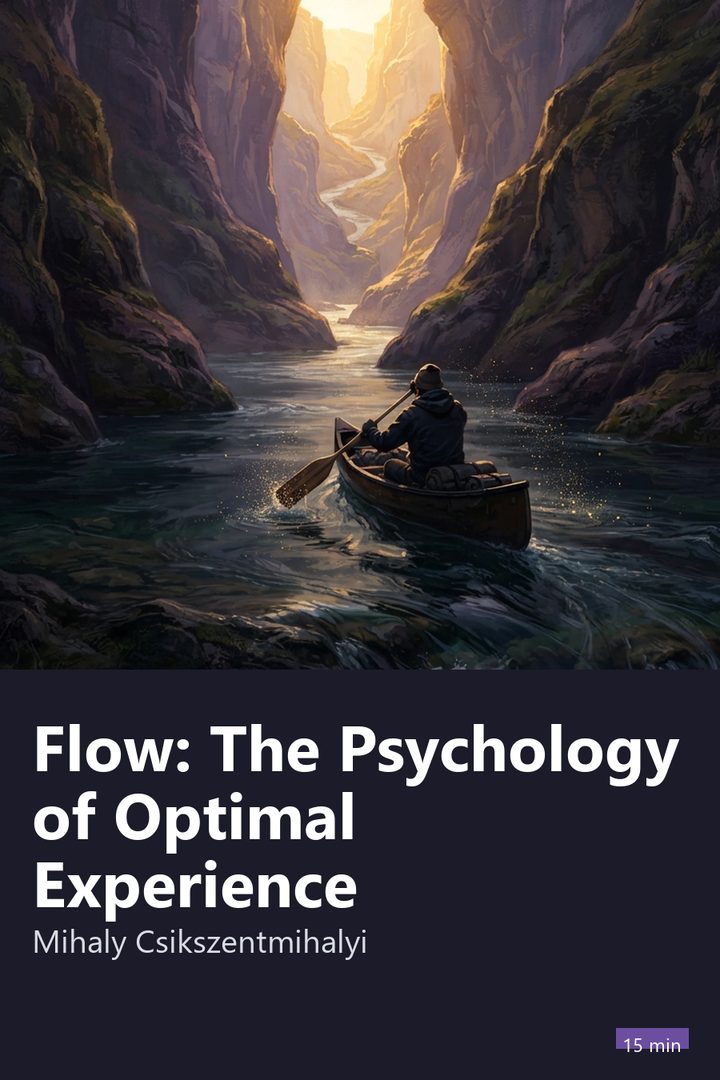
Cover of Flow: The Psychology of Optimal Experience

Psychology · 16 min

Flow: The Psychology of Optimal Experience

Mihaly Csikszentmihalyi · 1990

Who it's for

This one is for you if you've ever spent hours doing something without noticing time pass, and you want to understand why that happens so rarely in the rush of everyday life. Flow is for anyone who wants to stop waiting for vacation to be happy and learn to build moments of total absorption into their own routine.

Read it in the app

⚡ Free to download • 🎁 One full book free every day

🎧 Audio coming soon in the app

Narration for the English summaries is on its way. Meanwhile you can read the full summary in the app.

3 ideas to take with you

1

The sweet spot of flow always sits one step above what you already do well: too easy bores you, too hard freezes you.

2

Losing your sense of self for a while is not erasing yourself. It is a rare pause in the constant judgment the mind passes on its own performance.

3

Plenty of people feel more flow clocking in at work than lying on the couch on a day off, because work has goals and feedback, and passive rest has neither.

“
People who learn to choose where their attention goes discover that happiness depends much less on circumstances than it seems.
An idea from Flow: The Psychology of Optimal Experience, in the words of 15 Minutes

Preview

Start reading now

What this book tries to answer

The question that opens the book is simple to ask and hard to answer: why do some people feel that life is worth living and others don't, even with similar money, luck, and health? The book doesn't promise a recipe for wealth or fame. It promises to map this pattern.

Mihaly Csikszentmihalyi spent decades interviewing ordinary people: factory workers, dancers, mountain climbers, chess players, surgeons, farmers. He was looking for a common thread in the best moments each of them described, that instant when a person felt most alive and most capable.

He gave this pattern the name flow, a state of total absorption in an activity with just the right amount of challenge. The book is the report of that research, not a ten-step manual for being happy tomorrow.
Pleasure is not the same as enjoyment

The book separates two kinds of well-being. Hedonic pleasure is physical and passive: eating well, lying on the couch, drinking an ice-cold beer. Enjoyment takes effort and challenge, and leaves the person a little bigger than they were before they started.

Think of a Sunday barbecue: it feels good in the moment, but it fades from memory quickly. Now think of assembling a wardrobe by yourself, cursing the instruction manual, sweating through your shirt: at the end, the tiredness comes with a different kind of satisfaction, because you beat a real obstacle.

The book's point is that consumer society sells easy pleasure all the time: scrolling the feed, watching one more episode, eating a bag of chips. But easy pleasure doesn't accumulate. It vanishes as soon as it ends. The satisfaction of overcoming a challenge keeps paying off for days, sometimes weeks.

Attention: the limited energy that sustains consciousness

For the author, consciousness works like a flow of information that a person chooses to process, and attention is the psychic energy that sustains that choice. This energy has a physical limit: the mind can only process a small amount of information per second.

That's why it's impossible to read texts on your phone, follow a coworker's conversation, and pay attention in the bank line all at once, doing all three well. The mind picks one, or gets hijacked by one, and the rest turns into background noise.

People who deliberately decide where this limited psychic energy goes have a better chance of living truly good moments. People who let notifications and worries decide for them spend the same energy and, at the end of the day, have little of value to show for it.

13 more sections and the quiz

Continue in the app

Read the whole summary, finish with the Flow: The Psychology of Optimal Experience quiz and follow the guided Journeys. No ads in the app.

About Mihaly Csikszentmihalyi

Mihaly Csikszentmihalyi was born in 1934 in the city of Fiume, now Rijeka, in Croatia, to a Hungarian family. He lived through World War II as a child and later emigrated to the United States, where he built an academic career in psychology. He was a professor at the University of Chicago and, later, at Claremont Graduate University in California. He died in 2021, after decades of researching what makes a life worth living.

Explore

Category:
Psychology
Part of the Journeys:
The Science of Happiness