15 Minutes
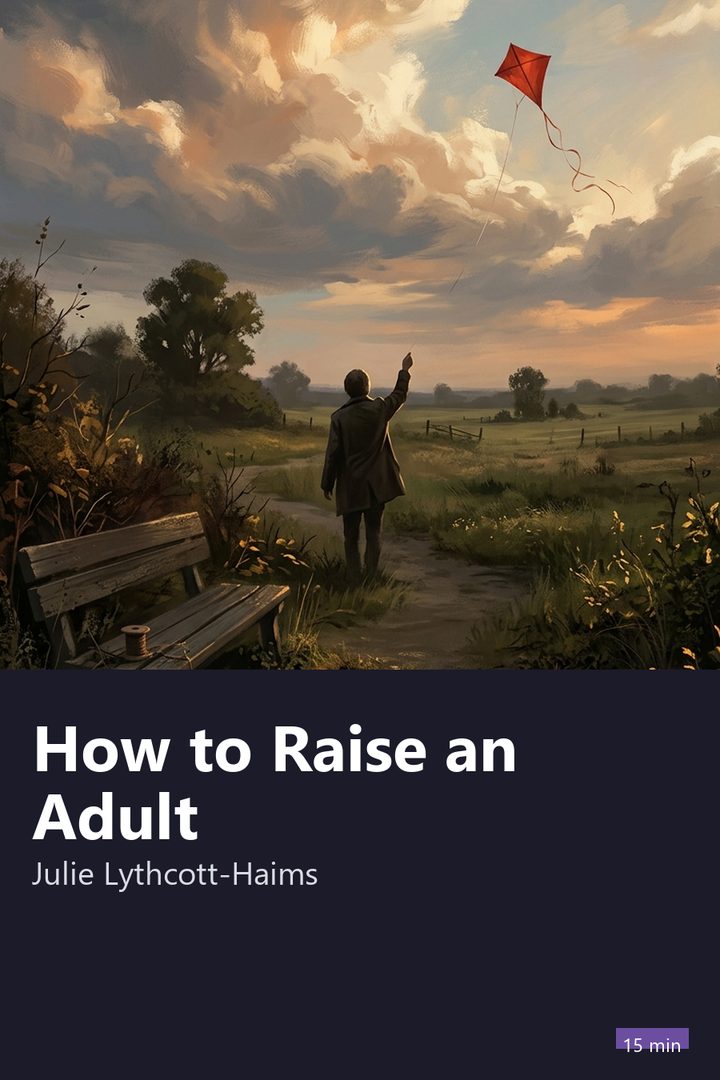
Cover of How to Raise an Adult

Family and Parenting · 14 min

How to Raise an Adult

Julie Lythcott-Haims · 2015

Who it's for

For anyone raising, educating, or mentoring children and teens who wants to help them build independence without letting go of care. It also speaks to those who grew up overprotected and want to understand how that shaped them.

Read it in the app

⚡ Free to download • 🎁 One full book free every day

🎧 Audio coming soon in the app

Narration for the English summaries is on its way. Meanwhile you can read the full summary in the app.

3 ideas to take with you

1

Much of overprotection grows out of fear, and fear is a terrible advisor when you are raising a child.

2

Offering deep warmth and clear expectations at the same time usually works far better than choosing between being a tough disciplinarian or a friend.

3

According to the author, a prestigious degree matters much less than what a young person does with the experience they choose to pursue.

“
Parents who solve every problem for their child teach them that they cannot handle any.
An idea from How to Raise an Adult, in the words of 15 Minutes

Preview

Start reading now

The brilliant freshman who didn't know how to choose

For about ten years, Julie Lythcott-Haims worked at Stanford as the dean responsible for freshmen and undergraduate advising. Every year, she watched students arrive with top grades, packed resumes, and impressive track records. Yet up close, many of them seemed lost when facing simple decisions, like picking a class or working out a disagreement with a roommate.

What struck her most was the sheer scale of parental involvement. Parents called the university, sat in on meetings with their kids, wrote emails in the student's name, and tried to negotiate grades. That left her with an uncomfortable question: how can a young person be so accomplished on paper and yet so unprepared to live their own life?

That question gave birth to How to Raise an Adult. The book is not a scolding aimed at moms and dads; it is an investigation into what happens when love turns into surveillance and help turns into taking over. And, in the end, it is an invitation to do things differently.


What overparenting is

The author uses the term overparenting for the habit of doing for children what they can already do for themselves, or are nearly ready to learn how to do. It might be the dad who finishes the science project the night before it is due, the mom who calls the teacher to complain about a grade, or the caregiver who packs a twelve-year-old boy's backpack every single day.

The most popular label is helicopter parents, those who hover constantly overhead, ready to swoop down. There is also the image of the snowplow, clearing every obstacle out of the way so the child can glide through without effort. Both images describe the same impulse: keeping the child from suffering.

The author's point is that the intention is good, while the outcome is not. Every time an adult steps in to fix things, the child loses a chance to try, fail, feel frustrated, and try again. That loop, repeated thousands of times, is precisely what builds a capable person.

Where all this fear comes from

Lythcott-Haims does not treat parents as villains, and she devotes real space to understanding what pushed them in this direction. One major factor is fear. Constant news coverage of kidnappings and violence made many families believe the world is far more dangerous than statistics actually show, so children began spending more time indoors and under close watch.

Another factor is economic pressure. With the sense that good jobs are harder and harder to land, many parents concluded their child cannot afford to miss a single advantage. That fuels the race for top schools, extra classes, and activities designed to pad a resume from an early age.

Add constant comparison on top of that. In a parents' group chat, all it takes is one mom mentioning that her eight-year-old is already studying three languages for everyone else to panic about falling behind. A culture of performance turns into a race where nobody knows quite where they are running, yet everyone is terrified to stop.

10 more sections and the quiz

Continue in the app

Read the whole summary, finish with the How to Raise an Adult quiz and follow the guided Journeys. No ads in the app.

About Julie Lythcott-Haims

Julie Lythcott-Haims is an American writer and speaker. She served as dean of freshmen and undergraduate advising at Stanford University for about ten years. She earned a law degree from Harvard and is also the author of the memoir Real American. How to Raise an Adult became a bestseller and led her to speak about parenting and education in many countries.

Explore

Part of the Journeys:
Childhood and Attachment