15 Minutes
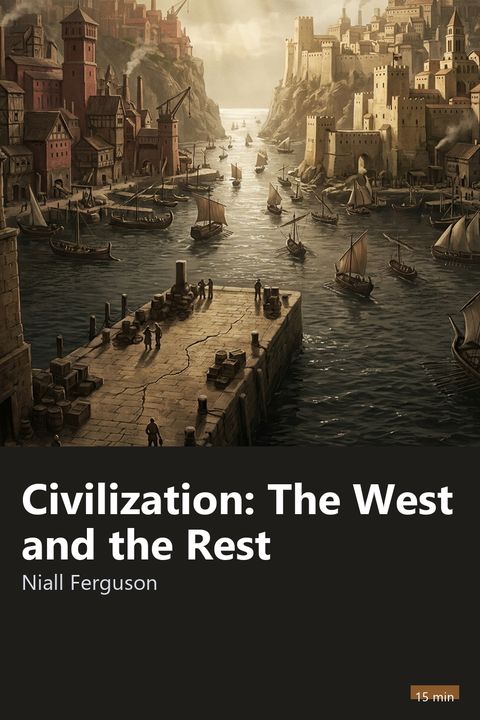
Cover of Civilization: The West and the Rest

History · 15 min

Civilization: The West and the Rest

Niall Ferguson · 2011

Who it's for

For anyone who enjoys big historical questions and wants to understand an influential argument about why the West dominated the world for so long. It is also for readers who want to think critically about Asia’s rise and the risks societies face from within.

Read it in the app

⚡ Free to download • 🎁 One full book free every day

🎧 Listen to this summary in the app

Every summary has audio narration. Open the app to read it or listen to it.

3 ideas to take with you

1

Competition makes life uncomfortable for established businesses, but it tends to drive innovation, unlike a centralized system where a single decision can shut down an entire project.

2

When people fear losing what they have built, they hide their wealth instead of investing it. That is how legal uncertainty holds an economy back.

3

Apparent stability does not guarantee security, because complex structures can collapse all at once after years of calm.

“
Those who choose to copy what works for others can catch up with those who were ahead.
An idea from Civilization: The West and the Rest, in the words of 15 Minutes

Preview

Start reading now

A Question Spanning Six Centuries

Historian Niall Ferguson begins with a seemingly simple question: Why did a small corner of the world, Western Europe, begin to dominate the planet around 1500? For centuries, that dominance shaped politics, economics, science, and culture on almost every continent.

In Civilization, he proposes an answer in the form of a package. The West, he argues, developed six institutions, meaning six sets of ideas and practices, that other societies either lacked or did not use in the same way. Ferguson provocatively calls them killer apps.

The book also asks what happens when those six ideas are no longer exclusively Western. He was writing in 2011, after the 2008 financial crisis, when many people were predicting the decline of the West and the rise of Asia.
In 1500, Who Would Have Bet on Europe?

One surprising starting point is remembering how far behind the West once was. In 1500, China had a sophisticated administration, enormous cities, advanced technology, and major maritime expeditions. The Ottoman Empire was a feared power, while Europeans lived in fragmented states, constantly at war.

Anyone surveying the world at the time would have struggled to believe that the future belonged to the small, poor, quarrelsome kingdoms at Eurasia’s western edge. According to Ferguson, what changed the game was not an obvious initial advantage, but a series of choices whose effects accumulated.

This perspective has one important strength: It reminds us that history was not predetermined. Western dominance was built, which means it can also be changed, copied, or lost.

Competition: The Advantage of Being Divided

The first app is competition. Europe was divided into many rival states and cities. That generated wars, but it also forced rulers to invest in technology, trade, and weapons, or risk being swallowed up by their neighbors.

China, by contrast, was a unified empire. In the early 15th century, it sent enormous fleets commanded by Admiral Zheng He to distant regions. But when the court decided the expense was not worthwhile, the voyages stopped and the ships were abandoned. In a centralized system, one decision can bring everything to a halt.

The lesson is that competition is uncomfortable, but it produces innovation. Anyone working in a crowded market, whether food delivery apps or a neighborhood with several bakeries, knows that rivalry improves prices and quality, even if it wears business owners out.

12 more sections and the quiz

Continue in the app

Read the whole summary, finish with the Civilization: The West and the Rest quiz and follow the guided Journeys. No ads in the app.

About Niall Ferguson

Niall Ferguson was born in Glasgow, Scotland, in 1964 and is a historian. He has taught at universities including Oxford, New York University, and Harvard, and works at the Hoover Institution, affiliated with Stanford University. His books include The Ascent of Money, published in 2008, and Civilization, published in 2011. The book became the basis for a British documentary series.

Explore

Category:
History