15 Minutes
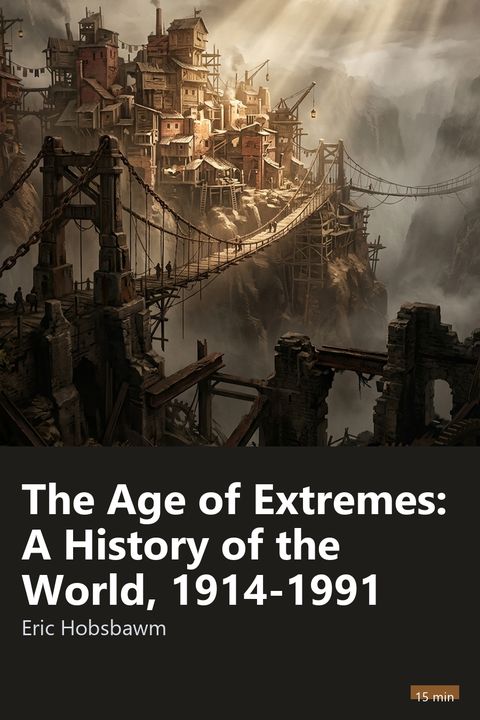
Cover of The Age of Extremes: A History of the World, 1914-1991

History · 15 min

The Age of Extremes: A History of the World, 1914-1991

Eric Hobsbawm · 1994

Who it's for

For you if you want to follow one clear line of reasoning through the twentieth century, from wars and crises to prosperity and then uncertainty. This is a book for anyone who likes history with a point of view and a big-picture perspective.

Read it in the app

⚡ Free to download • 🎁 One full book free every day

🎧 Listen to this summary in the app

Every summary has audio narration. Open the app to read it or listen to it.

3 ideas to take with you

1

Governments only respond boldly to a crisis when desperation hits large numbers of people at once, and that is when the market stops looking inevitable.

2

Anyone promising order and an easy scapegoat tends to find an audience among people who feel humiliated or fear losing the position they have earned.

3

A rapidly growing world can become both richer and less connected, because individual freedom often comes with the loss of ties that once offered protection.

“
When a war demands everyone's effort, it stops being just the army's business and starts reshaping who works, who eats, and who gives the orders.
An idea from The Age of Extremes: A History of the World, 1914-1991, in the words of 15 Minutes

Preview

Start reading now

A Short Century, from 1914 to 1991

Hobsbawm proposes a different yardstick for measuring the twentieth century. Instead of counting from 1901 to 2000, he starts in 1914, when World War I breaks out, and ends in 1991, when the Soviet Union falls apart. Within that span, a story unfolds with a beginning, a middle, and an end.

The book divides this period into three stages. First comes the Age of Catastrophe, with two world wars and a devastating economic crisis. Next is the Golden Age, a quarter century of extraordinary prosperity. Finally comes the Landslide, when the certainties of the postwar world crack one by one.

The appeal of this framework is that it turns a jumble of dates into a narrative. You stop memorizing the names of treaties and start asking: Why did the world collapse, why did things improve so much afterward, and why did the party end? That question ties together hundreds of pages.


Total War: When Everyone Becomes a Soldier

World War I was unlike anything that had come before. Entire countries were mobilized: factories became arsenals, women took on heavy industrial work, and public money poured into the trenches. No one had planned for such a long war, and no one could stop, because each side had already spent too much to accept a draw.

This is one of the book's strongest points: war stopped being a duel between professional armies and became a contest between societies. That explains why cities became targets in World War II and civilians made up most of the dead. When the enemy is an entire people, any neighborhood becomes a trench.

Think of a family watching inflation eat away at its paycheck by the end of the month. Imagine that multiplied by years of rationing, grief, and disorder. In the author's reading, the revolutions and authoritarian regimes of this period emerged from that simmering mixture of exhaustion.

The Russian Revolution and the Fear That Shaped the World

In 1917, the Bolsheviks seized power in Russia, promising to end war and inequality. To one part of the world, this became a source of hope. To another, it became a nightmare. Hobsbawm shows that even without successfully exporting its revolution, Soviet Russia became a reference point no one could ignore.

The most intriguing effect was indirect. Western governments and business leaders spent decades afraid that the example would spread, and that fear pushed them to make concessions: labor rights, retirement benefits, and taxes on great fortunes. In the author's view, communism helped save capitalism from itself.

In Brazil, that influence is visible in formal employment protections and the labor laws of the 1930s and 1940s, which emerged in a world haunted by the possibility of revolt. The author was not a neutral observer, and that is worth remembering, but the idea that fear produces reforms is quite defensible.

12 more sections and the quiz

Continue in the app

Read the whole summary, finish with the The Age of Extremes: A History of the World, 1914-1991 quiz and follow the guided Journeys. No ads in the app.

About Eric Hobsbawm

Eric Hobsbawm was born in 1917 in Alexandria, Egypt, and grew up in Vienna and Berlin. He moved to England in the 1930s and became one of Britain's best-known historians and a professor at the University of London. A lifelong Marxist, he belonged to the British Communist Party. He died in London in 2012.

Explore

Category:
History