15 Minutes
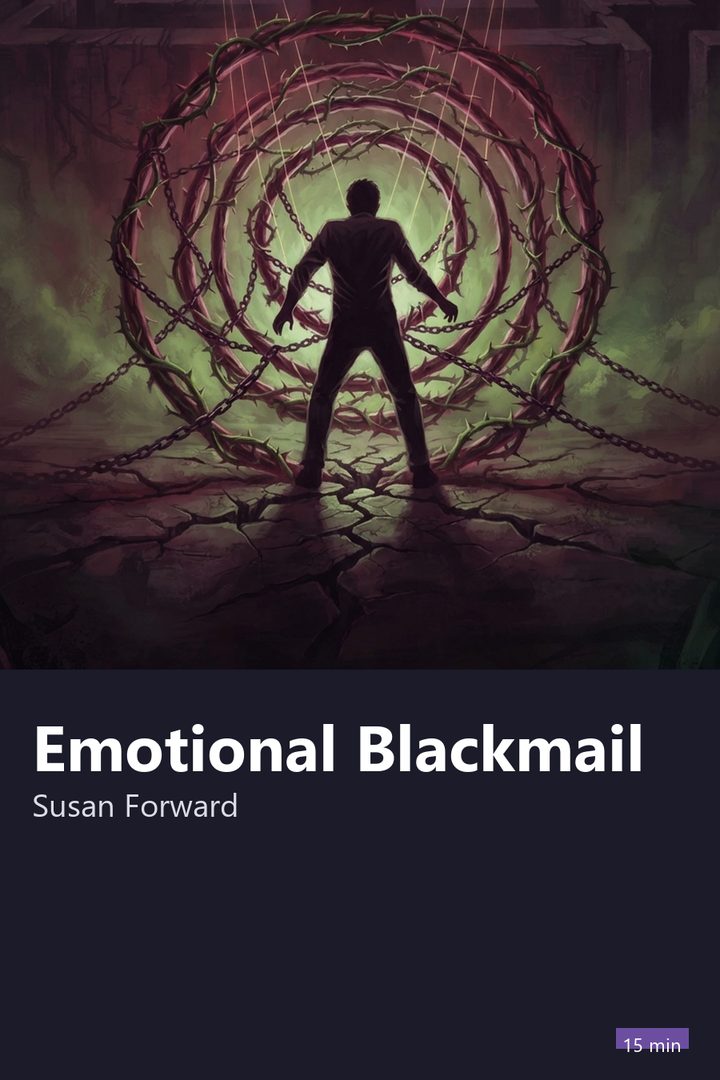
Cover of Emotional Blackmail

Relationships · 14 min

Emotional Blackmail

Susan Forward · 1997

Who it's for

For you if you give in on things you didn't want to just to avoid a fight, bad vibes, or guilt. It's also for anyone who wants to understand how emotional pressure works in families, couples, and the workplace.

Read it in the app

⚡ Free to download • 🎁 One full book free every day

🎧 Audio coming soon in the app

Narration for the English summaries is on its way. Meanwhile you can read the full summary in the app.

3 ideas to take with you

1

Someone who is always playing the sufferer may be asking for something without asking, and your refusal becomes proof that you're selfish.

2

When pressure works once, the other person learns that it pays off, and the cycle tends to repeat.

3

In families where disagreeing costs weeks of silence, giving in ends up being the way to keep the peace.

“
In the fog, the question stops being what do I want and becomes how do I avoid disaster.
An idea from Emotional Blackmail, in the words of 15 Minutes

Preview

Start reading now

What emotional blackmail is

When we hear the word blackmail, we think of a criminal demanding money. Susan Forward is talking about something else, far more common and harder to see: people close to you, like parents, partners, bosses, and friends, who threaten to punish you, openly or in disguise, if you don't do what they want.

The threat almost never sounds like a crime. It shows up as "if you loved me, you would," "after everything I've done for you," a silence that lasts for days, or a sadness put on display on purpose. The person on the receiving end feels a tightness in the chest and gives in, without quite knowing why.

What defines the phenomenon is not intensity but mechanism. There is a demand and, attached to it, an emotional consequence tied to affection: losing love, approval, or peace. That is what makes the request weigh so much.

A distinction is worth making: asking is normal, and pushing a little is too. Every relationship involves negotiation, and nobody is a blackmailer just for wanting something. The problem begins when affection becomes a bargaining chip and a no is answered with punishment instead of conversation.


The fog: fear, obligation, and guilt

The book sums up the effect with an acronym, FOG, which stands for fear, obligation, and guilt, the three feelings the blackmailer triggers to cloud the thinking of the person on the other side.

The fear is of losing the relationship, of watching the other person explode or fall apart. The obligation is the idea that we owe something to someone just because of who they are. The guilt is the remorse for saying no, even when the request was abusive.

In the fog, we stop asking ourselves what we want and start asking how to avoid disaster. That's why so many people discover, years later, that they are living choices that were never theirs, in education, in marriage, in where they live.

The author states that the closer the relationship, the thicker the fog. It's easier to say no to a salesperson than to your own mother, because your mother controls something the salesperson doesn't: our sense of being a good person.

The punisher: the open threat

The author describes four styles of blackmailer. The first is the punisher, who says in plain words what will happen if you don't obey. It might be a threat to leave, to cut off financial help, to yell, or to make the other person's life a living hell.

There are subtle versions, such as cold anger, sarcasm, or withdrawal of affection. There isn't always shouting. Sometimes the punisher simply changes mood and makes it clear that the atmosphere at home depends on your obedience.

This is the boss who says "if you're not happy, you know where the door is," the husband who sulks for days, the relative who threatens to cut ties. The common thread is the explicit promise that the price of saying no will be high.

People who live with a punisher often develop the habit of gauging his mood before speaking. They spend their whole lives checking the temperature at home, like someone walking on thin ice. This chronic exhaustion is one of the least discussed effects of the pattern.

11 more sections and the quiz

Continue in the app

Read the whole summary, finish with the Emotional Blackmail quiz and follow the guided Journeys. No ads in the app.

About Susan Forward

Susan Forward is an American psychotherapist and writer who has practiced clinically in California. She became known for books about difficult family relationships, such as Toxic Parents, published in 1989. Emotional Blackmail, from 1997, was written with the collaboration of Donna Frazier.

Explore

Category:
Relationships
Part of the Journeys:
Relationships That Hurt