15 Minutes
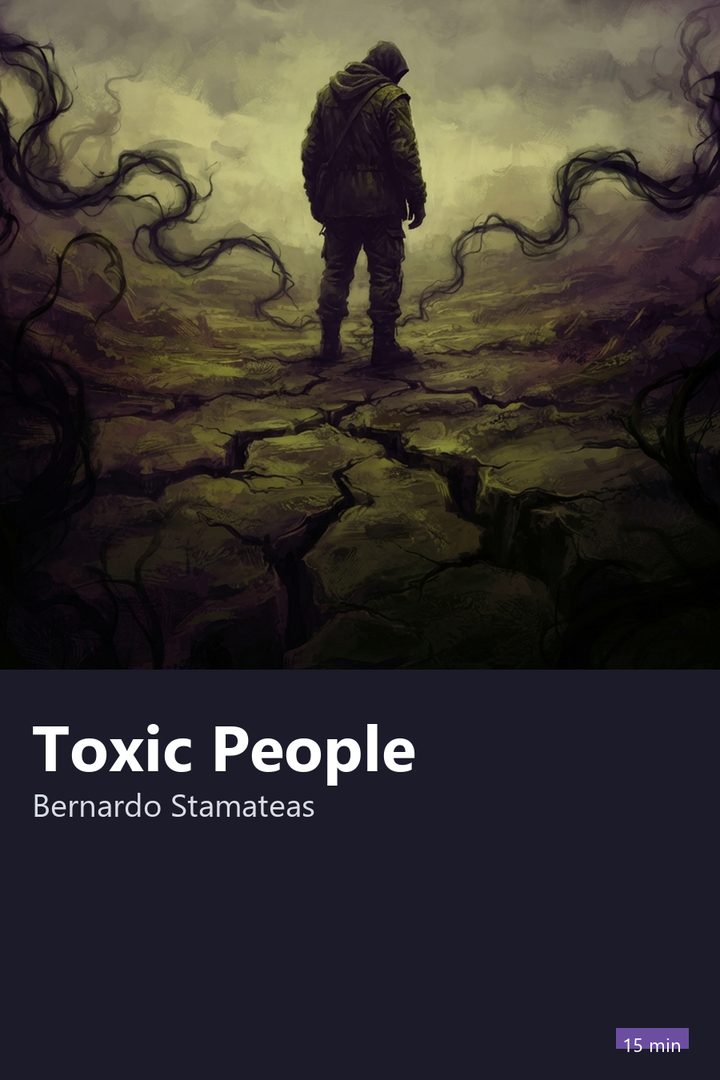
Cover of Toxic People

Relationships · 16 min

Toxic People

Bernardo Stamateas · 2008

Who it's for

Original title (Portuguese): Gente Tóxica. For you if you leave certain conversations drained, with the feeling that someone at work, in your family or in your circle of friends is sapping your energy. It also suits anyone who wants to learn how to set limits without becoming anyone's enemy.

Read it in the app

⚡ Free to download • 🎁 One full book free every day

🎧 Audio coming soon in the app

Narration for the English summaries is on its way. Meanwhile you can read the full summary in the app.

3 ideas to take with you

1

The less your sense of worth depends on other people's applause, the less power a provocation has over you.

2

When you can't cut off the relationship, you can change the rules: schedules, topics and agreed limits.

3

Calling someone toxic explains very little; describing the behavior that hurts and the limit you need helps a lot more.

“
According to the book, constant criticism often hides the insecurity of the person criticizing.
An idea from Toxic People, in the words of 15 Minutes

Preview

Start reading now

What the book calls toxic people

Everybody knows someone who, after ten minutes of conversation, leaves us more tired than before. Stamateas gives this kind of person a name: toxic people would be those who, over and over, put others down, control them or drain them, leaving a trail of unease wherever they go.

The strength of the book is its simplicity. Instead of theory, it presents profiles that are easy to recognize, with traits, typical phrases and tips on how to react. It works like a catalog of everyday characters, and many people see themselves in it within the first few pages, sometimes on both sides.

It's worth warning that the term is a popular metaphor, not a category of psychiatry. No medical manual lists toxic person as a diagnosis. Think of it as a way of talking about patterns of behavior that hurt, not as a scientific label to stick on someone.


Where the author is coming from

It matters to know who is writing. Stamateas is trained in psychology, but he is also a pastor, and that shows in the language of the book: there are faith values, moral appeals and a tone of counseling, more than of research. This mix pleases many readers and bothers others.

The book has no data-driven studies or extensive footnotes. What it offers is the experience of the counseling office and the church, organized into short chapters. That's why it's best read as a guide for personal reflection rather than as a treatise on human relationships.

This caveat applies to everything that follows. When you read the profiles and strategies, remember that they are the author's proposals, based on his practice. Some match what psychology recommends, and others are opinions. Throughout this summary, we'll try to tell one from the other.

The critic: the one who always finds fault

The first profile is the critic. He complains about your work, your clothes, the way you talk, and usually disguises the nitpicking as help or as a joke. People who live with him learn to write messages already imagining what he'll find wrong.

According to the book, the constant critic rarely talks about the other person. He talks about himself: he criticizes because he feels insecure and needs to put someone down to feel bigger. This reading is the author's opinion, and it doesn't hold in every case, but it helps you take the comment less seriously.

The practical guidance is to separate useful criticism from destructive criticism. The useful kind offers an example, has a time and place, and points a way forward. The destructive kind is vague, repeated and humiliating. Faced with the second, the suggestion is to say thanks without getting into an argument and move ahead with what you've already decided.

11 more sections and the quiz

Continue in the app

Read the whole summary, finish with the Toxic People quiz and follow the guided Journeys. No ads in the app.

About Bernardo Stamateas

Bernardo Stamateas is an Argentine psychologist, also a clinical sexologist and an evangelical pastor, who lives in Buenos Aires. He writes self-help books and gives talks in several Latin American countries. Toxic People, published in 2008, is among his best-known titles and grew into a small series about relationships and emotions.

Explore

Category:
Relationships
Part of the Journeys:
Relationships That Hurt