15 Minutes
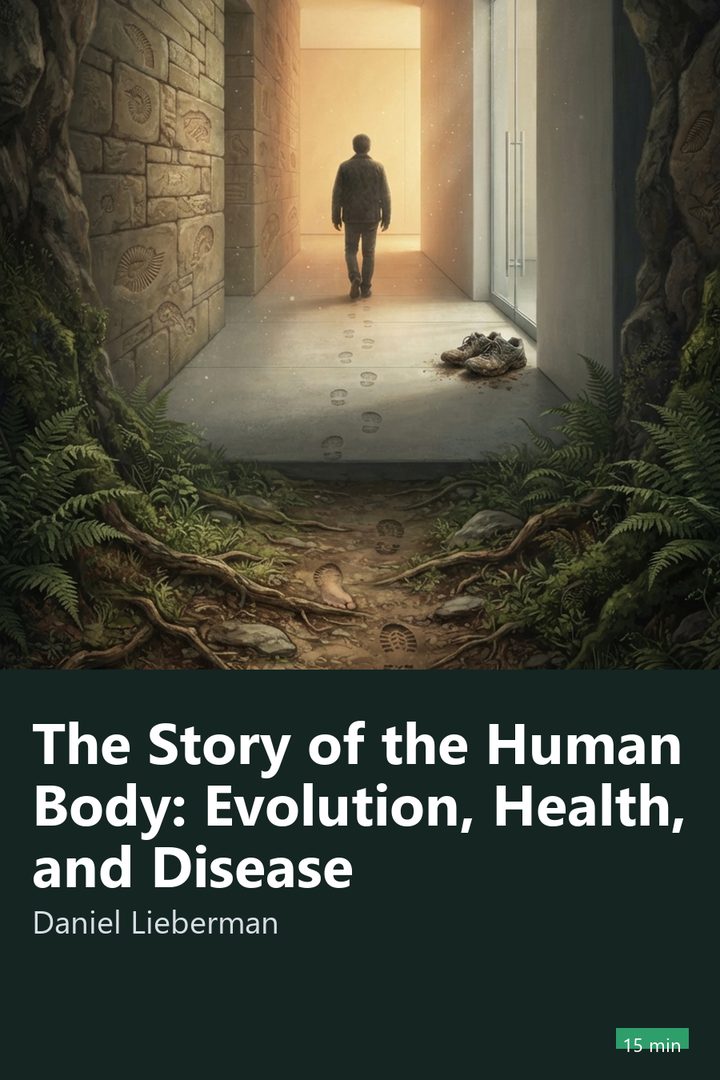
Cover of The Story of the Human Body: Evolution, Health, and Disease

Health · 17 min

The Story of the Human Body: Evolution, Health, and Disease

Daniel Lieberman · 2013

Who it's for

This is for you if you've ever been stunned to hear that someone has nearsightedness, cavities, or back pain, and you want to understand why the human body seems so poorly suited to modern life. It's a book for people who like to understand the why behind things before changing any habit.

Read it in the app

⚡ Free to download • 🎁 One full book free every day

🎧 Audio coming soon in the app

Narration for the English summaries is on its way. Meanwhile you can read the full summary in the app.

3 ideas to take with you

1

According to Lieberman, running long distances in the heat was, for much of prehistory, the most effective hunting weapon of the genus Homo, more so than speed.

2

Many ordinary people in the history of agriculture ended up eating worse and working harder than the earlier hunter-gatherers.

3

According to the book, treating only the symptom of a mismatch disease, without changing the environment that causes it, pushes the same problem forward, onto another person or another generation.

“
Walking on two legs burns far less energy than walking on all fours, like a chimpanzee does, and it also left the hands free to carry food.
An idea from The Story of the Human Body: Evolution, Health, and Disease, in the words of 15 Minutes

Preview

Start reading now

Why standing on two legs was the turning point

Before anything else that separates humans from other primates, there came bipedalism: walking on just two legs, with the trunk upright. That happened long before the big brain, the stone tool, or speech. The first bipedal ancestors already walked this way, while the rest of the body still looked quite ape-like.

Walking upright frees the hands, which can now carry babies, fruit, sticks. It also changes the energy bill: walking on two feet burns far fewer calories per mile than moving on all fours, which matters when food is scattered and far away.

The price came along with it: spine, knee, and hip had to reorganize to support an entire body stacked over a small base, the feet. That same design, built for walking long distances slowly, is what suffers today when daily life turns into decades of sitting in a chair and very little walking.


Australopithecines: neither ape nor human

The australopithecines, who lived in Africa between about 4 and 2 million years ago, are a good portrait of this transition phase. They already walked upright, but still had long arms and curved hands, good for climbing trees when danger came. The brain remained about the size of a chimpanzee's.

This group's diet relied on fruit, leaves, roots, and seeds, chewed with huge teeth and jaws adapted to hard, fibrous food. With no knife and no fire, the body itself had to grind the food down before swallowing.

It's tempting to imagine the australopithecine as an unfinished human, but the book invites a different view: it was a successful species in its own way, adapted to a niche that combined ground and trees. Humanity as we know it today would only appear much later, with the genus Homo.

The genus Homo bets on running

With Homo erectus, the body really changes: longer legs, narrower hips, a system for sweating across the whole skin that no other primate has to the same degree. This combination was tailor-made for running long distances in intense heat, when most other animals have to stop to cool off.

This is the basis of the endurance running hypothesis the author defends: instead of beating prey with short-distance speed, the human body won through accumulated fatigue, chasing the animal for hours in the midday heat until it collapsed from exhaustion, unable to cool itself. It's a hunt of endurance, not of sprinting.

Along with this came a taste for meat and animal fat, energy-dense food that fueled a body burning far more calories per day than an ape of the same size. Eating meat also opened room for another change: the gut could shrink, because digesting meat takes less work than digesting raw leaves, leaving energy for another expensive organ.

11 more sections and the quiz

Continue in the app

Read the whole summary, finish with the The Story of the Human Body: Evolution, Health, and Disease quiz and follow the guided Journeys. No ads in the app.

About Daniel Lieberman

Daniel Lieberman is an American paleoanthropologist and professor of human evolutionary biology at Harvard University. He is known for his research on the evolution of endurance running and human bipedalism. He published The Story of the Human Body in 2013, a work that became a reference in the discussion of evolution and modern diseases. He is also the author of other books on human evolutionary biology for general readers.

Explore

Category:
Health
Part of the Journeys:
Lasting Health