15 Minutes
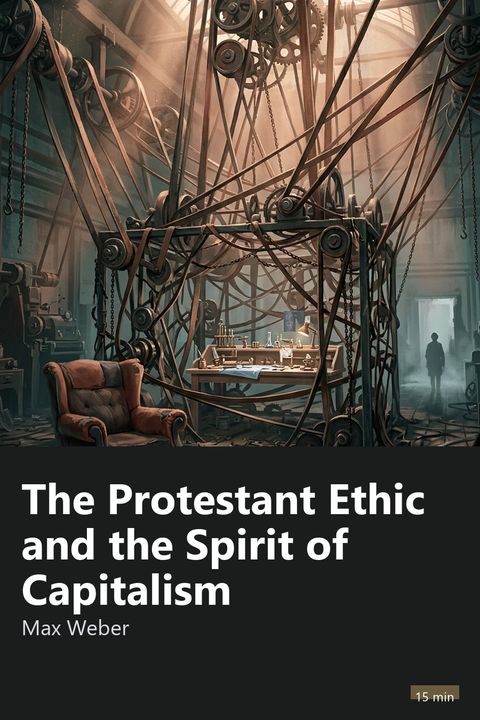
Cover of The Protestant Ethic and the Spirit of Capitalism

Economy and Society · 15 min

The Protestant Ethic and the Spirit of Capitalism

Max Weber · 1905

Who it's for

For you if you want to understand where our ideas about work, discipline, and money come from. This sociology classic is for anyone who enjoys discovering the history behind what seems natural.

Read it in the app

⚡ Free to download • 🎁 One full book free every day

🎧 Listen to this summary in the app

Every summary has audio narration. Open the app to read it or listen to it.

3 ideas to take with you

1

For Weber, what is new about modern capitalism is not profit, which already existed in antiquity, but the idea that earning money continuously and rationally is a duty.

2

According to his thesis, the anxiety of not knowing whether they were among the chosen led believers to look for signs, and disciplined work became one of them.

3

In an age of spreadsheets and targets, someone who feels guilty about resting may be repeating an inherited pattern they do not even know they carry.

“
Many convictions about work and merit that seem natural have a history that begins in debates about faith.
An idea from The Protestant Ethic and the Spirit of Capitalism, in the words of 15 Minutes

Preview

Start reading now

A curious question about money and religion

Max Weber published The Protestant Ethic and the Spirit of Capitalism as articles in 1904 and 1905, and later as a book. The question driving him seems strange: why did modern capitalism, with its emphasis on working hard, saving, and reinvesting, emerge so powerfully in certain Protestant regions of Europe and North America?

Weber noticed something in the data of his time: in religiously mixed countries such as Germany, business owners, skilled workers, and technical school students were disproportionately Protestant. He wanted to understand whether there might be a connection between faith and economic ways of life, and proposed a bold hypothesis that is still debated today.

The book is a work of historical sociology, short but dense, filled with notes and references. This summary presents its ideas simply, with an important reminder from the start: Weber does not say that religion alone causes capitalism. He shows an affinity between certain values and a way of organizing life and work.


What Weber means by the spirit of capitalism

For Weber, capitalism, in the sense of pursuing profit, has existed since antiquity: merchants, bankers, and adventurers have always made money. What is new in the modern era is the spirit of capitalism, a mindset in which making money continuously and rationally comes to be seen as a duty, almost a calling.

This mindset is unusual. Modern entrepreneurs do not work just to enjoy their wealth or spend it on luxuries. They work, save, reinvest, and avoid showing off. Profit becomes a measure of seriousness and duty fulfilled, and their entire lives revolve around producing more, in a cycle that seems to have no end.

Think of a bakery owner who gets up at four in the morning, reinvests earnings in the business, and rarely takes a vacation. Weber would find this figure revealing: money is not a means to a better life; instead, work itself takes on moral value. That reversal is what he wants to explain.

Traditionalism: the counterpoint

To show what is new, Weber draws a comparison with traditionalism. Traditional workers are paid by output, and when employers raise the piece rate, they often work less, not more, because they have already earned what they consider enough. They want to live as they always have, not earn as much as possible.

This way of thinking needs a push to change. In many societies, it remains strong: the purpose of work is to meet needs, not accumulate endlessly. Weber observes that raising wages does not always increase output, and that modern capitalism needed people willing to work with discipline for its own sake, not just out of necessity.

The contrast is easy to recognize: someone who wants to earn enough to live and go home versus someone who always wants to expand the business. Neither is foolish or wrong, but these are different mindsets, and Weber wants to know where the second one came from, since it has spread so widely in the modern world.

11 more sections and the quiz

Continue in the app

Read the whole summary, finish with the The Protestant Ethic and the Spirit of Capitalism quiz and follow the guided Journeys. No ads in the app.

About Max Weber

Max Weber was born in Germany in 1864 and was a sociologist, economist, and legal scholar. He taught at universities including Freiburg, Heidelberg, and Munich. Considered one of the founders of sociology, he also wrote Economy and Society and Politics as a Vocation. He died in Munich in 1920.

Explore