15 Minutes
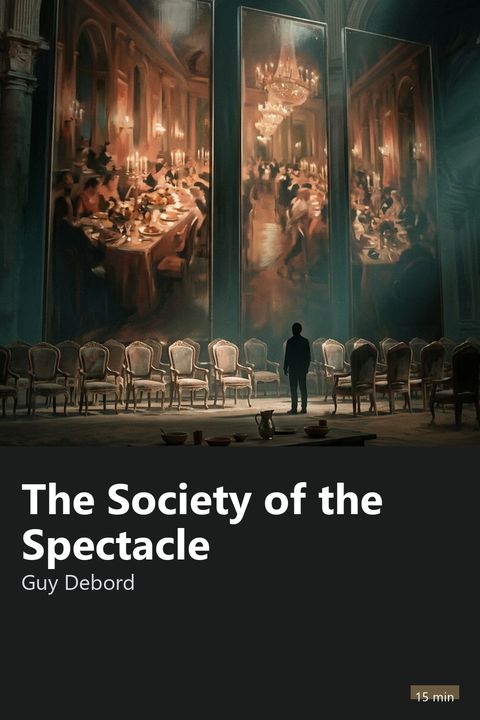
Cover of The Society of the Spectacle

Economy and Society · 15 min

The Society of the Spectacle

Guy Debord · 1967

Who it's for

For you if you feel you spend more time watching other people's lives, or what looks like life, than living your own. This is a short, challenging classic for anyone who likes reflecting on consumption, images, and attention.

Read it in the app

⚡ Free to download • 🎁 One full book free every day

🎧 Listen to this summary in the app

Every summary has audio narration. Open the app to read it or listen to it.

3 ideas to take with you

1

According to the book, people gather before the same image and remain alone, because their connection is to the screen rather than to one another.

2

In political campaigns, when the impression a candidate makes matters more than the substance, voters become spectators and start cheering instead of deciding.

3

For Debord, modern life moved from being to having, and from having to appearing, and it is in that final stage that appearance becomes the measure of value.

“
A person's worth cannot be contained in the image they manage to project, no matter how carefully edited it is.
An idea from The Society of the Spectacle, in the words of 15 Minutes

Preview

Start reading now

A Book in Fragments, Written in 1967

The Society of the Spectacle, by Guy Debord, was published in France in 1967, a year before the uprisings of May 1968. It does not look like a typical academic book: it is divided into nine chapters and 221 short, numbered theses, written in the style of an aphorism, with brief, provocative statements that demand slow reading.

The style is part of the message. Debord writes as though he is delivering an indictment, using dense sentences that blend philosophy, economics, and cultural criticism. Many people find it difficult, and that difficulty is real. This summary organizes the main ideas, but the original book deserves to be read gradually, one thesis at a time.

The underlying question is easy to state and hard to answer: what happens to life when everything that was once experienced directly becomes an image, a representation, something to look at? Debord argues that this has changed society as a whole, and that the price of that change is steep.
What the Spectacle Is

For Debord, the spectacle is not just television, advertising, or movies. It is a social relationship between people, mediated by images. Instead of things being experienced directly, life becomes something represented and consumed from a distance. Everything that was directly lived recedes into a representation.

The central thesis is that, in modern societies organized around capitalist production, all of life presents itself as an immense accumulation of spectacles. Images stop being reflections of the world and become the very world we live in, shaping desires, values, and relationships. Those who look at the images become spectators, passive before something they do not control.

Think of a championship game: millions of people follow something they cannot influence, cheering and commenting. Debord would extend that example to all of life: politics, work, love, consumption. The spectacle is not a collection of images. It is how society organizes what people look at and how they participate.

From Being to Having, from Having to Appearing

Debord describes a transformation that unfolds in stages. First, social life depended on being: what people were and what they did. As the economy became dominant, it came to depend on having: what people owned. Now, in the stage of the spectacle, everything depends on appearing: what you seem to have and to be.

At this stage, someone's value lies not in what they do or the goods they actually own, but in the image they manage to project. Goods matter less for their usefulness than for the status they display. The result is a life in which appearance takes priority over substance, and social recognition becomes the main goal.

Think of a car financed over sixty monthly payments just to display success, or a birthday party with a perfect backdrop, designed for photos. What matters is how it looks. Debord saw this in the 1960s, before any social media existed, and believed the trend could only grow.

11 more sections and the quiz

Continue in the app

Read the whole summary, finish with the The Society of the Spectacle quiz and follow the guided Journeys. No ads in the app.

About Guy Debord

Guy Debord was born in Paris in 1931 and was a French writer, filmmaker, and theorist. He was a central figure in the Situationist International, a group active during the 1950s and 1960s. Beyond the book, he directed films including The Society of the Spectacle, released in 1973, and wrote Comments on the Society of the Spectacle, published in 1988. He died in 1994.

Explore