15 Minutes
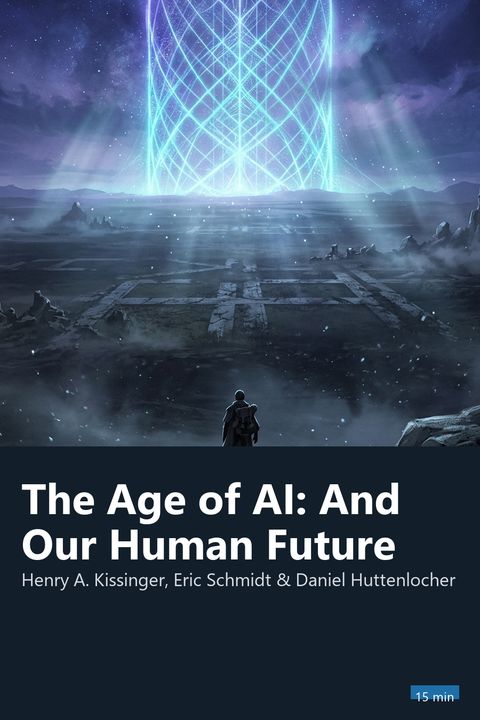
Cover of The Age of AI: And Our Human Future

Technology and the Future · 15 min

The Age of AI: And Our Human Future

Henry A. Kissinger, Eric Schmidt & Daniel Huttenlocher · 2021

Who it's for

For readers who want to discuss the impact of artificial intelligence on politics, ethics, and human identity, with no technical background required.

Read it in the app

⚡ Free to download • 🎁 One full book free every day

🎧 Listen to this summary in the app

Every summary has audio narration. Open the app to read it or listen to it.

3 ideas to take with you

1

According to the book, artificial intelligence could have an impact on knowledge comparable to the Enlightenment, because it changes who makes discoveries.

2

Systems we see and use every day choose what shows up on our screens, and this silent curation shapes opinions and habits.

3

In the authors' view, rules between countries need to come before the crisis, as we learned in the nuclear age.

“
When the machine gets it right without explaining, the question becomes how far to trust it.
An idea from The Age of AI: And Our Human Future, in the words of 15 Minutes

Preview

Start reading now

A book written by three hands

The book brings together three authors with very different profiles: a statesman, a tech executive, and a computer scientist. Henry Kissinger was U.S. Secretary of State, Eric Schmidt ran Google, and Daniel Huttenlocher leads a computing college at MIT. The mix gives the text an unusual reach.

The question guiding them is broad: what changes in human history when machines start making decisions, discovering patterns, and producing knowledge without us being able to explain how? They don't aim to teach you to code, but to provoke a discussion about politics, ethics, and identity.

Published in 2021, before the arrival of the conversational assistants that went viral afterward, the text reads like an essay, not a technical manual. It is best read as a map of concerns and questions rather than an exact forecast of what's coming, and that is the spirit of this summary.

It's also worth noting how the book came about: it grew out of years of conversations among the three, each bringing his own background. Kissinger asks about historical meaning, Schmidt about economic potential, Huttenlocher about the technology. The result is a work that balances a worldview with technical knowledge, though without going deep on either side.
From the Enlightenment to the machine that learns

The historical starting point is the Enlightenment. For centuries, knowledge was guided by faith and tradition; with the scientific revolution, it came to depend on reason, observation, and proof. The authors suggest that artificial intelligence may represent a comparable turning point, because it changes who produces knowledge.

For the first time, a tool doesn't just carry out orders but finds, on its own, solutions its creators never imagined. Humanity stops being the only source of discoveries. This brings enormous promise and a philosophical discomfort: what does it mean to understand something that the machine knows and we can't explain?

The book argues that it isn't enough to celebrate or to fear. We need to create a new way of thinking about the relationship between humans and machines, just as the Enlightenment created a way of thinking about reason. The authors admit we don't have that philosophy ready yet.

How these machines learn, without anyone knowing exactly why

The authors explain, in accessible terms, that today's artificial intelligence doesn't work through hand-written rules, like the first programs, but through machine learning. The system takes in enormous amounts of data, adjusts millions of parameters, and discovers patterns the programmer never specified.

This method delivers impressive results but creates a transparency problem. Often it's hard to say why the system reached a certain answer. It can be right most of the time and still fail in strange ways that a human never would, which makes it dangerous in sensitive settings like credit, health care, and justice.

For the average reader, the lesson is to realize that artificial intelligence is neither magic nor consciousness. It is statistics at a gigantic scale, with its own strengths and limits. Knowing that it's good at recognizing patterns and bad at understanding context helps you decide when to trust it and when to double-check.

10 more sections and the quiz

Continue in the app

Read the whole summary, finish with the The Age of AI: And Our Human Future quiz and follow the guided Journeys. No ads in the app.

About Henry A. Kissinger, Eric Schmidt & Daniel Huttenlocher

Henry Kissinger was U.S. Secretary of State, received the Nobel Peace Prize in 1973, and died in 2023. Eric Schmidt was chief executive of Google from 2001 to 2011. Daniel Huttenlocher is a computer scientist and dean of the MIT Schwarzman College of Computing. The three co-wrote this book, published in 2021.

Explore