15 Minutes
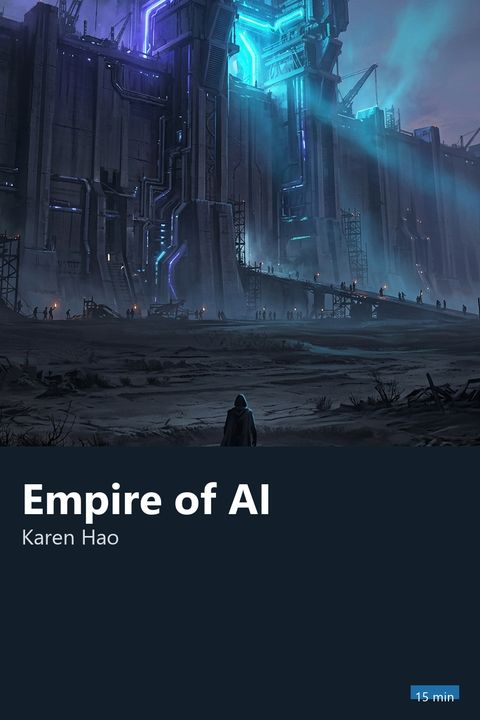
Cover of Empire of AI

Technology and the Future · 15 min

Empire of AI

Karen Hao · 2025

Who it's for

For anyone who uses ChatGPT and other tools and wants to understand the power, labor, and resources behind the scenes.

Read it in the app

⚡ Free to download • 🎁 One full book free every day

🎧 Listen to this summary in the app

Every summary has audio narration. Open the app to read it or listen to it.

3 ideas to take with you

1

For the author, choosing ever-larger models was a strategic bet among alternatives, and it favored those who already had money and infrastructure.

2

Much of the work that makes AI seem intelligent is human, repetitive, and poorly paid, performed far from the spotlight.

3

According to the book, OpenAI's 2023 crisis exposed the limits of a structure designed to protect the public interest when money and loyalty carry more weight.

“
Behind the answer that appears in seconds is a chain of labor, energy, and decisions that almost no one sees.
An idea from Empire of AI, in the words of 15 Minutes

Preview

Start reading now

A Journalist, a Company, and a Powerful Metaphor

Karen Hao is a journalist specializing in artificial intelligence who spent years closely following OpenAI, the company behind ChatGPT. In this book, she brings together that reporting to tell the story of how an organization that promised to benefit humanity became one of the world's most powerful and valuable companies. This is journalism, not a technical manual.

The title introduces the central idea. For the author, major AI companies behave like empires of the past: they take resources that do not belong to them, exploit the labor of distant workers, concentrate knowledge, and justify it all through a narrative of a civilizing mission. This provocative metaphor shapes the book from beginning to end.

Keep two cautions in mind as you read. First, remember that this is an argument supported by reporting, not an indisputable fact. Second, do not confuse criticism of specific companies with criticism of the technology itself, which continues to have legitimate and valuable uses.

From Nonprofit Lab to Industry Giant

The book recalls that OpenAI began in 2015 as a nonprofit organization, promising to develop AI openly and for everyone's benefit. Its founders included Sam Altman, Greg Brockman, Ilya Sutskever, and Elon Musk. The idea was to create a counterweight to the major technology companies.

Over time, that reality changed. Training ever-larger models requires enormous amounts of money and computing power, and the company created a capped-profit structure and struck a multibillion-dollar partnership with Microsoft. Musk left the organization after disagreements over leadership, and the promise of openness gradually lost ground.

Hao presents this trajectory as a series of decisions rather than an inevitable outcome. At every step, the company offered a good reason for changing course, which helps explain why such major shifts seemed natural to the people on the inside.

Betting on Scale

One thread running through the book is the bet on scale: the belief that getting more capable systems simply requires increasing the amount of data, chips, and energy. This strategy led from the GPT series to ChatGPT, released in late 2022 and quickly transformed into a worldwide phenomenon.

The author reminds us that this was one choice among other possibilities. There were, and still are, researchers who advocate smaller, cheaper models trained on more carefully selected data. By choosing the path of scale, the industry also chose the path requiring more resources, favoring those who already had money and infrastructure.

For anyone outside the field, the lesson is simple: AI's current direction is not a law of nature. It was decided by people with specific interests and perspectives, which means it is open to debate.

Then there is the question of money. Training a cutting-edge model costs a fortune in chips and electricity, which explains why so few companies can compete and why billionaire investors have come to play a central role in decisions about the technology's future.

10 more sections and the quiz

Continue in the app

Read the whole summary, finish with the Empire of AI quiz and follow the guided Journeys. No ads in the app.

About Karen Hao

Karen Hao is an American journalist who covers artificial intelligence and its effects on society. She studied engineering at MIT and worked at publications including MIT Technology Review and The Wall Street Journal. She has written for The Atlantic and closely followed OpenAI, the subject of her book published in 2025.

Explore