15 Minutes
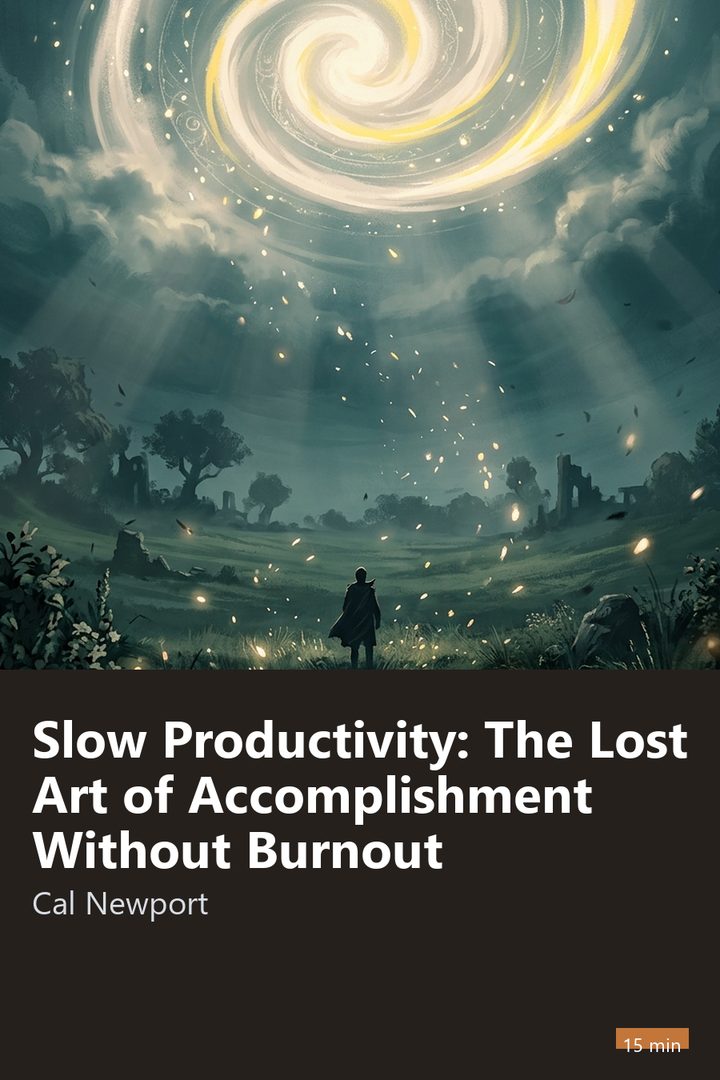
Cover of Slow Productivity: The Lost Art of Accomplishment Without Burnout

Productivity and Focus · 16 min

Slow Productivity: The Lost Art of Accomplishment Without Burnout

Cal Newport · 2024

Who it's for

For knowledge workers, academics, creators, and managers who feel buried under emails, instant messages, and endless meetings, and who feel constantly busy without accomplishing anything memorable. It is an essential manual for anyone who wants to trade empty busyness for the completion of deep, meaningful projects.

Read it in the app

⚡ Free to download • 🎁 One full book free every day

🎧 Audio coming soon in the app

Narration for the English summaries is on its way. Meanwhile you can read the full summary in the app.

3 ideas to take with you

1

Constant context switching fragments attention and exacts a biological toll that cuts real intelligence in half.

2

Reducing the number of active projects in progress speeds up the completion of each task instead of delaying deliveries.

3

True professional mastery does not compete in the race for cheap speed, but in the handcrafted solidity of what it delivers.

“
The frantic busyness of answering quick messages is just the cowardly disguise of those who flee from deep work.
An idea from Slow Productivity: The Lost Art of Accomplishment Without Burnout, in the words of 15 Minutes

Preview

Start reading now

The modern trap of pseudo-productivity

In the era of the factories of the Industrial Revolution, measuring a worker's output was a direct and transparent task: you simply counted how many pieces came off the conveyor belt at the end of the shift. With the rise of modern intellectual work, however, quantifying the value of a strategic report, a line of code, or a marketing plan became a murky equation that is difficult to solve.

Faced with this chronic measurement difficulty, the corporate world adopted a crude and harmful approximation that Cal Newport calls pseudo-productivity. This is the habit of treating visible activity as if it were synonymous with real productivity: answering Slack messages within thirty seconds, keeping the inbox at zero, jumping from meeting to meeting on Zoom, and staying connected late into the night.

This posture creates an illusory treadmill of busyness that devastates professionals' mental health. We spend the day rushing to put out small bureaucratic fires, generating a paralyzing mental fatigue that steals the energy indispensable for sitting down and producing work of real impact and depth for the organization.
The invisible cost of context switching

The human brain was not designed by evolution to process dozens of complex demands in parallel. Every time you interrupt the writing of an important document to check a message notification on your phone or peek at an inbox, your neurons pay a severe biological toll known as attention residue.

The mind does not flip the switch instantly from one task to another; a considerable fraction of your working memory remains stuck on the content of the previous message. When this context switching happens dozens of times per hour, the individual enters a chronic state of cognitive fog, taking twice as long to complete simple reasoning and making careless mistakes out of distraction.

In the modern American workplace, this fragmentation is fueled by the culture of corporate group chats and team channels that respect neither weekends nor rest hours. The manufactured urgency of anxious bosses turns any ordinary Tuesday into a nightmare of dispersion and accumulated stress.

The first principle: do fewer things

The first great law of slow productivity consists of a radical and counterintuitive decision: drastically reducing the number of active projects taken on at the same time. When a person carries fifteen open obligations simultaneously, most of their week is drained simply by the bureaucracy of managing those tasks, scheduling alignment meetings, and responding to deadline pressure.

Newport proposes implementing a pull system, inherited from Japanese lean manufacturing. Instead of accepting new projects into your schedule the moment they appear on the horizon, future demands should be placed in an organized waiting list. A new project is only pulled onto the active workbench when a previous task has been fully completed and delivered.

This discipline protects the mind from paralyzing overload. Having only two or three open priorities on the desk allows you to dive in with intensity and total focus, accelerating your real speed of delivery and eliminating the friction of daily indecision about which fire to put out first.

9 more sections and the quiz

Continue in the app

Read the whole summary, finish with the Slow Productivity: The Lost Art of Accomplishment Without Burnout quiz and follow the guided Journeys. No ads in the app.

About Cal Newport

Cal Newport is an associate professor of computer science at Georgetown University and one of the most influential contemporary essayists on technology and work. The author of worldwide bestsellers such as Deep Work and Digital Minimalism, he writes regularly for The New Yorker about the impact of algorithms on culture. His ideas about focus and productivity without anxiety have been adopted by millions of professionals around the planet.

Explore