15 Minutes
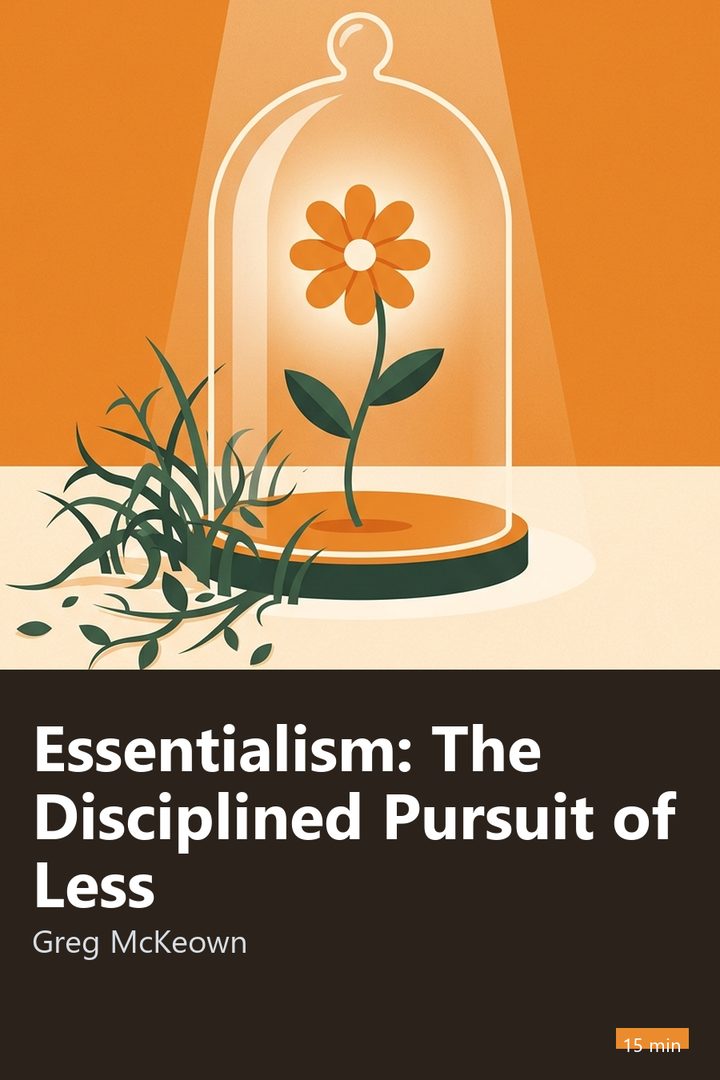
Cover of Essentialism: The Disciplined Pursuit of Less

Productivity and Focus · 15 min

Essentialism: The Disciplined Pursuit of Less

Greg McKeown · 2014

Who it's for

This one is for you if your calendar is packed, you say yes by reflex, and you feel constantly busy without knowing exactly with what. Essentialism is a manual for anyone who wants to trade a pile of tasks for quality of results.

Read it in the app

⚡ Free to download • 🎁 One full book free every day

🎧 Audio coming soon in the app

Narration for the English summaries is on its way. Meanwhile you can read the full summary in the app.

3 ideas to take with you

1

If you don't decide what your priorities are, you end up living the schedule other people chose for you.

2

Almost everything is irrelevant; only a small fraction of what you do produces real results.

3

Saying no clearly is an act of respect, not rudeness.

“
The maybe you say to avoid hurting anyone is already a hidden no, and it steals your calendar all the same.
An idea from Essentialism: The Disciplined Pursuit of Less, in the words of 15 Minutes

Preview

Start reading now

The trick of believing you can do it all

Notice something: every time you say 'I can handle it all,' you are, in practice, promising to do a bunch of things halfway. Nobody has infinite energy, just the illusion that the next cup of coffee will fix it. Essentialism starts when you accept that doing everything is mathematically impossible, and stop trying to prove otherwise.

This isn't about laziness, it's about the physics of attention. Every commitment you accept steals minutes and mental energy from another one. When you pretend that cost doesn't exist, the one who pays the bill is always the most important project, because it's the only one that will let itself be postponed without screaming.

McKeown calls this the 'everything matters trap': a comfortable belief, because it takes away your responsibility to choose. If everything is a priority, you never have to admit you dropped something important. In practice, though, dropping everything halfway is exactly what happens.

Notice that this trap has a social side too: saying 'I'm in for everything' seems more generous than admitting a limit. But generosity that breaks a promise later is worth less than a clear limit stated up front.

Almost everything you do today is irrelevant

This sounds harsh, but it's liberating: if you look at last week's to-do list, chances are good that 80% of the results that mattered came from 20% of the tasks. The rest was noise: meetings that could have been a voice memo, emails nobody was going to follow up on, tasks that existed only so you could feel productive.

The essentialist doesn't try to do more relevant things. He cuts the irrelevant ones so there's time and headspace left for the few that really move the needle. Fewer items on the list, more depth in each one.

The practical exercise is simple: take last week's calendar and mark, item by item, what would actually have had consequences if it had been canceled. The list that remains, small almost every time, is your true essential.

The power of a well-delivered 'no'

Saying no often feels impolite, but it's the opposite: it's respect for what you already promised to finish properly. A poorly considered yes today is a badly explained apology two weeks from now, when you realize you won't be able to deliver.

McKeown's practical tip is to separate the decision from the person: you can turn down a request without turning down the person who asked. 'I can't take that on right now, but I'm happy to suggest someone else' does more for a relationship than a forced yes that falls apart later.

It's worth practicing ready-made phrases for these moments, because in the heat of the moment your mind freezes and the yes comes out on autopilot. Having a rehearsed answer takes the emotional weight out of refusing and makes it feel more natural over time.

With practice, you notice that the person who asked for the favor rarely remembers the refusal the following week. The one who carries the weight longest is always the one who said no, imagining a reaction worse than the real one.

10 more sections and the quiz

Continue in the app

Read the whole summary, finish with the Essentialism: The Disciplined Pursuit of Less quiz and follow the guided Journeys. No ads in the app.

About Greg McKeown

Greg McKeown is a British writer, speaker, and consultant based in the United States. He graduated from the Stanford Graduate School of Business and has advised companies such as Apple, Google, and Twitter/X on strategic decision-making. He writes regularly for the Harvard Business Review and hosts the podcast 'What's Essential'. Besides Essentialism, he is the author of the book Effortless, published in 2021.

Explore