15 Minutes
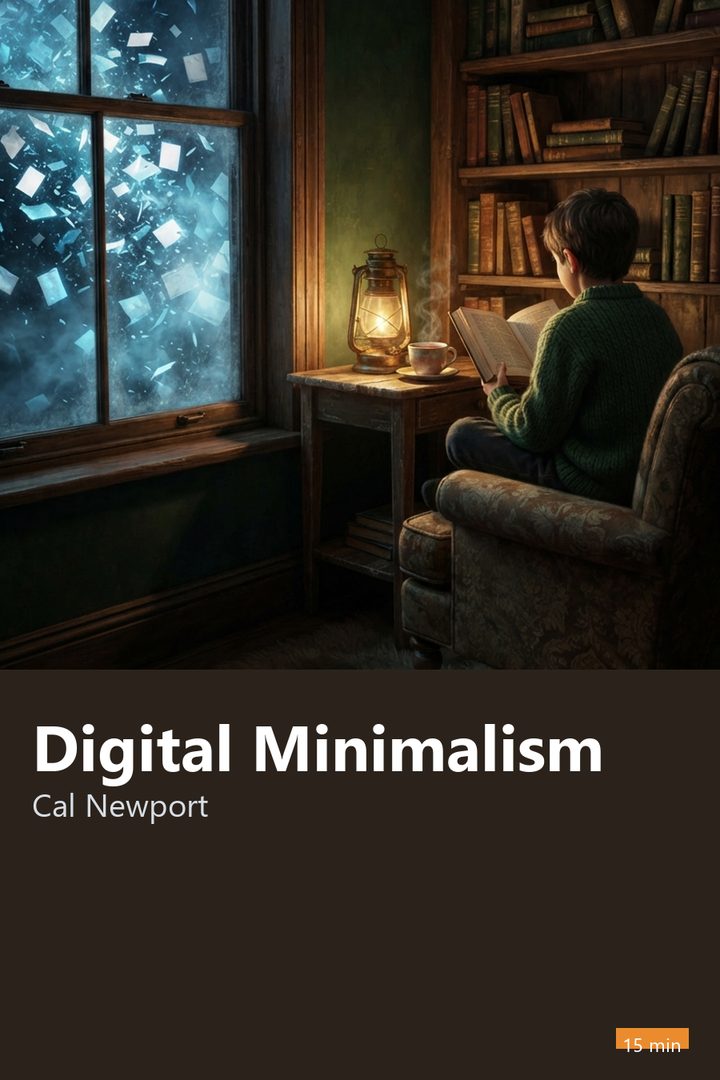
Cover of Digital Minimalism

Productivity and Focus · 17 min

Digital Minimalism

Cal Newport · 2019

Who it's for

For you if you feel like your phone is glued to your hand and suspect you're losing real time to it, but don't know where to start cutting. Digital Minimalism is a guide to choosing technology based on your values, not on the automatic habit of checking everything.

Read it in the app

⚡ Free to download • 🎁 One full book free every day

🎧 Audio coming soon in the app

Narration for the English summaries is on its way. Meanwhile you can read the full summary in the app.

3 ideas to take with you

1

A free app doesn't make money when you use it well and stop: it makes money when you stay inside it as long as possible.

2

Being alone with your own thoughts, with no screen and no earbuds, isn't wasted time: it's where your mind organizes what a whole day of stimulation didn't let it process.

3

Liking a photo or sending an emoji gives you the feeling of contact without delivering the substance of a real conversation.

“
Thirty days without apps cost you willpower in the first few days, but they give back an old boredom that the screen had retired.
An idea from Digital Minimalism, in the words of 15 Minutes

Preview

Start reading now

Your phone hijacked you by accident, not by chance

Nobody bought a smartphone planning to check it hundreds of times a day. The original idea was practical: call someone, look at a map, take care of something quickly and put the device away again. But since the first iPhone launched, something quietly changed: the phone stopped being a tool you use and became a habit that uses you.

Cal Newport calls this phenomenon an accidental connected life. Nobody decided, on purpose, to spend three or four hours a day texting, scrolling the feed and checking notifications: it happened little by little, app by app, with no one stopping to ask whether that time was worth it.

The book grows out of this uncomfortable question: if you could choose again, from scratch, how much screen time would you put in your life? For most people, the answer is far smaller than the real number. That gap is what digital minimalism tries to close.
Attention economy: you're not the customer, you're the product

Social networks, short-video apps and news sites have something in common: they're free to use, but expensive to keep running. Servers, engineers, offices, all of it is paid for with ad money, and ads only sell well when lots of eyes stay glued to the screen for a long time.

That creates a simple incentive: the more time you spend in the app, the more money the company makes. It's not the fault of any one programmer, it's the business model itself pushing in that direction. Attention became the product being sold, and you are the raw material.

Newport points out that this is very different from buying a drill, where the manufacturer wants you to use it well and stop when the job is done. In the world of free apps, using it well and stopping is the worst possible outcome for the company that owns the product.

The slot machine that fits in your pocket

Casino slot machines run on a mechanism studied for decades: the reward comes unpredictably, sometimes on the first pull, sometimes only on the twentieth. This variable reward pattern holds attention better than a guaranteed prize, because the brain stays in suspense about the next result.

The book shows how this mechanism was copied into the social media feed. You swipe the screen down without knowing whether something trivial or interesting will show up. That uncertainty is the engine: your thumb keeps going down because the next reward might be right around the corner.

Notifications work in a similar way. That red number on the icon doesn't tell you whether something is important or trivial, and the brain treats both as urgent. Newport argues that just understanding this mechanism helps you stop blaming yourself for a lack of willpower and start looking at the design of the product.

12 more sections and the quiz

Continue in the app

Read the whole summary, finish with the Digital Minimalism quiz and follow the guided Journeys. No ads in the app.

About Cal Newport

Cal Newport is a computer science professor at Georgetown University in the United States, with a PhD from MIT and an undergraduate degree from Dartmouth College. He has written several books on technology and productivity, including Deep Work, which is also in this catalog. Since the 2000s he has kept a blog called Study Hacks, and he writes often about technology for outlets like The New Yorker.

Explore

Part of the Journeys:
Focus and Productivity