15 Minutes
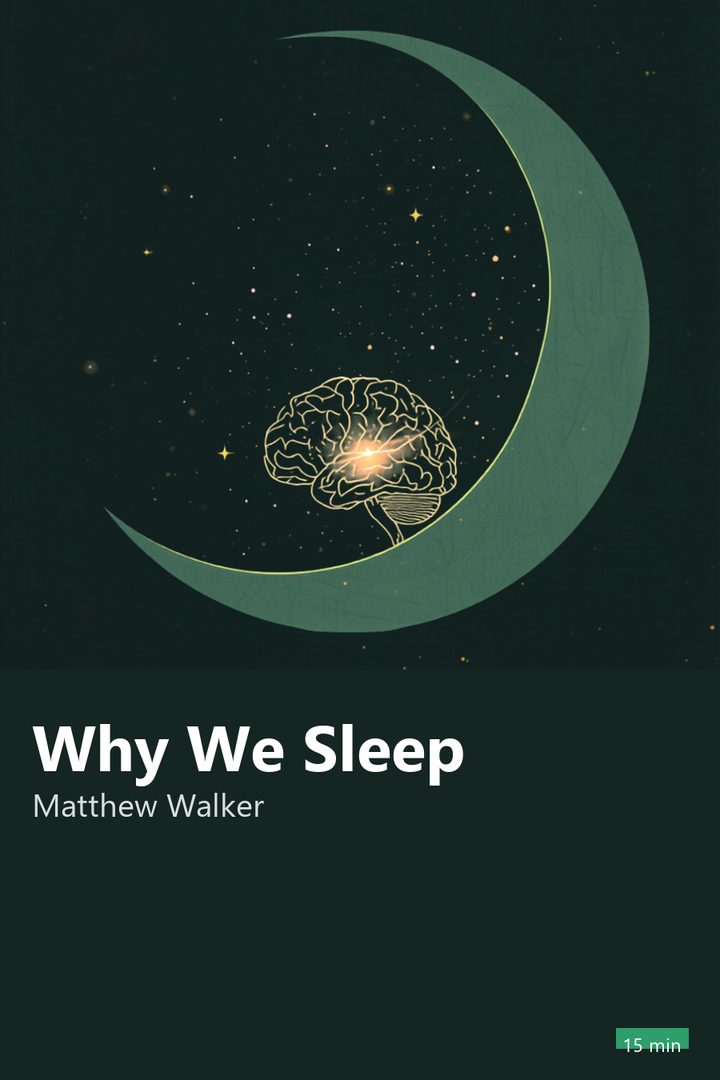
Cover of Why We Sleep

Health · 15 min

Why We Sleep

Matthew Walker · 2017

Who it's for

For anyone who treats sleep as the first thing to cut when the day gets tight and has never stopped to understand what that costs later. The book is a deep dive into the science of why sleeping badly messes with memory, mood and body, far beyond the obvious tiredness of the next day.

Read it in the app

⚡ Free to download • 🎁 One full book free every day

🎧 Audio coming soon in the app

Narration for the English summaries is on its way. Meanwhile you can read the full summary in the app.

3 ideas to take with you

1

A bad night's sleep doesn't vanish the next day. It leaves a buildup that your body bills you for all week.

2

Your brain uses part of the night to store what you learned and another part to sort out what you felt.

3

Cutting sleep to get more done during the day usually returns less focus than the time that trade saved.

“
A bad night's sleep doesn't disappear with the next morning's coffee. It fades slowly over several days of recovery.
An idea from Why We Sleep, in the words of 15 Minutes

Preview

Start reading now

The item your routine cuts first

When the day gets tight, sleep is usually the first thing sacrificed. It seems negotiable, a stretchy block of time you can shrink without much side effect, unlike skipping a meal or missing work, which demand an immediate answer.

Matthew Walker's book was born to dismantle exactly that idea. After decades studying brains asleep in the lab, he argues that sleep is not a passive pause. It is an active process with a specific function in each phase of the night, one that no other activity of the day can replace.

The tone of the book is didactic much of the time, explaining mechanism by mechanism, but it also carries a declared urgency: the author wants sleep to move up in priority in his readers' lives, the same way nutrition and exercise have in recent decades.
What changes in the brain after the lights go out

A night of sleep is not a uniform block. It is divided into cycles that repeat several times, each passing through phases of different depth. The body relaxes, temperature drops, and the brain enters an electrical rhythm of its own, quite distinct from the waking state.

In some of these phases the brain is almost as active as during the day, only turned inward, not processing the world outside. In others it slows down a lot, entering a deep state that is when much of the physical recovery happens.

Understanding this layered structure helps explain why six broken hours of sleep are not the same as six continuous hours: the body needs to go through complete cycles to reap the benefit of each phase, not just add up hours on the clock.

Deep sleep and REM sleep do different jobs

The book splits the night into two families of sleep with distinct jobs. In deep sleep, concentrated in the first half of the night, the body prioritizes physical repair and the brain sweeps through recent information to decide what is worth keeping.

In REM sleep, more present near dawn, the most vivid dreams show up and the brain works more on the emotional layer of what you lived through, besides connecting old information with new learning in a way the waking mind rarely does.

Cutting the night in half, then, doesn't cut a bit of each phase equally. It tends to sacrifice precisely the final part, rich in REM sleep, leaving the night's emotional work incomplete even when the person slept a few hours.

12 more sections and the quiz

Continue in the app

Read the whole summary, finish with the Why We Sleep quiz and follow the guided Journeys. No ads in the app.

About Matthew Walker

Matthew Walker is a British neuroscientist and a professor of neuroscience and psychology at the University of California, Berkeley, where he directs the Center for Human Sleep Science. He spent more than two decades studying how lack of sleep affects memory, emotion and physical health before writing this book. Why We Sleep came out in 2017 and became an international bestseller, and it also earned the author a podcast of his own and consulting work with sports teams and companies on sleep routines.

Explore

Category:
Health
Part of the Journeys:
Lasting Health, Truly Rest