15 Minutes
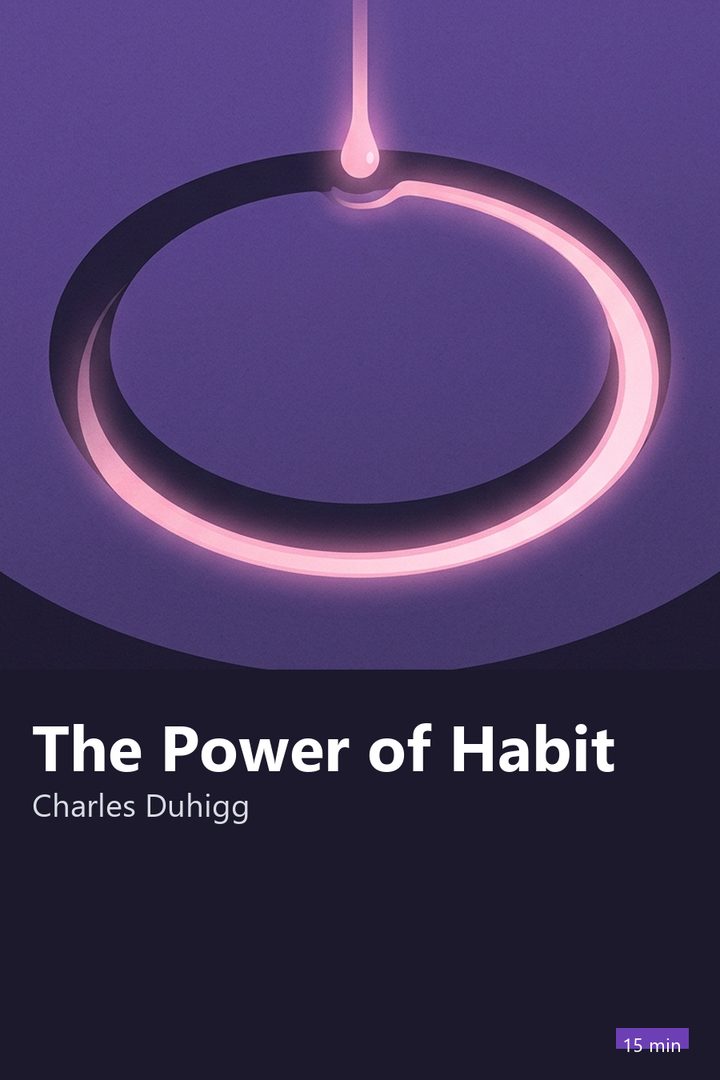
Cover of The Power of Habit

Habits and Discipline · 15 min

The Power of Habit

Charles Duhigg · 2012

Who it's for

For anyone who keeps repeating the same mistake in a loop (dieting, phone, procrastination) and is tired of blaming themselves for a lack of willpower.

Read it in the app

⚡ Free to download • 🎁 One full book free every day

🎧 Audio coming soon in the app

Narration for the English summaries is on its way. Meanwhile you can read the full summary in the app.

3 ideas to take with you

1

A habit isn't made of willpower, it's made of structure: a cue, a routine, and a reward locked into an automatic loop.

2

Swapping a habit works better than erasing it, because the brain keeps the old path forever.

3

A single well-chosen habit can pull a whole chain of other changes along with it, without you planning each one.

“
A habit isn't a character flaw, it's a loop of cue, routine, and reward etched into the brain.
An idea from The Power of Habit, in the words of 15 Minutes

Preview

Start reading now

Willpower was never the problem

Every time you fall off a diet or slip back into procrastinating, the easiest explanation is to say you lack discipline. Duhigg invites you to throw that explanation out. He shows, with neuroscience studies, that a good part of what you do every day doesn't go through the part of the brain that decides. It goes through the basal ganglia, an automatic region, almost an autopilot.

That changes the game: if the behavior is automatic, trying to beat it with conscious effort alone means fighting at a disadvantage. You're spending mental energy on a war that should be won with engineering, not suffering.

Think about how many times you've promised yourself "this time will be different" and, a few weeks later, ended up right back at the starting point. That isn't proof that you have less discipline than other people. It's proof that nobody beats an automatic system on promises alone.

The loop that runs without you noticing

The book describes a three-part circuit that repeats in every habit: a cue that triggers the behavior, the action itself, and a reward that locks it all into memory. Think about your own day: your phone buzzes (cue), you open Instagram (action), you feel that relief of distraction (reward). The next time the phone buzzes, your brain already expects that relief.

The twist is that, with repetition, the brain starts anticipating the reward as soon as it notices the cue, even before you act. That's why resisting a habit gives you that physical feeling of craving, almost a discomfort: your brain is already "collecting" the reward it promised itself.

Notice that the same cue can trigger different reactions in different people: the same boring stretch at work sends one person to a cigarette, another to coffee, another to social media. The cue matters less than the reward it has come to promise each of them.

Swapping is easier than erasing

Once a habit is formed, it leaves a practically permanent mark on the structure of the brain. That explains why, years after quitting smoking, the smell of a cigarette can still set off a craving. The good news is that you don't need to erase that mark to live differently. What you need is to give the same cue a new response that delivers a similar reward.

In practice: if you snack on sweets when you're bored at work, swapping the candy for a five-minute walk down the hallway can keep the same cue (boredom) and a similar reward (a break, movement), without fighting the whole circuit. You're remodeling the house, not demolishing it.

This also explains relapses in moments of stress: under pressure, the brain goes back to the most worn path, even after months of following the new route. The old mark is still there, waiting for an emergency to be used again.

12 more sections and the quiz

Continue in the app

Read the whole summary, finish with the The Power of Habit quiz and follow the guided Journeys. No ads in the app.

About Charles Duhigg

Charles Duhigg is an American journalist with a history degree from Yale and an MBA from Harvard. He spent years at the New York Times covering human behavior and business, and won a Pulitzer in 2013 for reporting on Apple's labor practices. After "The Power of Habit" he wrote other books on productivity and communication, always translating neuroscience research into the language of reporting.

Explore