15 Minutes
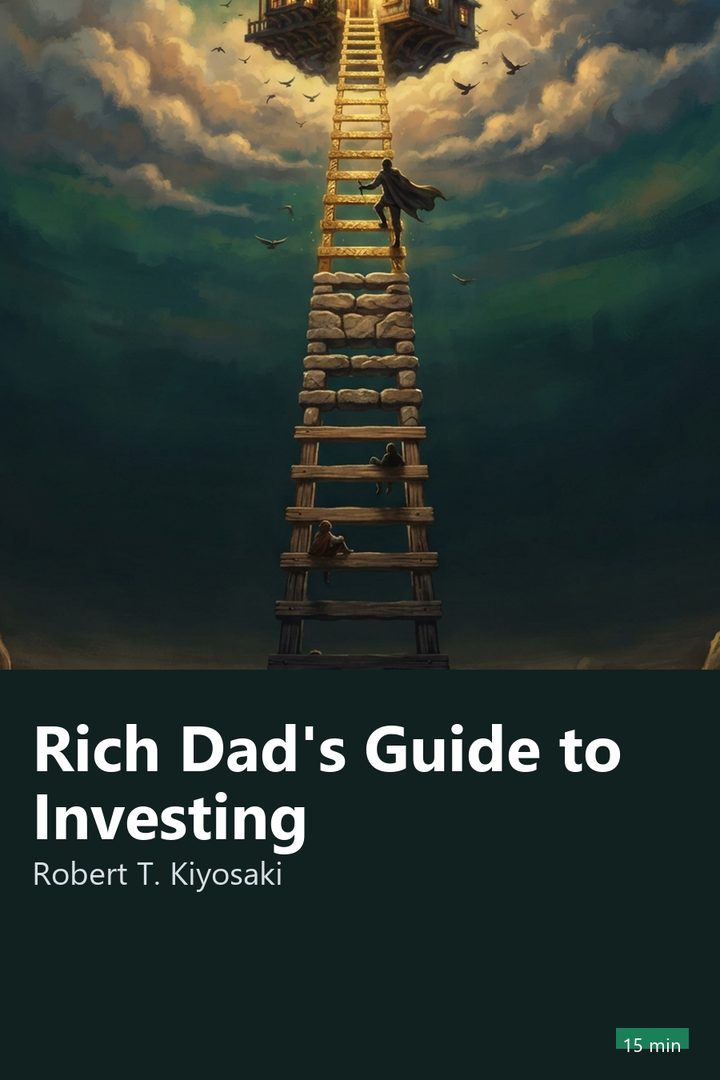
Cover of Rich Dad's Guide to Investing

Personal Finance · 15 min

Rich Dad's Guide to Investing

Robert T. Kiyosaki · 2000

Who it's for

For readers who already understand the difference between assets and liabilities and the four income quadrants from the earlier books, and want the next practical step: figuring out what level of investor you are today and what it takes to move up.

Read it in the app

⚡ Free to download • 🎁 One full book free every day

🎧 Audio coming soon in the app

Narration for the English summaries is on its way. Meanwhile you can read the full summary in the app.

3 ideas to take with you

1

Saving money is only the zero rung: someone who just saves is not an investor yet, and the book describes four more rungs before anyone becomes an owner of their own business.

2

People who build or buy part of a business before investing get inside information, while people who just buy stock are betting from the outside.

3

The author's plan to get rich through real estate bought with financing is his own personal bet, not a guaranteed formula for anyone who copies it.

“
The outside investor never enters the room where the company's decision was made, and only gets the summary afterward.
An idea from Rich Dad's Guide to Investing, in the words of 15 Minutes

Preview

Start reading now

The third book of the trilogy: from theory to becoming a real investor

After explaining the difference between people who work for money and people who make money work for them, and after detailing the four ways to earn income, the author devotes this third book to a practical question: how does someone get off the page and start actually investing? He assumes that anyone who made it this far has understood the logic of the first two books and wants the next step.

This volume is less about mindset and more about concrete rungs: what kind of investor you are today, what it takes to move up a level, and which legal, accounting and negotiation tools separate people who build a structure from people who just buy a paper asset on the stock market and hope for the best.

It is a more technical book and also a more personal one: the author recounts decisions from his own career as an investor, mostly in real estate, to illustrate each level of the ladder he describes. It's worth reading that account as one person's case study, not as a manual to be replicated point by point.


The levels of the investor, from zero to the top

The author organizes investors on a ladder of levels, starting with people who have nothing left over to invest, sometimes even owing more than they earn, and climbing up to those who create companies and assets that other people buy. In the middle of the ladder are people who only save, people who invest out of obligation, on the autopilot of a retirement plan, and people who study before they put money in.

The central idea is that nobody is born at a fixed level: you can climb rung by rung by studying, testing with a little money and correcting mistake by mistake. But climbing takes time and repetition, not just willpower: the author insists that each rung demands a new skill, not just more money.

The most useful point for beginners is simple: honestly figure out which rung you're on today, without comparing yourself to people who are further ahead. Someone who still can't make the monthly bills balance, for example, gains more from organizing a budget than from studying stocks.

A saver is not an investor: keeping money has a hidden cost

For Kiyosaki, saving is the most comfortable rung on the ladder and also the most deceptive: it looks like prudence, but idle money loses purchasing power over time, and people who only save rarely learn to make money grow on their own.

That doesn't mean throwing away your emergency fund, and the author doesn't go so far as to defend that: it means understanding that saving is only the first step, a pause before learning to invest, not the final destination of anyone's financial education.

It's worth noting that this criticism of the simple saver overlooks a real detail of everyday life: someone living on minimum wage who manages to set aside any amount at all is already making an enormous effort, and swapping that for risky investing with no cushion is exactly the kind of bet a certified professional would advise against.

11 more sections and the quiz

Continue in the app

Read the whole summary, finish with the Rich Dad's Guide to Investing quiz and follow the guided Journeys. No ads in the app.

About Robert T. Kiyosaki

Robert Kiyosaki was born in 1947 in Hawaii and served as a helicopter pilot in the U.S. Marine Corps during the Vietnam War. In 1997 he self-published Rich Dad Poor Dad, which became one of the biggest personal finance bestsellers in the world, followed in 1998 by Cashflow Quadrant. This third book in the series, released in 2000, goes deeper into how to move from theory to building a real investor structure. Kiyosaki also founded the Rich Dad Company, which sells books, games like Cashflow, and courses on financial education.

Explore

Part of the Journeys:
Investing From Scratch