15 Minutes
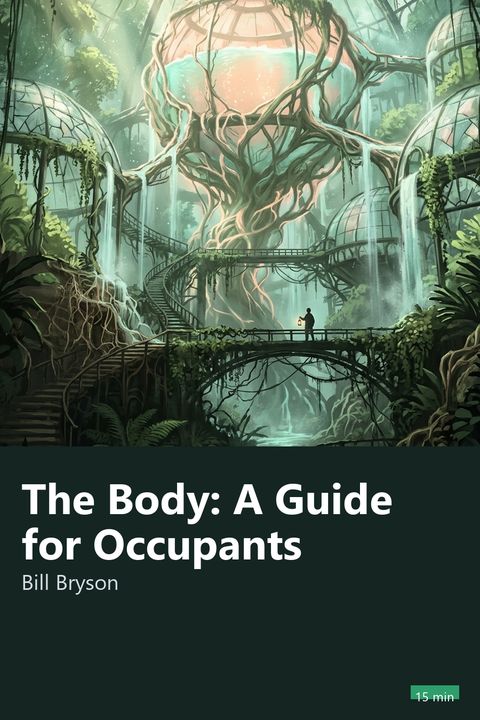
Cover of The Body: A Guide for Occupants

Health · 15 min

The Body: A Guide for Occupants

Bill Bryson · 2019

Who it's for

For anyone curious about their own body who wants a lighthearted, humorous tour of the skin, brain, heart, immune defenses, and nutrition. It is also for anyone who wants to separate what science knows from what is just a trend.

Read it in the app

⚡ Free to download • 🎁 One full book free every day

🎧 Listen to this summary in the app

Every summary has audio narration. Open the app to read it or listen to it.

3 ideas to take with you

1

The body's value lies less in its ingredients than in the quiet coordination among trillions of cells.

2

Every memory is reconstructed when you recall it, so writing down what matters is safer than relying on memory alone.

3

Physical inactivity does not hurt at first, so getting up and walking a little throughout the day is worthwhile before your body starts complaining.

“
Some of the dust collecting in your home is your own skin, renewed and shed.
An idea from The Body: A Guide for Occupants, in the words of 15 Minutes

Preview

Start reading now

A handbook of wonder, with humor

Bill Bryson is known for travel books and popular science written with a sense of humor. In The Body, he takes you on a guided tour of the human body without sounding like an anatomy lecture. The idea is simple: you have lived in this body since birth and know almost nothing about it.

The book covers skin, the brain, the heart, blood, the immune system, sleep, nutrition, cancer, birth, and death. Each chapter offers a surprising fact, a story about a researcher, and a reminder that science still has plenty of gaps.

For the reader, the effect is amazement at everything that happens without anyone asking. Your body is calculating, repairing, and defending itself at this very moment, while you read, and it asks very little of you.

What we are made of

The starting point is matter. We are made of a handful of common elements, primarily oxygen, carbon, hydrogen, and nitrogen, along with smaller amounts of calcium, phosphorus, and others. If someone tried to buy the body's ingredients at a store, the price would be surprisingly low.

The value, then, lies in the organization. Trillions of cells work together, each with specific functions, constantly exchanging signals. Without that coordination, the ingredients are still just ingredients.

The book also reminds us that, at the atomic level, we are made of material that has passed through other things and other lives. Nobody is made of exclusive matter: everything that makes up your body is recycled, and there is something both humbling and beautiful about that.

Skin: armor that renews itself

The skin is the body's largest organ and one of its most effective barriers against the world. It protects against bacteria, regulates temperature, senses touch, and keeps the body from losing water. It also constantly renews itself: dead cells fall away and new ones take their place.

Some of the dust that collects at home comes from this shedding, a fact that tends to be both unsettling and amusing. Anyone who has mopped the bedroom floor on a Sunday morning knows that the body is always leaving traces behind.

There is broad agreement on simple skin care: protect it from the sun, moisturize when necessary, and watch for moles and spots that change shape or color. Any lesion that grows, bleeds, or fails to heal deserves an evaluation by a dermatologist.

12 more sections and the quiz

Continue in the app

Read the whole summary, finish with the The Body: A Guide for Occupants quiz and follow the guided Journeys. No ads in the app.

About Bill Bryson

Bill Bryson was born in Des Moines, Iowa, in 1951 and has lived in the United Kingdom for decades. He became famous for humorous travel books and later turned to popular science. In A Short History of Nearly Everything, published in 2003, he explored science's big questions. The Body, published in 2019, follows a similar path.

Explore

Category:
Health