15 Minutes
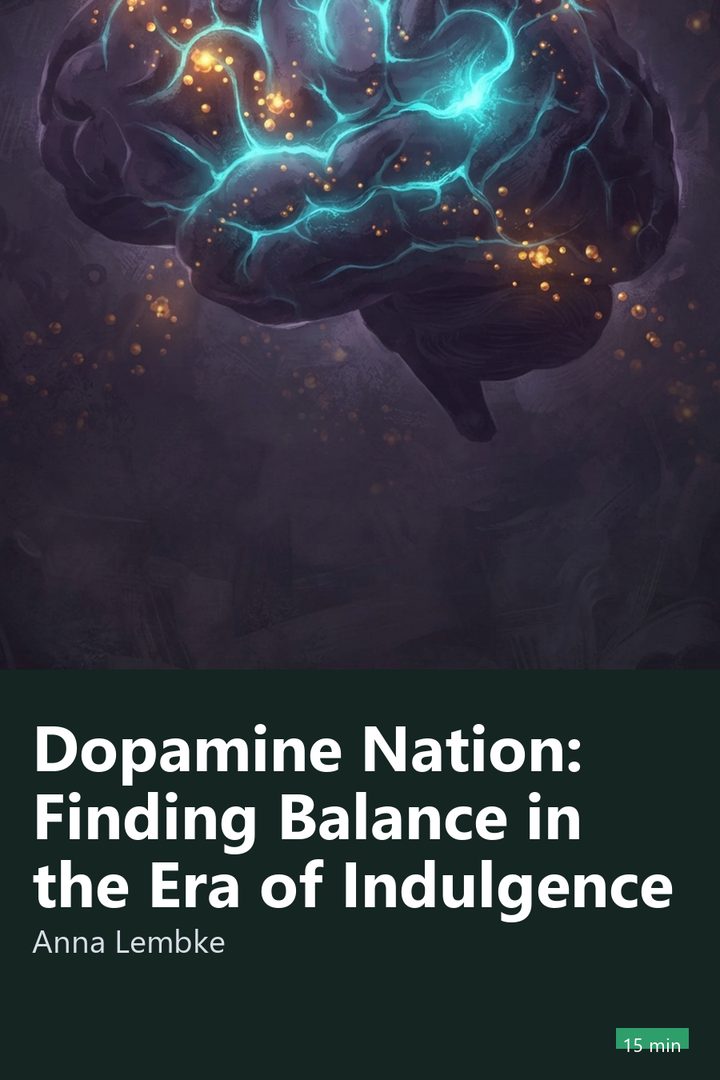
Cover of Dopamine Nation: Finding Balance in the Era of Indulgence

Mental Health · 15 min

Dopamine Nation: Finding Balance in the Era of Indulgence

Anna Lembke · 2021

Who it's for

For anyone who feels that their phone, drinking, food, or betting takes up too much room and wants to understand why it is so hard to stop. It is also for people who are close to someone in that situation and want to talk without judging.

Read it in the app

⚡ Free to download • 🎁 One full book free every day

🎧 Audio coming soon in the app

Narration for the English summaries is on its way. Meanwhile you can read the full summary in the app.

3 ideas to take with you

1

According to the author, the brain tries to balance every pleasure with a discomfort of equal size on the opposite side, which is why the same stimulus pays off less each time it is repeated.

2

According to the book, a chosen discomfort, like a hard workout, can leave the body calmer afterward.

3

A relapse works more as a clue than as a failure: it shows what was weighing on you that day.

“
When everything that gives pleasure fits in your pocket, the hard part stops being getting it and becomes stopping.
An idea from Dopamine Nation: Finding Balance in the Era of Indulgence, in the words of 15 Minutes

Preview

Start reading now

A seesaw inside your head

Picture a playground seesaw. Pleasure sits on one end, pain on the other. When you eat a brownie, watch a funny video, or get a nice notification on your phone, the seesaw tips toward pleasure. The central thesis of the book is that the brain can't stand to stay tilted for long: it rushes to put the seesaw back in the middle.

This automatic adjustment is called homeostasis, and it works like the thermostat at home. It gets too hot, the air conditioner kicks on. It gets cold, the heater comes on. The author, a psychiatrist who has treated people with addiction for many years, uses this image to explain why the same pleasure, repeated over and over, stops giving the same effect and starts charging a price.

Dopamine: the molecule of wanting

Dopamine is a neurotransmitter, meaning a substance that neurons use to talk to each other. It got a reputation as the pleasure molecule, but the book's more accurate reading is different: dopamine is more tied to wanting and chasing than to the enjoyment itself. It's what makes you open the app again, even when you can't remember what you were looking for.

The author explains, backed by research, that different experiences stir up dopamine at different intensities. A piece of chocolate gives a modest nudge. A cigarette gives a bigger one. Hard drugs deliver a huge jolt. The stronger and faster the peak, the greater the chance that the brain will react with a deep crash right afterward.

That's why the subject isn't limited to drugs. Anything that delivers a quick reward, from an episode of a TV drama to an online bet, is part of the same conversation.

A nation surrounded by triggers

The title says nation because, for the author, we all live in an entire country of stimuli. In the past, getting access to sugar, alcohol, pornography, or gambling took effort, money, and travel. Today pleasure fits in your pocket: the phone delivers social media, short videos, sports betting, and food delivery, all one tap away, at any hour.

Think about the routine of an ordinary American. You wake up and grab your phone before getting out of bed. On the bus, you scroll the feed. At lunch, you order a meal through an app. At night, one series after another, and maybe a bet on a football game, the kind the ads push all day long. None of this is a crime, but the sum creates an environment where the seesaw is always tilted.

For the author, abundance is the new problem. The brain evolved in a world of scarcity and wasn't designed for a pleasure storefront open twenty-four hours a day.

12 more sections and the quiz

Continue in the app

Read the whole summary, finish with the Dopamine Nation: Finding Balance in the Era of Indulgence quiz and follow the guided Journeys. No ads in the app.

About Anna Lembke

Anna Lembke is a psychiatrist and a professor of psychiatry and behavioral sciences at Stanford University in the United States. She directs the university's addiction medicine and dual diagnosis clinic and has treated patients with addiction for many years. Before Dopamine Nation, she published a book in 2016 about the prescription opioid crisis in the United States. The 2021 book made her known to the general public and was among the best sellers in the country.

Explore

Category:
Mental Health
Part of the Journeys:
Brain and Emotion in Practice