15 Minutes
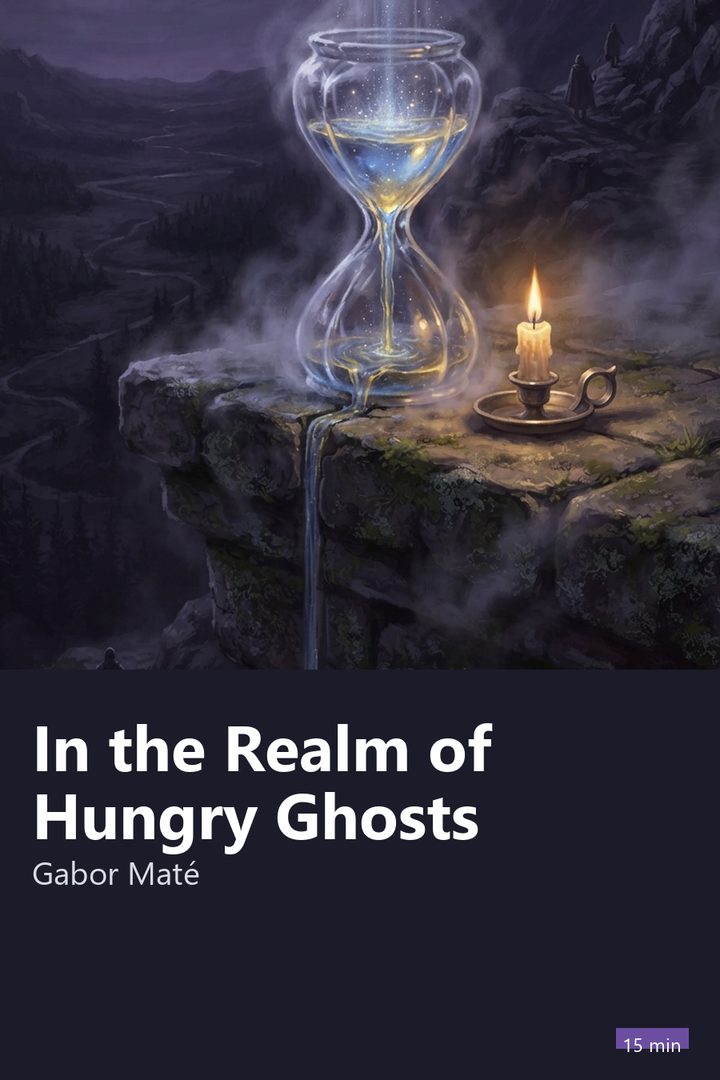
Cover of In the Realm of Hungry Ghosts

Mental Health · 16 min

In the Realm of Hungry Ghosts

Gabor Maté · 2008

Who it's for

For anyone who wants to understand addiction, their own or a loved one's, without falling for the easy line that it's just a matter of willpower. It's also useful for people who work in health care, social services, or education and deal with this issue up close.

Read it in the app

⚡ Free to download • 🎁 One full book free every day

🎧 Audio coming soon in the app

Narration for the English summaries is on its way. Meanwhile you can read the full summary in the app.

3 ideas to take with you

1

For Maté, addiction looks like the hungry ghost of Buddhist tradition: a hunger so big that no amount of a substance can truly satisfy it, because the emptiness it tries to fill isn't in the stomach.

2

According to the author, treating addiction as a character flaw ignores the role the substance plays: it doesn't show up in spite of the person's pain, it shows up precisely to relieve that pain.

3

According to the book, the way out of addiction depends more on self-examination and self-compassion than on shame or punishment, because shame tends to be one of the very feelings the substance was already numbing.

“
For Maté, the care missing in childhood leaves a mark on the brain long before the child can explain what they felt.
An idea from In the Realm of Hungry Ghosts, in the words of 15 Minutes

Preview

Start reading now

A doctor on the worst street in the country

Gabor Maté spent more than a decade as a general practitioner at the Portland Hotel Society, a clinic and housing complex in Vancouver's Downtown Eastside, one of the neighborhoods with the highest concentration of addiction, extreme poverty, and mental illness in all of North America. His patients lived in tiny rooms, many without steady work for years, getting by on public benefits or odd jobs, and they carried decades of accumulated suffering before they ever touched a drug for the first time.

The book was born in that exam room, not in a library. Maté describes the daily routines of care, bodies marked by infection and overdose, and a medical team that learned, the hard way, that shouting 'just stop using' never worked on anyone there. He doesn't name real patients in any identifiable way, but he draws on the pattern of stories he saw repeated every day to build the book's argument.

It's important to understand this starting point: the whole book is written in the first person by someone who examined, prescribed, and often failed to help. It isn't armchair theory, it's the account of someone who worked for years on one of the toughest streets on the continent.
The question that changes the whole problem

Most of society asks why someone uses drugs. Maté proposes a different question: why does this person carry such a huge pain that they needed chemical relief just to get through the day? The switch seems subtle, but it changes everything: moving from 'what's wrong with this person' to 'what happened to this person.'

This change of question takes the focus off the drug itself and puts it on the life experience of the person using. For Maté, the substance isn't the original cause of the problem, it's an imperfect and destructive attempt to solve a problem that already existed: an emotional pain the person had no other way to relieve.

That doesn't mean excusing anyone from responsibility for their own choices. The book is clear that recovery requires the person to take an active role in their own treatment. The point is that understanding the source of the pain completely changes the kind of help that makes sense to offer.

Hungry ghosts: the hunger nothing satisfies

The book's title comes from a figure in Buddhist cosmology: the hungry ghost, portrayed with a huge belly and a throat as thin as a hair, condemned to a hunger that is never satisfied no matter how much it eats. Maté uses this image as the central metaphor for addiction: a compulsion to look for something outside yourself, again and again, hoping to fill an emptiness that the substance itself can never truly fill.

The metaphor works because it describes exactly the clinical pattern he saw in the clinic: the relief from a dose lasts minutes or hours, the pain returns, and the person has to repeat the cycle. It isn't a lack of willingness to stop eating, it's that the throat is too thin for any amount of food to really satisfy that particular hunger.

Maté extends this same image beyond hard drugs: compulsive shopping, gambling, food, overwork, all of it can take the form of a hungry ghost when it becomes a repeated attempt to fill an emotional emptiness that the activity itself never fully resolves.

10 more sections and the quiz

Continue in the app

Read the whole summary, finish with the In the Realm of Hungry Ghosts quiz and follow the guided Journeys. No ads in the app.

About Gabor Maté

Gabor Maté was born in Budapest, Hungary, in 1944, survived the Nazi persecution of Jews as a baby, and emigrated to Canada with his family in the late 1950s. He trained as a physician and worked for more than a decade as a general practitioner at the Portland Hotel Society, in Vancouver's Downtown Eastside neighborhood, treating residents with severe substance dependence. He is the author of other books on health, stress, and trauma, including When the Body Says No and The Myth of Normal, the latter written with his son Daniel Maté. Today he is one of the most widely cited voices in the world on the link between life experience and physical and mental health.

Explore

Category:
Mental Health
Part of the Journeys:
Take Care of Your Mind