15 Minutes
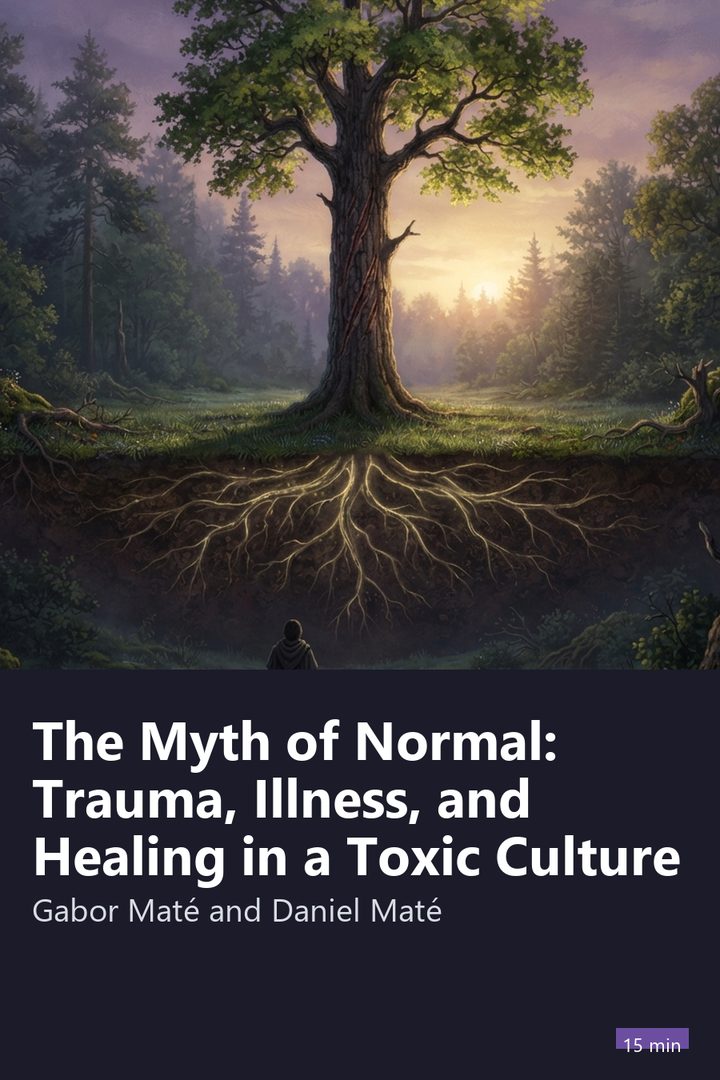
Cover of The Myth of Normal: Trauma, Illness, and Healing in a Toxic Culture

Mental Health · 16 min

The Myth of Normal: Trauma, Illness, and Healing in a Toxic Culture

Gabor Maté and Daniel Maté · 2022

Who it's for

Original title (Portuguese): O Mito do Normal: Trauma, Saúde e Cura em um Mundo Doente. This is for anyone who feels like they're just stressed but suspects there's something deeper underneath, and who wants to understand why so many people get sick in the same ways in a culture that looks down on rest and genuine emotion. It's also for anyone who has heard about trauma and wants a broader, less dramatic explanation than just something terrible that happened.

Read it in the app

⚡ Free to download • 🎁 One full book free every day

🎧 Audio coming soon in the app

Narration for the English summaries is on its way. Meanwhile you can read the full summary in the app.

3 ideas to take with you

1

For Maté, what marks a person is not exactly what happened to them as a child, but what stayed locked inside because they had no one to process it with.

2

For Maté, traits like putting other people's needs ahead of your own and avoiding expressing anger can take a toll on the body over time, though this specific link is still debated among researchers.

3

Recovering the sense of having a choice about your own life, what Maté calls agency, is for him an important part of healing, alongside medical treatment and never in place of it.

“
A culture can get so used to tired, anxious people that it starts calling that normal, instead of asking what is making everyone sick at the same time.
An idea from The Myth of Normal: Trauma, Illness, and Healing in a Toxic Culture, in the words of 15 Minutes

Preview

Start reading now

What normal means in a sick culture

Maté opens the book with a provocation: part of what we call normal, the chronic exhaustion, the anxiety that has become routine, the rates of autoimmune disease climbing year after year, is not a sign of health. It's a sign of a culture that makes people sick and then treats the symptom as if it were purely individual. He calls this culture toxic, not because it contains literal poison, but because it promotes disconnection: from our own emotions, our own bodies, other people, and rest.

The central thesis is that the rise in chronic disease, addiction, obesity, and depression in wealthy countries won't be reversed by treating each case in isolation, without asking what in the environment keeps producing sick people. For Maté, asking only why one person got sick, without asking what in this culture demands the price of illness, is treating the symptom and ignoring the cause.

That doesn't mean he dismisses biology or genetics. It means he insists on adding a third factor, rarely discussed in a fifteen-minute doctor's appointment: the social, economic, and emotional environment a person has lived in since childhood.

Gabor Maté's own childhood becomes the lens for the whole book

Maté was born in Budapest in 1944, a Jewish baby in a city occupied by the Nazis. He says he spent the first months of his life absorbing his mother's fear through his body in that context, before he even had words to name anything. This personal experience is the thread running through the whole book: for him, a baby doesn't need to understand danger to be marked by it.

From this story, and from decades as a family doctor and working with people struggling with addiction in Vancouver, Maté builds the book's central argument: experience in the earliest years of life shapes the nervous system, and that mold stays active decades later, even when the adult consciously remembers nothing.

Trauma with a capital T and trauma with a lowercase t

One of the most cited distinctions in the book separates two kinds of trauma. Trauma with a capital T is the obvious event: abuse, a serious accident, catastrophic loss, war. Trauma with a lowercase t is quieter: not being seen by your parents when you needed it, growing up in a tense house with no yelling or slapping, learning early that feeling too much bothered everyone around you.

For Maté, both kinds leave a mark, and the second often goes unnoticed precisely because nobody points to a culprit or an exact day it happened. It's the accumulation of small absences that quietly builds a kind of wound similar to what a single violent event also leaves.

A common example: a child who learned, without anyone ever saying it out loud, that crying too much irritated a tired mother. There was no yelling or violence, just a subtle pulling away every time the child showed strong feeling. Years later, as an adult, that person may have trouble naming their own sadness, without remembering any specific event that explains it.

12 more sections and the quiz

Continue in the app

Read the whole summary, finish with the The Myth of Normal: Trauma, Illness, and Healing in a Toxic Culture quiz and follow the guided Journeys. No ads in the app.

About Gabor Maté and Daniel Maté

Gabor Maté is a Canadian physician born in Budapest, Hungary, in 1944, as an infant during the Nazi occupation of the country. As a family doctor, he worked for years with people struggling with severe addiction in Vancouver, Canada. He is the author of other books on the same theme, including In the Realm of Hungry Ghosts and When the Body Says No. The Myth of Normal, from 2022, was written together with his son, Daniel Maté.

Explore

Category:
Mental Health
Part of the Journeys:
Take Care of Your Mind