15 Minutes
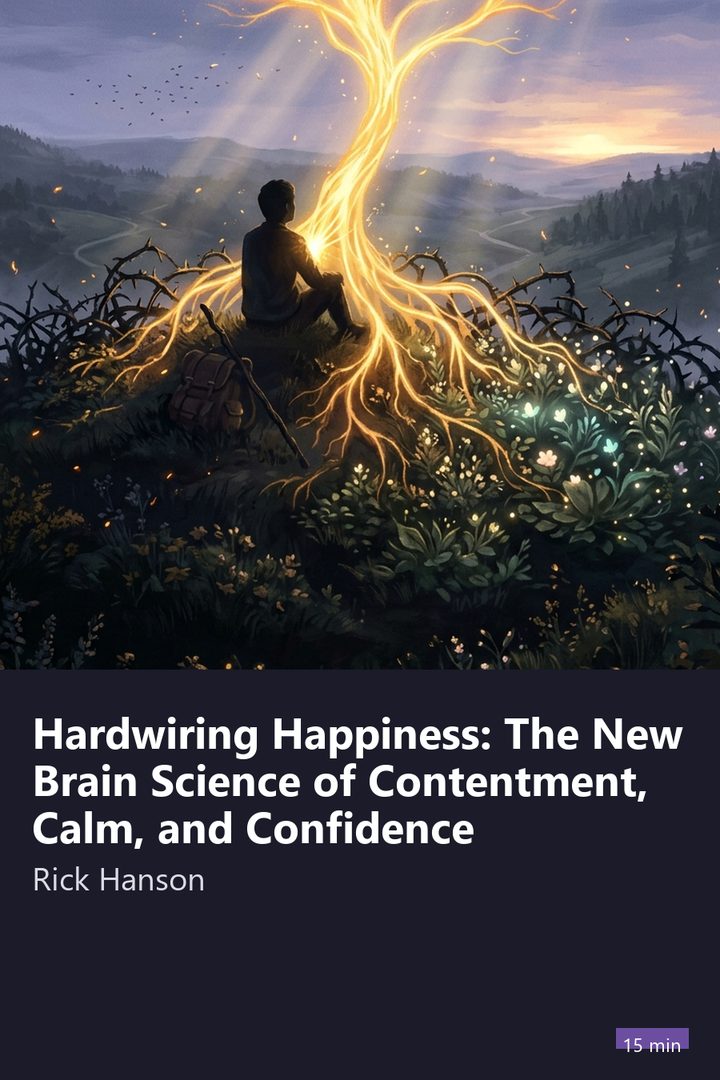
Cover of Hardwiring Happiness: The New Brain Science of Contentment, Calm, and Confidence

Psychology · 15 min

Hardwiring Happiness: The New Brain Science of Contentment, Calm, and Confidence

Rick Hanson · 2013

Who it's for

For people who feel constantly overwhelmed by self-critical thoughts, ruminate on past hurts, and are looking for a practical, neuroscience-based method to cultivate inner peace.

Read it in the app

⚡ Free to download • 🎁 One full book free every day

🎧 Audio coming soon in the app

Narration for the English summaries is on its way. Meanwhile you can read the full summary in the app.

3 ideas to take with you

1

The human brain was shaped by evolution to act like Velcro for bad experiences and Teflon for good ones.

2

Neuroplasticity makes it possible to turn fleeting positive mental states into lasting neural traits through sustained attention.

3

Cultivating a sense of safety, satisfaction, and connection is the most solid way to disarm primitive circuits of stress and anxiety.

“
The brain evolved to prioritize physical survival, accumulating fears from the past unless we learn to deliberately take in the good.
An idea from Hardwiring Happiness: The New Brain Science of Contentment, Calm, and Confidence, in the words of 15 Minutes

Preview

Start reading now

The negativity bias inherited from our ancestors

Most people have had the unsettling experience of receiving ten warm compliments at work and a single bitter criticism from a coworker, only to lie awake all night dwelling exclusively on the harsh words of that one critique. No matter how hard we try to focus on everyday wins, our minds seem magnetically drawn to problems, threats, and flaws.

Neuropsychologist Rick Hanson explains that this tendency is neither a character flaw nor a personal psychological weakness, but the direct result of natural selection. The brains of our ancestors on the Paleolithic savannas had to deal with two fundamental types of stimuli: carrots, which represented vital rewards like food, shelter, and mates, and sticks, which represented mortal dangers like hungry predators and violent enemies.

If a hunter missed out on a carrot, he went hungry, but he would get another chance to eat the next day; however, if he ignored the sound of a stick snapping in the grass and got attacked by a predator, he lost his life. Evolution therefore shaped the human brain with a powerful negativity bias: we were designed by nature to overestimate danger and overlook the good things in life in order to ensure immediate physical survival.


Velcro for the bad and Teflon for the good

To describe the biological impact of this evolutionary bias on modern daily life, Hanson created a memorable metaphor: the human brain works like Velcro for negative experiences and like Teflon for positive ones.

Unpleasant events, traffic frustrations, romantic rejections, and verbal slights are instantly registered in the brain's amygdala, triggering emotional memory with alarming ease and sticking to our psyche like strips of heavy-duty Velcro. By contrast, peaceful moments of family affection, the aroma of fresh coffee, or a beautiful sunset slide right through the mind without leaving a lasting trace, like water rolling off a nonstick Teflon pan.

This biological asymmetry explains why so many people feel chronically anxious and dissatisfied, even when their material lives are comfortable and stable. Unless we actively intervene in where we place our attention, the brain will keep piling up memories of danger and scarcity, feeding a permanent sense of inner vulnerability.

Self-directed neuroplasticity and Hebb's Law

The good news from contemporary neuroscience is that the physical structure of the adult brain is neither fixed nor unchangeable. Thanks to the phenomenon of neuroplasticity, neural tissue is constantly remodeling itself, altering its synaptic connections in response to the thoughts, emotions, and stimuli to which we frequently pay attention.

Hanson bases his work on the famous principle formulated by neuropsychologist Donald Hebb in nineteen forty-nine, summed up in the aphorism: neurons that fire together wire together. This means that every time we allow our minds to linger in a state of anger, resentment, or obsessive worry, we physically reinforce the neural highways that make it easier for those bad states to return in the future.

On the other hand, when we deliberately sustain our attention on feelings of gratitude, safety, and generosity, we stimulate new circuits of calm and resilience. The author calls this conscious practice of reshaping one's own mind self-directed neuroplasticity: using the mind to change the brain, and through the brain, transforming your own life.

10 more sections and the quiz

Continue in the app

Read the whole summary, finish with the Hardwiring Happiness: The New Brain Science of Contentment, Calm, and Confidence quiz and follow the guided Journeys. No ads in the app.

About Rick Hanson

Rick Hanson is a clinical neuropsychologist, a Senior Fellow at the Greater Good Science Center at the University of California, Berkeley, and an international bestselling author. He graduated with honors from UCLA and has spent decades counseling families and organizational leaders. His books, including Buddha's Brain, have been translated into more than thirty languages and blend modern neuroscience with mindfulness practices. He is the founder of the Wellspring Institute for Neuroscience and Contemplative Wisdom and has spoken at NASA and the University of Oxford.

Explore

Category:
Psychology
Part of the Journeys:
Journey Through the Brain