15 Minutes
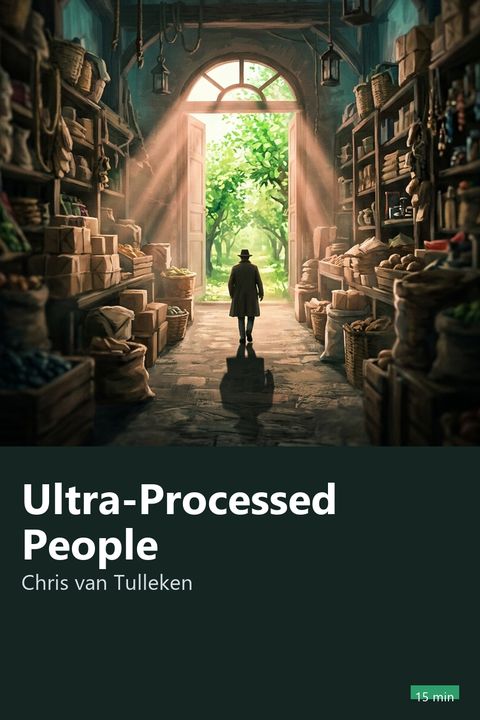
Cover of Ultra-Processed People

Health · 15 min

Ultra-Processed People

Chris van Tulleken · 2023

Who it's for

For anyone who lives on snacks and packaged food, feels hungry all the time, and wants to understand what's behind it. It's also for parents who want to make better choices about the food they bring home.

Read it in the app

⚡ Free to download • 🎁 One full book free every day

🎧 Listen to this summary in the app

Every summary has audio narration. Open the app to read it or listen to it.

3 ideas to take with you

1

The controlled study cited in the book suggests that how food is produced can lead people to eat more, even when its nutrients are similar.

2

According to the NOVA classification, the degree of industrial processing matters as much as the nutrient list when evaluating a food.

3

The science on ultra-processed foods still has gaps, and the book calls for caution without demanding dietary purity.

“
Eating soft, ready-to-eat food quickly gives your body less time to tell you it's had enough.
An idea from Ultra-Processed People, in the words of 15 Minutes

Preview

Start reading now

A Doctor Who Became His Own Food Guinea Pig

Ultra-Processed People grew out of a concern that troubled British physician and presenter Chris van Tulleken. An infectious disease specialist, he spent years talking about health while eating like many other people: packaged bread, breakfast cereal, chips, sweetened yogurt, and soda. The book describes what happened when he decided to investigate what he was really eating.

His central argument is that the problem with modern diets isn't just calories, fat, or sugar, but the degree of industrial processing. Ultra-processed foods, he argues, are products formulated to be cheap, long-lasting, tasty, and easy to eat in large quantities. Many no longer even resemble the foods they came from.

The tone blends reporting, science, and personal experimentation. The author interviews researchers, visits factories, and talks to people in the industry. The result is a warning delivered with plenty of humor, but with a serious question at its heart: who benefits from the way we eat today?

What the Book Means by Ultra-Processed

The definition comes from the NOVA classification, developed by researchers at the University of São Paulo led by Carlos Monteiro. It divides foods into four groups: unprocessed or minimally processed foods, such as fruit, rice, beans, and meat; culinary ingredients, such as oil, salt, and sugar; processed foods, such as cheese and basic bread; and ultra-processed foods.

That last group includes products made with many ingredients you wouldn't find in your kitchen, such as emulsifiers, flavorings, colors, flavor enhancers, and specialized syrups. The idea is that these items are assembled in factories from substances that have been extracted and modified, then combined into ready-to-eat products.

One simple tip the author repeats is to check the ingredient list. If you see words that sound like they belong in a laboratory and ingredients nobody would use in a home kitchen, there's a good chance the product is ultra-processed. Soda, chips, sandwich cookies, instant noodles, and chicken nuggets are common examples.

The Monthlong Experiment

To experience the effects firsthand, the author spent a month getting about eighty percent of his calories from ultra-processed foods, a proportion similar to that of many British teenagers. Before and afterward, he underwent tests, measurements, and assessments, including evaluations of his brain and hormones.

He reports weight gain, changes in how his body functioned, and shifts in his mood and sleep. He also describes persistent hunger, even after eating a lot, and difficulty stopping. It's a personal account without rigorous scientific controls, but it illustrates his point in concrete terms.

The author himself acknowledges that an experiment involving just one person proves nothing on its own. It serves as an entry point, and the rest of the book presents more robust studies to give the experience scientific grounding.

10 more sections and the quiz

Continue in the app

Read the whole summary, finish with the Ultra-Processed People quiz and follow the guided Journeys. No ads in the app.

About Chris van Tulleken

Chris van Tulleken is an infectious disease physician who works at University College London in the United Kingdom. He is also a television and radio presenter and has worked on documentaries about health and food. He is the twin brother of physician and presenter Alexander van Tulleken, known as Xand. Ultra-Processed People, published in 2023, is his best-known book.

Explore

Category:
Health