15 Minutes
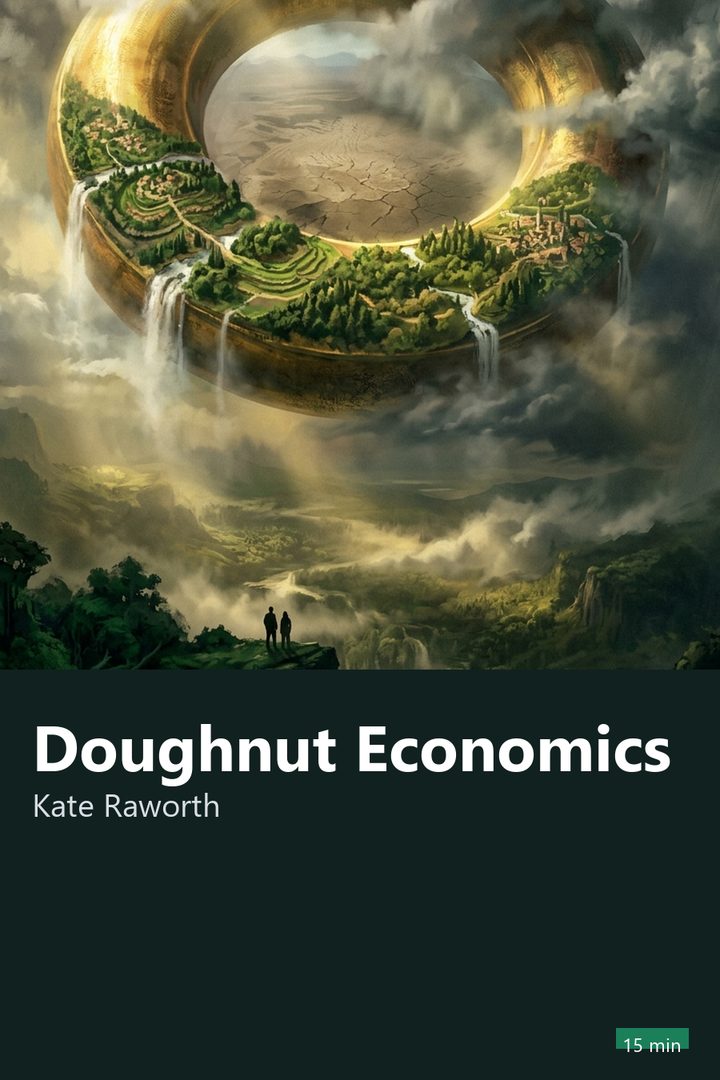
Cover of Doughnut Economics

Economy and Society · 18 min

Doughnut Economics

Kate Raworth · 2017

Who it's for

For anyone who wants to understand how economics, inequality, and the environment connect to the choices made by governments, companies, and households. It is not an investment guide or a personal finance manual.

Read it in the app

⚡ Free to download • 🎁 One full book free every day

🎧 Audio coming soon in the app

Narration for the English summaries is on its way. Meanwhile you can read the full summary in the app.

3 ideas to take with you

1

When an indicator becomes the destination, whatever it fails to measure can end up treated as if it has no value.

2

Inequality begins before a paycheck is issued: it also lives in the rules that distribute wealth, opportunities, and power.

3

A purpose becomes more reliable when an organization's rules protect it from the pressure for immediate results.

“
A dignified life requires both a social floor and a planet capable of sustaining it.
An idea from Doughnut Economics, in the words of 15 Minutes

Preview

Start reading now

1. An economy that needs to change its destination

Imagine a city where retail sales are climbing, yet rising rents push residents out, traffic eats up hours of the day, and raw sewage flows into the river. By traditional accounting, part of that activity might look like progress. Kate Raworth begins by questioning this link: producing and spending more does not guarantee that people are actually living better.

The book proposes changing the central question of economics. Instead of pursuing ever-increasing output alone, we should examine how to ensure dignified lives within the conditions the planet can sustain. This shift may sound abstract, yet it shapes decisions about transportation, housing, energy, employment, and the distribution of available public resources.

Raworth organizes her proposal into seven shifts in thinking rather than a single recipe for government. She revisits the images, assumptions, and goals that guide economic debate. For everyday readers, the opening challenge is concrete: a society can move vast sums of money while leaving basic needs without an adequate response.

2. The diagram that brings dignity and limits together

The doughnut represents a space between two concentric rings. The inner ring marks the social foundation, made up of essentials such as food, health, education, housing, and political voice. Anyone in the central hole faces deprivation. The goal is to lift people out of that void, not simply to expand the size of measured economic activity.

The outer ring corresponds to the ecological ceiling. Going beyond it means putting pressure on the natural processes we depend on, such as climate stability and the integrity of ecosystems. Between the two rings lies the safe and just space: an image for combining human well-being with respect for the environmental conditions that sustain life.

Think of a family that needs adequate housing while living in a city that is sprawling into protected natural areas. The answer should not be a choice between social neglect and environmental destruction. The diagram encourages joint solutions, such as renovating vacant buildings, upgrading infrastructure, and planning neighborhoods connected to public transit.

3. When the indicator becomes the goal itself

Gross Domestic Product, known as GDP, measures the value of final goods and services produced in an economy over a given period. It is useful for tracking economic activity, yet it was never designed to sum up overall quality of life. Income distribution, family caregiving, and environmental degradation require other measures.

A traffic accident can generate spending on vehicle repairs, medical care, and legal services. Those activities enter the production accounts even though the event represents suffering and loss. That does not make GDP useless. It simply shows why turning an indicator of activity into the primary portrait of collective success produces major distortions.

Raworth recommends replacing the obsession with an endlessly rising curve with a set of social and environmental goals. A city government could track commute times, access to clean water and sanitation, and air quality alongside tax revenue. The point is not to abandon numbers, but to choose numbers that better reveal where policies are taking us.

11 more sections and the quiz

Continue in the app

Read the whole summary, finish with the Doughnut Economics quiz and follow the guided Journeys. No ads in the app.

About Kate Raworth

Kate Raworth is a British economist educated at the University of Oxford. She has worked for the United Nations Development Programme and for the organization Oxfam. She first introduced the doughnut model in an Oxfam paper published in 2012, before developing her ideas in this 2017 book. She is the co-founder of the Doughnut Economics Action Lab, an organization that supports the practical application of this approach.

Explore

Part of the Journeys:
Understand the Economy