15 Minutes
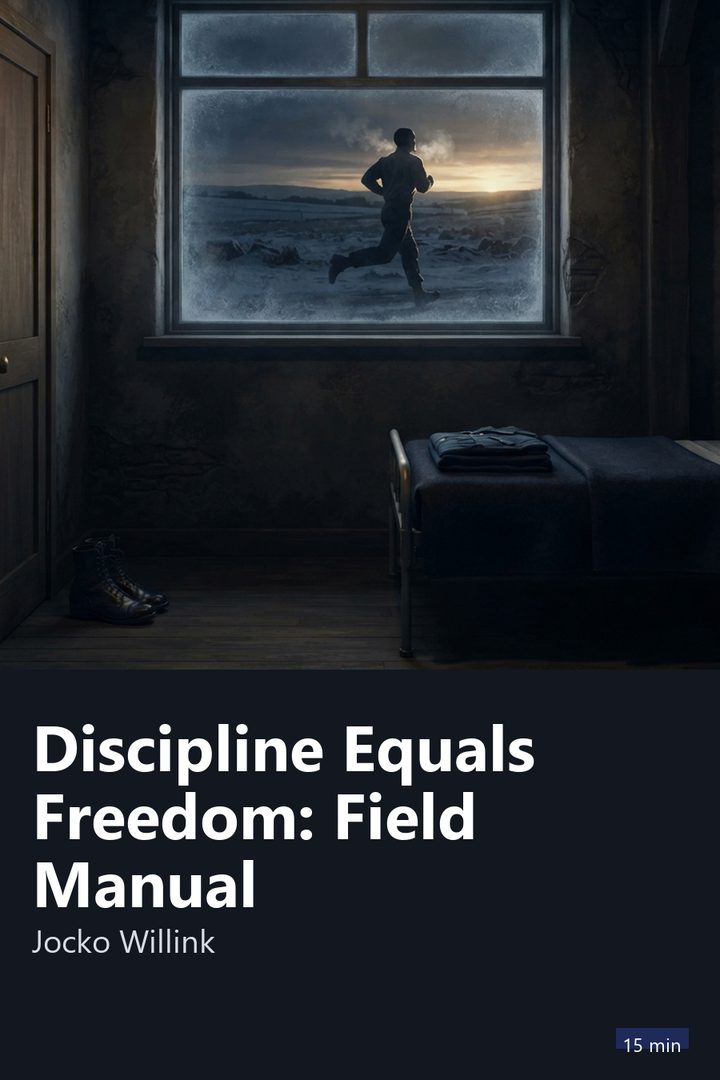
Cover of Discipline Equals Freedom: Field Manual

Habits and Discipline · 15 min

Discipline Equals Freedom: Field Manual

Jocko Willink · 2017

Who it's for

For you if you know what you need to do but keep waiting for the motivation to show up before you start. Discipline Equals Freedom is a short, direct push for anyone who wants to swap the excuse of motivation for a routine that doesn't depend on the mood of the day.

Read it in the app

⚡ Free to download • 🎁 One full book free every day

🎧 Audio coming soon in the app

Narration for the English summaries is on its way. Meanwhile you can read the full summary in the app.

3 ideas to take with you

1

The voice that suggests making an exception just this once is, for the book, the most common adversary inside any discipline routine.

2

For Willink, training the body matters less for looks and more for proving, every single day, that the word you give yourself carries weight.

3

For Willink, freezing up on a decision under pressure steals more time than accepting the risk of getting it wrong fast and correcting later.

“
In Willink's logic, setting aside part of your paycheck before spending it looks like a limitation, but that restriction is what buys you breathing room at the end of the month.
An idea from Discipline Equals Freedom: Field Manual, in the words of 15 Minutes

Preview

Start reading now

A field manual, not a book of theory

The book is a field manual even in its format: short blocks of text, almost no transitions, interspersed with black-and-white photos of the author training or standing at 4:30 in the morning. There is no long chapter with a case study, and that economy is deliberate: the sentence has to stick in your head like a command, not persuade you with academic argument.

The structure is split into two parts: mindset and action. In the first, Willink deals with discipline, fear, weakness and the difference between motivation and discipline. In the second, he moves down into concrete routine: physical training, eating and sleep, always coming back to the same idea in the title.

The cadence of the short sentences is not decoration, it is the method itself demonstrated on paper: a book about repeating the same behavior every day chooses to repeat the same sentence structure all the time.
The central idea: discipline is freedom

The phrase that gives the book its name sounds like a contradiction: how can something that limits, discipline, produce the opposite, freedom? The book's answer is that every freedom worth having comes from a restriction accepted beforehand. Someone who has never trained doesn't have the freedom to run after the bus without getting winded. Someone who has never saved money doesn't have the freedom to change jobs without panic at the end of the month.

The opposite holds too: doing only what you feel like in the moment looks like freedom, but it traps you. Spending your whole paycheck as soon as it lands in your account feels light that day, but it closes the door on any choice two weeks from now.

Discipline is not the opposite of freedom, it is the price of admission to it. The book repeats this same idea dozens of times in a different form each time, betting that repetition hammers harder than a single explanation.

Waking up before the world: the 4:30 ritual

One of the most repeated symbols in the book is the clock showing four thirty in the morning. Willink built part of his public image on it, posting nearly every day a photo of his wrist showing the time he woke up, as proof that the commitment was kept before any excuse could appear.

The logic isn't the time itself, it's winning the first decision of the day against your own inertia. Hitting the snooze button is already a small surrender, a first sign of lethargy that tends to open the door to a bigger surrender later on.

What matters is not the exact time on the clock, it's the principle behind it: whoever decides how the day starts takes that slice of time out of the hands of any unexpected event. I'll come back to this ritual later, because it's where the book charges a price that not every reader can pay.

12 more sections and the quiz

Continue in the app

Read the whole summary, finish with the Discipline Equals Freedom: Field Manual quiz and follow the guided Journeys. No ads in the app.

About Jocko Willink

Jocko Willink is a former Navy SEAL officer, part of the special operations force of the United States Navy. He commanded Task Unit Bruiser in the Battle of Ramadi, in Iraq, in 2006, one of the most intense episodes of urban combat in the war. After leaving the armed forces, he became the co-author of the book Extreme Ownership, alongside Leif Babin, and began hosting a hugely popular podcast about discipline, war and leadership.

Explore

Part of the Journeys:
Discipline in Practice