15 Minutes
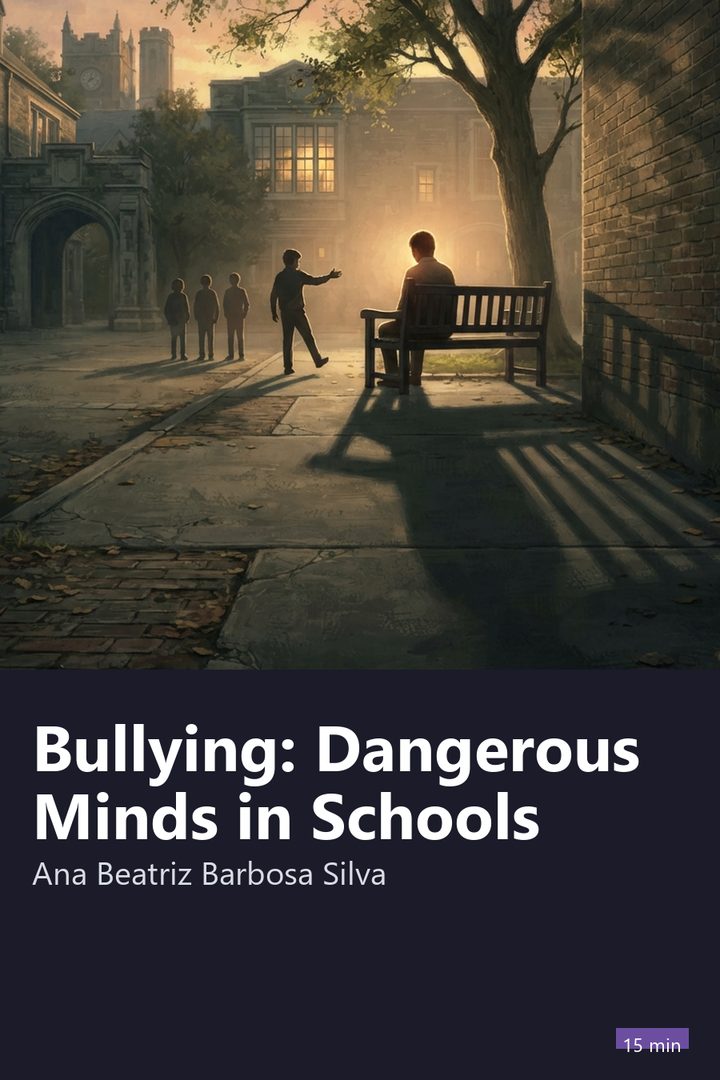
Cover of Bullying: Dangerous Minds in Schools

Family and Parenting · 16 min

Bullying: Dangerous Minds in Schools

Ana Beatriz Barbosa Silva · 2010

Who it's for

Original title (Portuguese): Bullying: Mentes Perigosas nas Escolas. For parents, teachers, and school administrators who want to recognize bullying, tell it apart from everyday fights between kids, and know how to step in. It is also useful for anyone who was bullied or bullied others in school and wants to make sense of what happened.

Read it in the app

⚡ Free to download • 🎁 One full book free every day

🎧 Audio coming soon in the app

Narration for the English summaries is on its way. Meanwhile you can read the full summary in the app.

3 ideas to take with you

1

Bullying is not just kids being kids: it is repeated aggression in which one side cannot defend itself, and brushing it off leaves scars.

2

Those who watch in silence are also part of the scene, and the group's complicity fuels the aggressor.

3

For the author, labels like psychopath demand great care, because a growing child changes, and a label can become a life sentence.

“
Whoever laughs at a cruel joke hands the aggressor an audience, and whoever walks away takes away the stage.
An idea from Bullying: Dangerous Minds in Schools, in the words of 15 Minutes

Preview

Start reading now

Bullying is not just kids playing around

The author begins by pinning down the concept. Bullying is a set of aggressive, intentional, and repeated behaviors carried out by one or more people against another, for no clear reason, within a relationship where one side holds more power than the other. The word comes from the English noun bully, meaning a tough or intimidating person.

This definition separates bullying from an isolated fight between classmates of similar strength. If two boys argue at recess and make up when the bell rings, that is not bullying. If a cruel nickname follows a girl around for months and she cannot push back, it is. In many schools, that boundary is ignored, and the child ends up being told that it is just part of growing up.

That is why the author insists that three ingredients must show up together: repetition, intention to hurt, and an imbalance of power. Without them, ordinary mediation is enough; with them, the school needs organized action.

The many forms of aggression

The book lists several distinct forms. There is verbal bullying, with nicknames, insults, and threats. There is physical bullying, with shoves, punches, slaps, and the destruction of personal belongings. There is psychological and moral bullying, built out of exclusion, gossip, humiliation, and isolation. There is sexual bullying, involving harassment and abuse, and cyberbullying, carried out online and over cell phones. Each type calls for its own response, and the author notes that several can happen at the same time to the same student.

Many of these attacks leave no mark on the body, and that is where carelessness and denial take root. Quietly shutting a child out of a circle of friends can hurt more than a shove and go completely unnoticed by adults. This category includes nicknames that stick, cliques that freeze someone out, and teachers who pretend not to hear.

The author points out that girls tend to use indirect aggression more often, such as rumors and isolation, while boys lean more toward physical force, although there is plenty of variation from case to case.

Who is who in the scene

The book maps out the roles. The perpetrator or aggressor is the one who carries out the attacks. The target is the one who suffers them, and the author prefers this term to victim. There is also the target-aggressor, who is bullied and then repeats the behavior on someone weaker, and the witness, who watches. This breakdown helps a school design specific actions for each group instead of treating everyone the same.

Most students fall into the category of witnesses, and they are the ones who set the tone. A group that laughs, records on a phone, or stays quiet gives the aggressor an audience. A group that walks away, gets an adult, or stands by the classmate changes the dynamic.

This view avoids the oversimplification that bullying is just a matter between two kids. It is a group phenomenon, one in which doing nothing carries real weight.

12 more sections and the quiz

Continue in the app

Read the whole summary, finish with the Bullying: Dangerous Minds in Schools quiz and follow the guided Journeys. No ads in the app.

About Ana Beatriz Barbosa Silva

Ana Beatriz Barbosa Silva is a Brazilian psychiatrist and author known for popular-science books on human behavior and mental health. She became widely known for her series of books whose titles begin with Minds, such as Restless Minds and Dangerous Minds. In this 2010 book, she brings together case studies, statistics, and practical guidance for families and schools. She has also published books on anxiety, compulsive buying, and depression.

Explore

Part of the Journeys:
Teenage Kids