15 Minutes
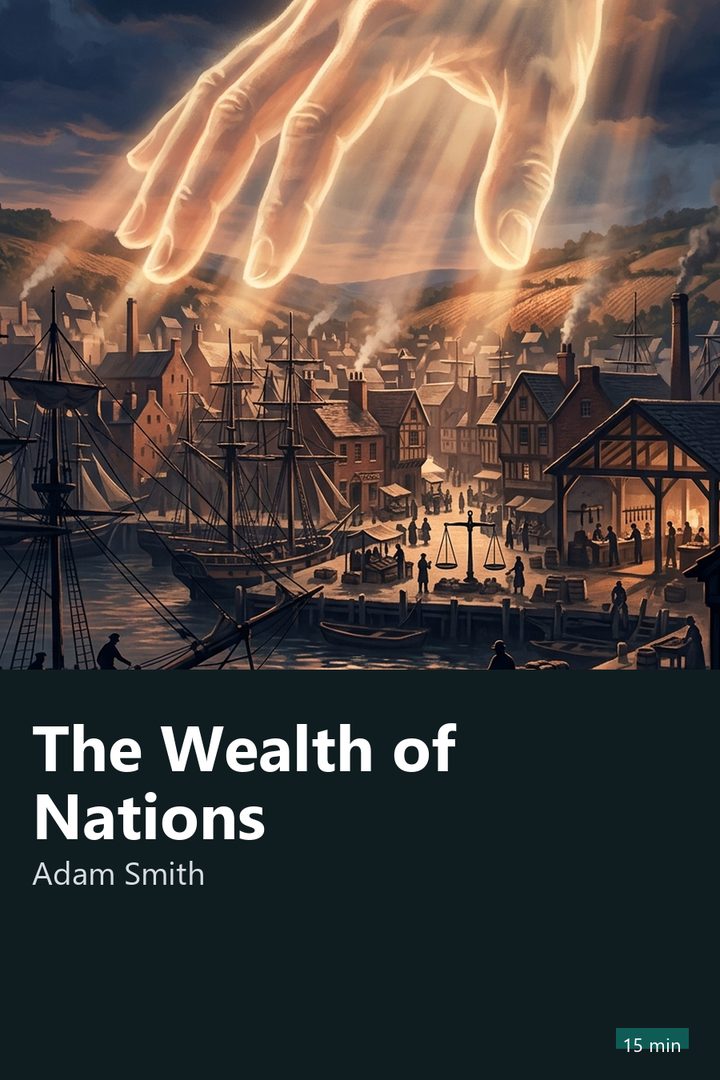
Cover of The Wealth of Nations

Economy and Society · 19 min

The Wealth of Nations

Adam Smith · 1776

Who it's for

For anyone who wants to understand how labor, trade, competition, and government participate in the creation of wealth. It is neither an investment manual nor a quick recipe for getting rich.

Read it in the app

⚡ Free to download • 🎁 One full book free every day

🎧 Audio coming soon in the app

Narration for the English summaries is on its way. Meanwhile you can read the full summary in the app.

3 ideas to take with you

1

Specializing tasks can multiply production, but coordinating responsibilities is what turns efficient parts into a working whole.

2

An agreement accepted by both sides can hide very different urgencies; understanding bargaining power helps reveal what the contract does not show.

3

Defending competition may require pushing back against businesses that have already gained ground and now want to close the door to others.

“
A country's prosperity shows up better in the life its production sustains than in the shine of its store windows.
An idea from The Wealth of Nations, in the words of 15 Minutes

Preview

Start reading now

1. Wealth as it appears in everyday life

For Adam Smith, the wealth of a society does not come down to the gold stored by the government or the luxury of a few families. It depends on the annual production of goods and services capable of sustaining the population. The central question shifts: how much organized labor can turn available resources into better living conditions?

Think of an American city lacking affordable food, reliable transit, and decent housing. Even if millionaire business owners live there, collective prosperity remains limited. The book invites us to look at productive capacity and at how what is produced gets distributed, not just at the money circulating or showing up in store windows.

This shift in perspective helps distinguish appearance from substance. A family might spend more because it took out loans, without having increased its income. Something similar happens with countries: financial activity, on its own, does not guarantee well-being. For Smith, understanding wealth requires investigating how people work, trade, and manage to consume what they need.

2. Dividing tasks to produce more

The division of labor sits at the center of Smith's explanation of productivity. When an activity is broken down into smaller operations, each worker can develop a specific skill. His famous example is pin manufacturing: coordinated tasks make it possible to produce far more than isolated individuals trying to carry out the entire process alone.

In a neighborhood bakery, one person prepares the dough, another tends the oven, and another helps the customers. This setup reduces constant switching between tasks and makes improvements easier. That does not mean any separation is good: if no one watches the whole picture, the bread may come out ready while the counter remains unattended.

The gain comes from skill, time saved, and the use of suitable machines. To apply this idea at work, notice where you repeatedly interrupt tasks or redo steps because of poor coordination. Organizing responsibilities can improve results, provided that specialization does not destroy communication among the people involved in the process.

3. The market sets limits on specialization

Specialization depends on the size of the market. A professional can only make a living from a very specific task when there are enough buyers. In a small town, the same technician might repair fans, blenders, and washing machines. In a major city, there may be enough demand for someone to work exclusively with a single type of appliance.

Accessible transportation and routes expand the possibilities for trade. Smith gives special importance to water transport, which made moving goods cheaper in his time. Today, we can think of highways, delivery networks, and digital connections. A rural producer gains opportunities when able to reach consumers without losing the entire margin to freight costs, delays, and spoiled goods.

This shows why individual talent does not explain everything. A cook may prepare excellent meals and still sell very little if customers cannot reach her. Improving access, information, and circulation can be just as important as improving the product. Productivity grows within a social network, not in a vacuum.

11 more sections and the quiz

Continue in the app

Read the whole summary, finish with the The Wealth of Nations quiz and follow the guided Journeys. No ads in the app.

About Adam Smith

Adam Smith was born in Kirkcaldy, Scotland, in 1723. He studied at the universities of Glasgow and Oxford and served as a professor of moral philosophy at Glasgow. He published The Theory of Moral Sentiments in 1759 and The Wealth of Nations in 1776. He died in Edinburgh in 1790.

Explore

Part of the Journeys:
How Power Works