15 Minutes
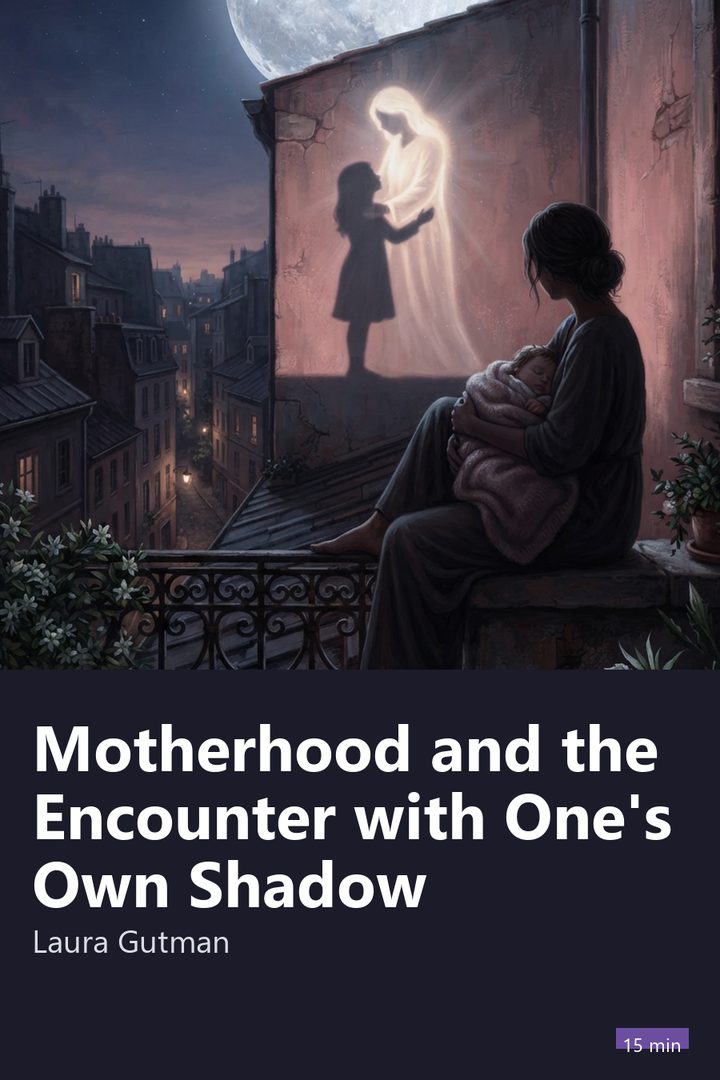
Cover of Motherhood and the Encounter with One's Own Shadow

Family and Parenting · 14 min

Motherhood and the Encounter with One's Own Shadow

Laura Gutman · 2003

Who it's for

Original title (Portuguese): A Maternidade e o Encontro com a Própria Sombra. For mothers and pregnant women who feel exhausted, guilty, or lost after the arrival of a baby, and for those who live with them and want to understand what is going on. It is also useful for healthcare professionals and anyone who carries wounds from their own childhood.

Read it in the app

⚡ Free to download • 🎁 One full book free every day

🎧 Audio coming soon in the app

Narration for the English summaries is on its way. Meanwhile you can read the full summary in the app.

3 ideas to take with you

1

According to the author, a baby stirs up the mother's own history: today's crying can awaken the helplessness of the child she once was.

2

No one was meant to parent alone, and the extreme exhaustion of many mothers says more about a lack of support than a lack of love.

3

Acknowledging what hurts, instead of pretending everything is fine, is the first step toward not taking out the past on your child.

“
The exhaustion of a mother without a support network is not a lack of love; it is a lack of people helping.
An idea from Motherhood and the Encounter with One's Own Shadow, in the words of 15 Minutes

Preview

Start reading now

The baby arrives and life turns upside down

The book begins with a realization that many mothers know firsthand and few say out loud: after childbirth, life changes radically, and not always in the way motherhood commercials promise. Instead of nonstop happiness, there is exhaustion, crying, confusion, and a feeling of not being the mother one imagined.

The author states that this crisis is common and has an explanation. The baby demands almost total presence, the woman's body is still recovering, routines fall apart, and her old identity is put on hold. A woman who used to work, go out, and make decisions on her own suddenly finds herself held hostage by a tiny being. Many women share that they were told at the hospital that from now on it would be pure joy, and that the first week at home was a shock between what they expected and what they actually experienced.

The goal of the text is to take the shame out of this moment and offer a perspective that helps mothers get through it with greater understanding.

What the shadow is

The term shadow comes from psychology and refers to what each person does not want to see in themselves: fears, anger, unmet needs, and old wounds. The author uses the word to talk about what motherhood brings to the surface.

Her thesis is that intense contact with a baby, who cries, demands, and is completely dependent, activates memories and feelings from the mother's own childhood. Someone who received little comfort as a child may feel invaded by a sense of helplessness when hearing her baby cry. It might be a mother who catches herself yelling at her child the exact way her father yelled at her, and is horrified to see herself repeating the scene.

According to this perspective, the difficulty is not a lack of maternal instinct. It is the collision between the baby's need and an old, nunca-met need within the woman herself.

The postpartum period as a crossing

An important concept is the puerperium, the postpartum period right after birth when body and emotions undergo a major reorganization. The author describes it as a time of fragility and fusion with the baby, in which the mother needs to be cared for in order to care for her child.

In practice, this means the first few weeks are not a time for productivity. Receiving ready-made meals, having someone wash the dishes, and being able to sleep when the baby sleeps are not luxuries; they are health necessities. From a medical standpoint, the consensus is that getting little sleep, feeling pain, and experiencing mood swings in the first weeks is common, and that postpartum follow-up is an essential part of care.

In many families today, short parental leave and the lack of a support network make this care difficult. Those who can should ask for help without guilt; those who cannot deserve compassion, not pressure.

13 more sections and the quiz

Continue in the app

Read the whole summary, finish with the Motherhood and the Encounter with One's Own Shadow quiz and follow the guided Journeys. No ads in the app.

About Laura Gutman

Laura Gutman is an Argentine psychotherapist and writer who has dedicated decades to the topics of motherhood, the postpartum period, and child-rearing. She sees clients and teaches courses for women and professionals, and she became well known across Latin America for her direct, provocative style. She has published several books on the subject, including The Revolution of Mothers. This book, from 2003, is one of her earliest and best known.

Explore

Part of the Journeys:
Parenting With Love and Limits