15 Minutes
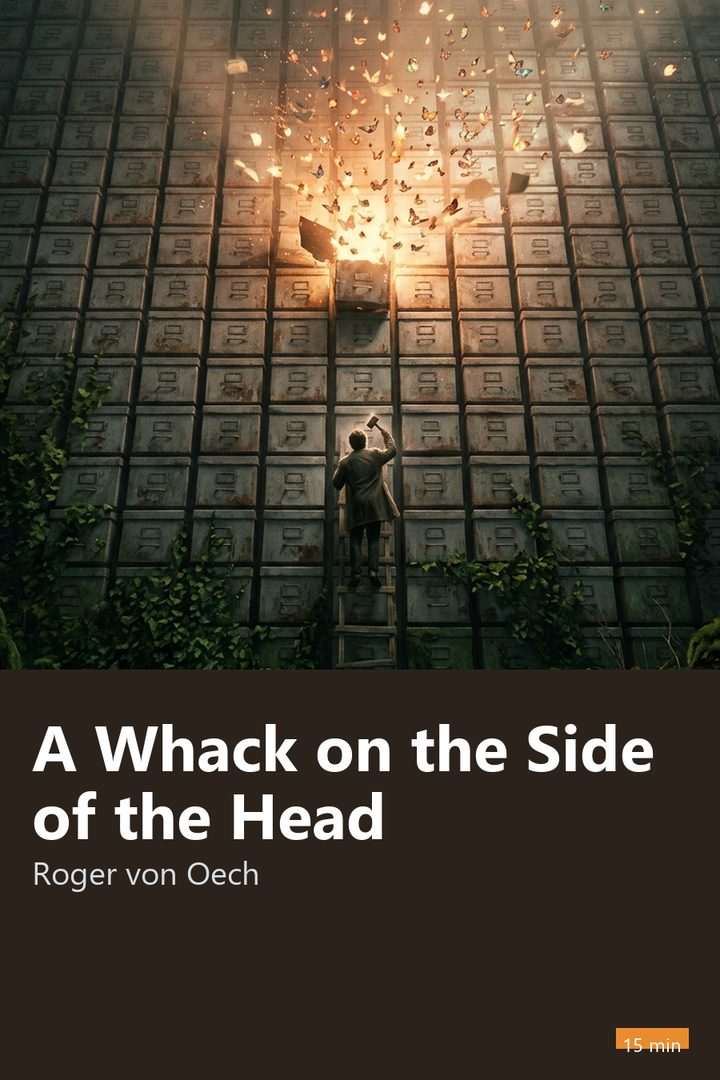
Cover of A Whack on the Side of the Head

Personal Development · 16 min

A Whack on the Side of the Head

Roger von Oech · 1983

Who it's for

For you if you feel stuck in the same thinking patterns, freeze up when solving problems, and think creativity is just for artists. It's also for anyone who leads a team and wants fresh ideas without relying on luck.

Read it in the app

⚡ Free to download • 🎁 One full book free every day

🎧 Audio coming soon in the app

Narration for the English summaries is on its way. Meanwhile you can read the full summary in the app.

3 ideas to take with you

1

Creating gets easier when you switch mental roles: exploring, imagining, evaluating, and taking action are different tasks, and trying to do them all at once gets in the way.

2

If you treat play as a waste of time, you're cutting off the very ground where many good ideas take root.

3

Looking at a problem across different fields usually produces more than sticking to what you already know.

“
When only one answer seems possible, it's a sign that the search ended too soon.
An idea from A Whack on the Side of the Head, in the words of 15 Minutes

Preview

Start reading now

What a whack on the side of the head means

The title comes from a simple image: a teacher giving a student a little tap on the head to snap them out of autopilot. Von Oech uses this scene as a metaphor. A whack on the side of the head is any jolt that shakes up your thinking and makes room for an idea you hadn't seen before.

The book isn't a manual of step-by-step techniques. It's a collection of thought-provoking prompts, short stories, puzzles, and odd questions, all designed to unsettle what you take for granted. The premise is that creativity depends less on rare talent and more on a willingness to look from another angle.

That changes the question. Instead of asking, 'Do I have a knack for inventing things?' the author suggests, 'What's keeping me from thinking differently right now?' He calls these obstacles mental locks, and the entire book revolves around recognizing them and unlocking them one by one.

The four roles in the creative process

Before discussing the locks, the author introduces a model of four roles anyone can take on: the Explorer, the Artist, the Judge, and the Warrior. Each role handles a different stage, and the most common mistake is using the wrong role at the wrong time.

The Explorer goes looking for information, including outside your field. The Artist takes that material and transforms it, testing combinations, playing with versions, and making rough drafts without worrying about how they look. These are the two roles involved in generating ideas.

The Judge comes in afterward, weighing costs, risks, and quality. The Warrior sees the chosen idea through, facing fatigue, red tape, and people who turn up their noses. When the Judge shows up too early, it kills an idea before it can grow. When the Warrior is missing, a good idea stays tucked away in a drawer.

What mental locks are

Mental locks are things we tell ourselves that sound sensible but act like padlocks. Von Oech lists ten of them and shows that each contains some truth and some exaggeration. They help in everyday life, but they get in the way when a problem calls for something new.

According to the author, they largely originate in school and at work, where people are rewarded for the right answer, following rules, and staying quiet when uncertain. That training helps you pass classes and complete tasks, but it leaves your brain reluctant to explore.

The first step is noticing a lock in action. When you hear yourself saying, 'That won't work' or 'That's not my field,' it's worth pausing to ask whether that's a fact or a habit. Often it's just a habit, and a good whack can help you break it.

11 more sections and the quiz

Continue in the app

Read the whole summary, finish with the A Whack on the Side of the Head quiz and follow the guided Journeys. No ads in the app.

About Roger von Oech

Roger von Oech is an American writer and creativity consultant with an academic background at Stanford. He founded Creative Think, a company that offers creative-thinking talks and workshops for businesses in California. He created the Creative Whack Pack, a deck of cards with thought-provoking prompts to get ideas flowing. He also wrote A Kick in the Seat of the Pants, published in 1986.

Explore

Part of the Journeys:
Creativity Without Blocks