15 Minutes
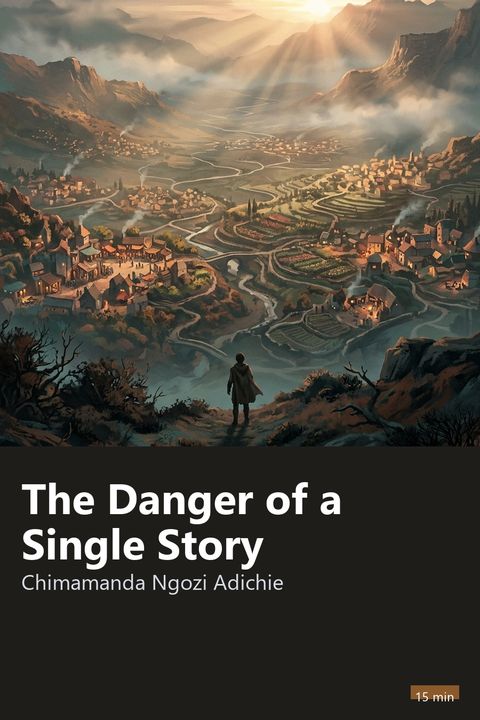
Cover of The Danger of a Single Story

Economy and Society · 15 min

The Danger of a Single Story

Chimamanda Ngozi Adichie · 2009

Who it's for

For you if you want to understand why repeating just one image of a people, a place, or a person narrows your perspective. This is a short, personal, accessible read about stereotypes, power, and literature.

Read it in the app

⚡ Free to download • 🎁 One full book free every day

🎧 Listen to this summary in the app

Every summary has audio narration. Open the app to read it or listen to it.

3 ideas to take with you

1

According to the author, the problem with a stereotype is not that it is false but that it is incomplete, because one part of the picture takes the place of the whole.

2

The book argues that reading writers from different backgrounds expands the imagination of readers and of those who see themselves represented.

3

The author shows that recognizing your own oversimplified images is the first step toward revising them, even if you have been a victim of them yourself.

“
An image repeated a thousand times does not become truth. It only becomes a habit of seeing.
An idea from The Danger of a Single Story, in the words of 15 Minutes

Preview

Start reading now

A Short Talk That Became a Touchstone

In 2009, Nigerian writer Chimamanda Ngozi Adichie took the stage at a conference devoted to ideas and spoke for just under twenty minutes. The text of that talk, later published as a short book, became widely known for a simple reason: it names something everyone has seen but almost no one knew how to explain. It describes what happens when a person or a place is defined by a single narrative.

The author develops her argument through personal stories, with a light touch and a sense of humor. There is no academic jargon, and each example helps you understand the next. The book feels almost like a conversation: she shares her experiences and, in the end, shows what she learned about power, prejudice, and literature.

Although the setting is Nigeria and the United States, the subject is universal. Every country has simplified versions of its groups, regions, and public figures, and every reader has fallen for them at some point. That is why the idea travels so easily across cultures.
The Girl Who Wrote About Snow

Adichie begins by recalling her childhood in a university town in Nigeria. She grew up reading British and American books and started writing her own stories at seven. The characters she created had blue eyes, played in the snow, ate apples, and remarked on how the sun had finally come out. None of that was part of her own life.

The detail is revealing. If the only books she knew featured people from other countries, it seemed natural that real stories should be about people from other countries. The literature that shaped her unintentionally suggested that characters in books did not look like her, live where she lived, or eat what she ate.

Discovering African writers changed that picture. Reading authors such as Chinua Achebe helped her understand that people like her could exist on the page. She began writing about mangoes, hot weather, and the life she knew. It is an example of how a lack of representation shapes a reader's imagination.

There is a lesson here for parents and schools. The stories available to children, on shelves and on screens, teach them what they can be and imagine. Offering books with characters of different skin colors, accents, and backgrounds naturally broadens their frame of reference and keeps them from learning that the world fits a single mold.

Fide and the Woven Basket

One of the most memorable episodes concerns a boy named Fide, who worked in her family's home. The author explains that his mother was described to her only as someone very poor. At home, all anyone said about that family was that they needed help, and the author's mother sent them food and old clothes.

One day, while visiting the boy's village, she saw a beautifully woven basket made by one of his brothers. She was surprised. It had never occurred to her that someone in that household could make something beautiful. Everything she knew about the family fit into a single word, poverty, leaving her no mental space to see anything else.

The scene illustrates the book's central mechanism. Seeing someone only in terms of what they lack strips away their complexity. The poverty was real, but it was not the only truth about the family, and the story told at home reduced them to that alone.

Anyone who has been treated as an object of pity at home or at work knows the effect from the other side. Being seen only through your struggles makes you feel small and invites help that overlooks your abilities. Respect means recognizing both someone's needs and their competence.

9 more sections and the quiz

Continue in the app

Read the whole summary, finish with the The Danger of a Single Story quiz and follow the guided Journeys. No ads in the app.

About Chimamanda Ngozi Adichie

Chimamanda Ngozi Adichie is a Nigerian writer born in Enugu in 1977. Her debut novel was Purple Hibiscus, and she gained international recognition with Half of a Yellow Sun and Americanah. She also wrote the essay We Should All Be Feminists. The talk that became this book dates to 2009.

Explore