15 Minutes
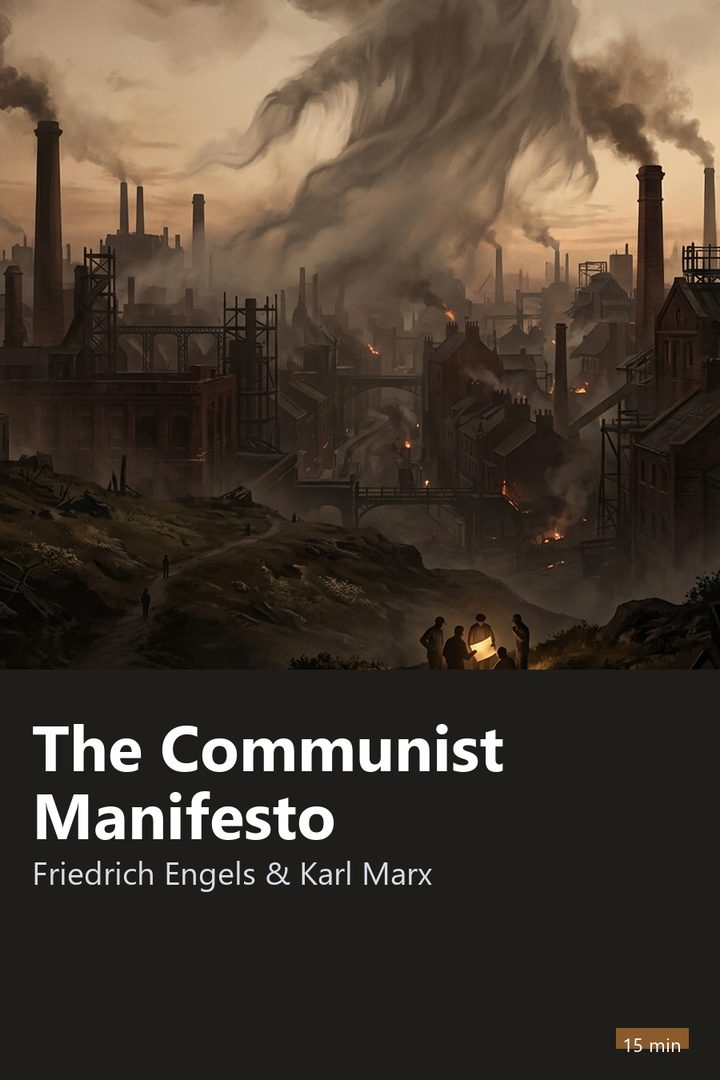
Cover of The Communist Manifesto

History · 17 min

The Communist Manifesto

Friedrich Engels & Karl Marx · 1848

Who it's for

For anyone who wants to understand the pamphlet that invented much of our modern political vocabulary but knows it only by name. This is history, with context and criticism, not a lesson in anyone's doctrine.

Read it in the app

⚡ Free to download • 🎁 One full book free every day

🎧 Audio coming soon in the app

Narration for the English summaries is on its way. Meanwhile you can read the full summary in the app.

3 ideas to take with you

1

For the authors, class conflict isn't an isolated episode; it's the engine of history. That perspective explains more about change than a list of kings and battles.

2

The 1848 text identified a pattern that resurfaced in 1929, in 2008, and during the pandemic: the capacity to produce racing ahead of the capacity to buy.

3

Reading a mistaken prediction without throwing out the author's entire work is the exercise a classic demands: getting globalization right and impoverishment wrong are parts of the same document.

“
The class the Manifesto portrays never rests: it feels alive only when revolutionizing the instruments of production.
An idea from The Communist Manifesto, in the words of 15 Minutes

Preview

Start reading now

A Pamphlet Commissioned on the Eve of Revolution

In late 1847, an organization of German workers exiled in London, the Communist League, commissioned two well-known figures in the movement to write a party platform, something short and direct to distribute across industrial Europe. They chose Karl Marx and Friedrich Engels, and the result appeared in February 1848, just as Europe was entering a year of revolutions, from France to Italy.

The opening is pure political provocation: the authors say that a ghost, the ghost of communism, was haunting Europe, and that all the continent's powers were joining in a holy hunt for it. Their response was straightforward: rather than deny the accusation, they decided to lay out their ideas openly, so anyone could judge for themselves.

Notice the format: this isn't an academic treatise. It's a pamphlet, written to be read aloud, printed cheaply, and passed from hand to hand. Once you understand the format, you understand half the text: short sentences, a clear enemy, and an emotional appeal at the end.
History Told as Class Conflict

The text's first thesis is among the most frequently cited in history: everything written about human history up to that point is, in the authors' reading, the history of class struggles. Patricians against plebeians in Rome, lords against serfs under feudal serfdom, and now the bourgeoisie against the proletariat in industry.

The mechanism behind this is economic: each era creates a mode of production and relationships between those who own the means of production and those who have only their labor power. When those relationships become too restrictive for the forces they themselves created, the old order cracks and another replaces it, often violently.

It's a lens, not a photograph. It illuminates much that the history of kings leaves hidden, while also simplifying things: real societies have layers in between and internal contradictions unlikely to fit into two boxes. Read it as a pair of glasses, not a complete X-ray.

The Bourgeoisie, the Most Revolutionary Class of All

Here's the part that surprises people who have never read it: the authors devote almost enthusiastic pages to the bourgeoisie. In their view, this class brought about more revolutionary change in a hundred years than all previous generations combined: it overthrew feudal power, created a world market, replaced handicrafts with industry, and filled the map with enormous cities.

The central idea is that the bourgeoisie cannot exist without constantly revolutionizing the instruments of production: new machines, new transportation, new markets, new communications. What once took centuries now happens in years, and what exists in one country appears in another the following week.

Keep this section in mind, because it has aged remarkably well: swap steam power for algorithms and railroads for fiber optics, and much of the description still applies to the world we live in today.

11 more sections and the quiz

Continue in the app

Read the whole summary, finish with the The Communist Manifesto quiz and follow the guided Journeys. No ads in the app.

About Friedrich Engels & Karl Marx

Karl Marx (1818-1883) was a German philosopher, economist, and journalist, the author of Capital, and one of the most influential thinkers of the modern era. Friedrich Engels (1820-1895), a German industrialist and writer, was his collaborator for decades and the financial backer who kept Marx's work going. They wrote the pamphlet at the request of the Communist League, a workers' organization in London. It appeared in February 1848, weeks before revolutions set the continent ablaze.

Explore

Category:
History