15 Minutes
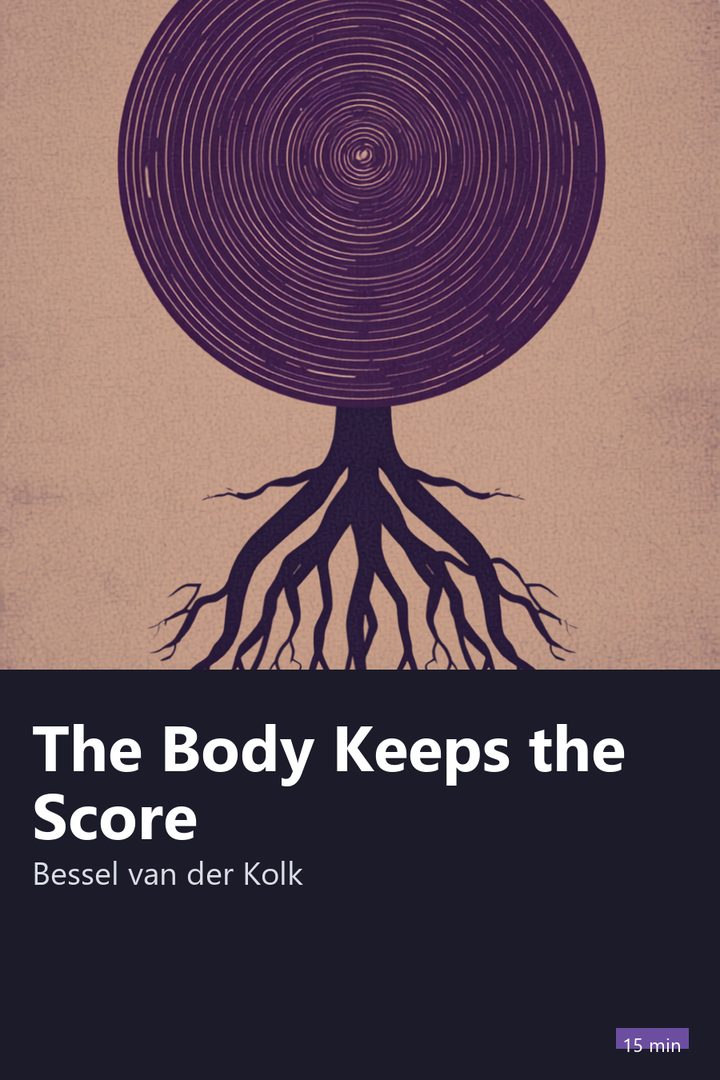
Cover of The Body Keeps the Score

Mental Health · 15 min

The Body Keeps the Score

Bessel van der Kolk · 2014

Who it's for

For anyone who has heard about trauma but never understood why the body reacts before the mind can explain why. A serious look at the body and memory, not a substitute for professional evaluation or treatment.

Read it in the app

⚡ Free to download • 🎁 One full book free every day

🎧 Audio coming soon in the app

Narration for the English summaries is on its way. Meanwhile you can read the full summary in the app.

3 ideas to take with you

1

A frightening experience from years ago can put your whole body on alert today, even when your mind understands that the danger has passed.

2

Freezing in the face of danger is just as much a survival response as running or fighting back, only quieter.

3

Feeling safe around someone involves your body just as much as the trust your mind builds.

“
What your eyes haven't registered as danger, your body may already have filed away as a threat years ago.
An idea from The Body Keeps the Score, in the words of 15 Minutes

Preview

Start reading now

Why a book about trauma became a phenomenon beyond the therapist's office

Bessel van der Kolk spent decades treating people who had been through difficult situations and noticed a puzzling pattern. Many patients could describe what had happened in detail, yet years later they still reacted as though the danger were right there, without being able to explain why.

That mismatch between the story someone tells and the way their body reacts is the book's central thread. It became a bestseller because it speaks not just to psychiatrists, but to anyone whose heart has ever raced when there was no actual danger in front of them.

This summary won't revisit patients' stories or detail what each person experienced. The idea is to take the central concepts, the body, memory, and the nervous system, and show where they appear in your everyday life, even without a major event behind them.

One important note right from the start, which will come up again throughout this text: nothing here replaces evaluation, diagnosis, or care from a mental health professional. The goal is simply to introduce concepts from a book, not to offer any kind of clinical guidance.
The body remembers through sensations, not ready-made sentences

When something deeply frightens a person, the brain records that moment differently from an ordinary memory. Instead of becoming an organized story with a beginning, middle, and end, it gets stored in disconnected pieces, such as a smell, texture, sound, or specific muscle tension.

That's why sometimes a small, seemingly unimportant detail, a door making a noise or a particular tone of voice, sparks a strong physical reaction before the person consciously understands why it's happening.

Understanding this difference helps take the blame off someone who responds to a trigger for no apparent reason. There is a reason, but it's stored as a bodily sensation, not as a ready-made sentence you can explain in a work meeting.

This also explains why telling your story in a neat, chronological order sometimes changes nothing in your body. The stored sensation follows a different logic, more like a collection of disconnected images than a continuous piece of writing.

Reliving isn't the same as remembering

Remembering an old event usually comes with a sense that it's over, even if the memory is unpleasant. Reliving is different: the body reacts as though the event is happening now, with a racing heart, shallow breathing, and foggy thinking.

This distinction explains why simply thinking positively rarely resolves a sudden startle response. It isn't a matter of willpower or misreading the situation. It's the body's alarm system going off before the rational part of the mind enters the picture.

Recognizing that you're reliving rather than simply remembering is already a first step in observing yourself. It helps you name what you feel, my body is reacting as though there's danger, instead of criticizing yourself for a reaction that seems out of proportion to the present situation.

12 more sections and the quiz

Continue in the app

Read the whole summary, finish with the The Body Keeps the Score quiz and follow the guided Journeys. No ads in the app.

About Bessel van der Kolk

Bessel van der Kolk is a Dutch psychiatrist based in the United States, a professor of psychiatry at Boston University School of Medicine, and the founder of the Trauma Center in Brookline, Massachusetts. He has spent more than four decades researching the effects of difficult experiences on the body and brain, with work published in peer-reviewed scientific journals. The Body Keeps the Score was published in 2014 and spent years on the New York Times bestseller list, becoming a popular reference on the subject beyond clinical settings. He has also participated in discussions about diagnostic criteria that remain debated within psychiatry.

Explore

Category:
Mental Health
Part of the Journeys:
Take Care of Your Mind