15 Minutes
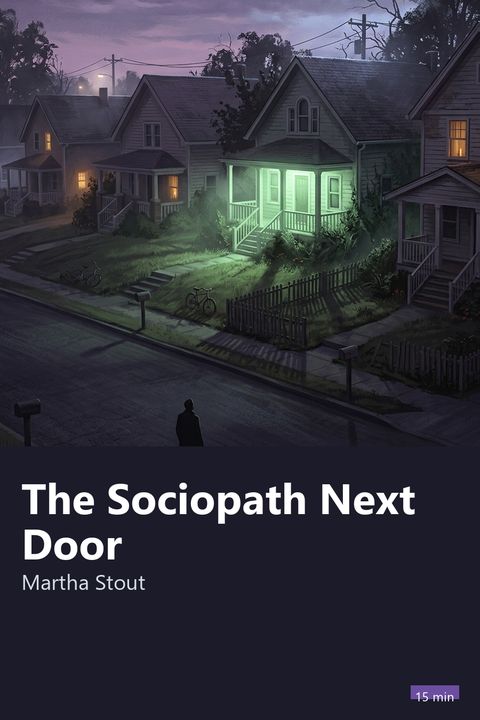
Cover of The Sociopath Next Door

Psychology · 15 min

The Sociopath Next Door

Martha Stout · 2005

Who it's for

For anyone wanting a conversational explanation of how people without guilt manipulate others and how to protect yourself without becoming paranoid. It also helps people who have experienced a difficult relationship and want to recognize patterns.

Read it in the app

⚡ Free to download • 🎁 One full book free every day

🎧 Listen to this summary in the app

Every summary has audio narration. Open the app to read it or listen to it.

3 ideas to take with you

1

For Stout, conscience arises from emotional connections with others, and people without those connections know the rules without feeling their weight.

2

According to the book, most sociopaths are not violent and live among us as coworkers, neighbors, and partners, making them hard to recognize.

3

The chapter on obedience reminds us that even people with a conscience can have it silenced by authority figures' orders and group pressure.

“
When charm arrives too quickly, let time and facts put it to the test.
An idea from The Sociopath Next Door, in the words of 15 Minutes

Preview

Start reading now

What if you felt no guilt?

The Sociopath Next Door begins with an imaginative exercise. Picture living without the inner voice saying some things should not be done, without the tightness in your chest after hurting someone, without the discomfort of having lied. For American psychologist Martha Stout, this is everyday life for a small but real portion of the population.

Published in 2005, the book became one of the most popular on its subject. The author, a clinician with decades of experience, treated people harmed by individuals without conscience and writes to help ordinary readers recognize the pattern and protect themselves.

The tone is conversational, combining case stories and practical advice. This is both an advantage and a limitation: the text is accessible but is not a scientific study, and the stories illustrate ideas rather than prove arguments.


What conscience means

Before discussing people without it, the author describes conscience. For her, it is not a memorized rulebook but a feeling arising from emotional bonds with other people. We care because we love, and this affection makes us hesitate before hurting someone.

In this view, conscience functions as an emotional brake. When considering something cruel, we feel discomfort, shame, or fear of hurting someone who matters. This feeling guides behavior far more than laws or fear of being caught.

People without this bond do not experience the brake. They may know what society considers right or wrong but lack the emotional weight. For the author, it resembles knowing theoretically that fire burns without ever feeling the pain of a burn.

One in twenty-five

The estimate that made the book famous is that about four percent of people, one in twenty-five, are sociopaths, meaning they lack conscience. The author uses this figure for the United States and suggests it warns us that the phenomenon is more common than we imagine.

The number is striking and deserves caution. Population studies of related diagnoses indicate lower rates, around one to three percent, varying by criteria and country. The author herself acknowledges limited research and that numbers depend on how the disorder is defined.

Even so, the practical lesson remains: encountering someone like this during your life, at work, in family, or in relationships, is not unusual. This does not mean distrusting everyone, but knowing such people exist and do not arrive wearing a villain's black cape.

11 more sections and the quiz

Continue in the app

Read the whole summary, finish with the The Sociopath Next Door quiz and follow the guided Journeys. No ads in the app.

About Martha Stout

Martha Stout is an American clinical psychologist who spent decades treating people who experienced abuse and trauma. She taught psychiatry at Harvard Medical School for about twenty-five years. She also wrote The Myth of Sanity, published in 2001, about trauma and dissociation. The Sociopath Next Door was released in 2005 and became a bestseller.

Explore

Category:
Psychology