15 Minutes
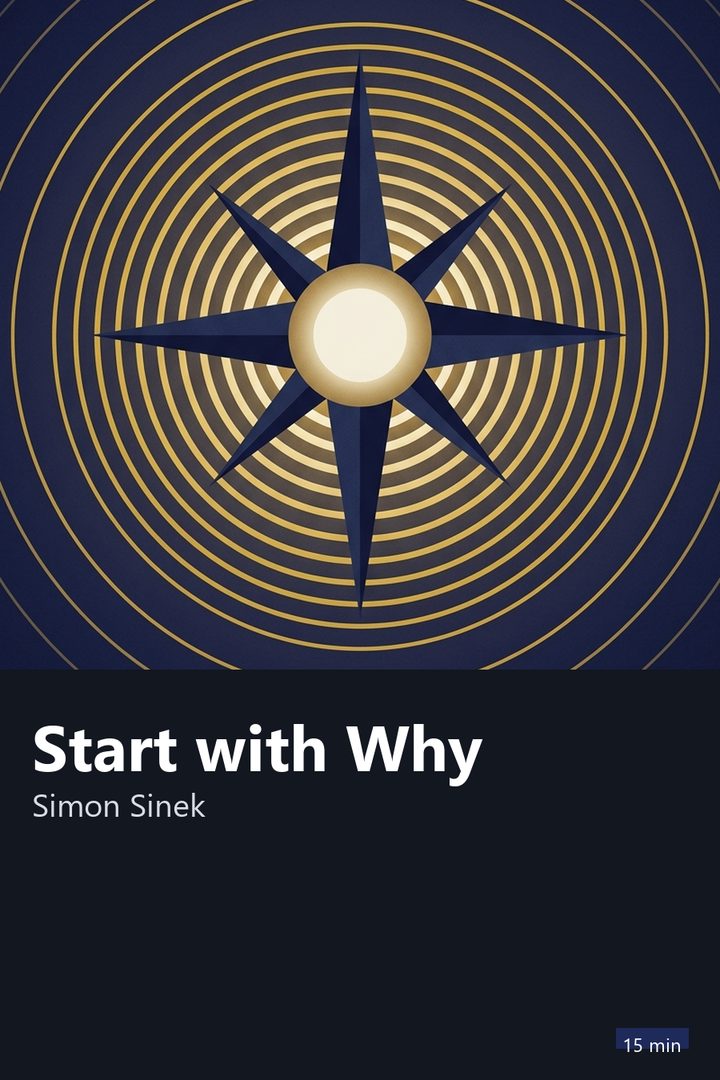
Cover of Start with Why

Leadership · 15 min

Start with Why

Simon Sinek · 2009

Who it's for

For you if you lead a small business, a team, or just your own career, and you feel like you talk a lot about what you do and very little about why you do it. Start with Why helps you organize that answer and use it to attract loyal customers and loyal employees, not just customers who show up for a sale.

Read it in the app

⚡ Free to download • 🎁 One full book free every day

🎧 Audio coming soon in the app

Narration for the English summaries is on its way. Meanwhile you can read the full summary in the app.

3 ideas to take with you

1

A company that can only explain what it sells, without knowing why it sells it, ends up competing on price alone until it goes under.

2

An employee who understands the reason behind the business solves problems on their own; one who only memorized the script freezes the moment things go off-script.

3

A reason for existing is only real when it shows up in a decision that costs something, not just in a sentence hanging on the wall.

“
A competitor can copy your menu, copy your storefront and copy your sales script, but it cannot copy the reason that made you open this business.
An idea from Start with Why, in the words of 15 Minutes

Preview

Start reading now

The question almost no company can answer

Pretty much every company can tell you what it sells. Ask the owner of any neighborhood shop what he sells and the answer comes out right away: bread, clothes, car repair, haircuts. Ask how he does it and he can explain that too: process, ingredients, technique. Now ask why that business exists, beyond making a profit at the end of the month, and the answer usually stalls.

Simon Sinek noticed this pattern while studying admired companies and leaders: they can answer all three questions, what, how and why, but they start with the last one, unlike most people. Instead of starting with the product, they start with the belief that holds that product up.

This is not a detail of motivational speeches. It is the difference between a customer who buys once because the price was good and a customer who comes back even when a cheaper option is right next door.

That same gap shows up outside the business world, in an ordinary job interview. Candidates usually explain well what they did in previous roles and how they did it, with plenty of detail on process and results. When it comes time to explain why they chose that particular career path, the answer rambles, turns generic, a list of memorized qualities meant to impress the recruiter. That same difficulty in answering why, inside a company or inside a professional's life, is the starting point for the whole line of reasoning in the book.
The Golden Circle, explained without conference jargon

Sinek organizes this idea in a simple drawing with three layers, which he called the Golden Circle: on the outside is what the company does, in the middle is how it does it, and at the center is why it does it. Most companies communicate from the outside in, starting with the product and only afterward, if there is time left, talking about purpose.

The brands that truly build loyalty do the opposite: they communicate from the inside out, starting with the belief and letting the product serve as proof of that belief. Customers do not decide only by a product's features; they also decide because it matches what they themselves believe.

Think of a neighborhood auto shop that only talks about parts and price, versus another that makes it clear it exists to return a safe car to families of people who work all day. Both replace the same part, but only one builds a relationship that survives a competitor's cheaper quote.

Why copying a product is easy and copying a belief is nearly impossible

A competitor can copy your menu, copy your store decor, even copy your memorized customer service script. What it cannot copy overnight is the reason that led the owner to build that business in that specific way.

A big gym chain can copy the equipment, the extended hours and the promotional price of a neighborhood gym. What it cannot easily copy is the reason that small gym greets every member by name and adjusts their workout without charging an extra fee.

This explains why a small business survives next to a big chain: not because it competes on price, but because it competes on something the big chain cannot replicate at scale, a genuine reason for existing.

11 more sections and the quiz

Continue in the app

Read the whole summary, finish with the Start with Why quiz and follow the guided Journeys. No ads in the app.

About Simon Sinek

Simon Sinek is a British-American writer and consultant who specializes in leadership and organizational communication. Before becoming an author, he worked in advertising and marketing consulting, a period in which he began to notice why some brands built loyal customers and others did not. Start with Why, from 2009, grew out of that observation and launched him as a speaker, including one of the most-watched talks in TED history. After that book, he published other titles on leadership and organizational culture, such as Leaders Eat Last.

Explore

Category:
Leadership
Part of the Journeys:
The Leader Who Inspires