15 Minutes
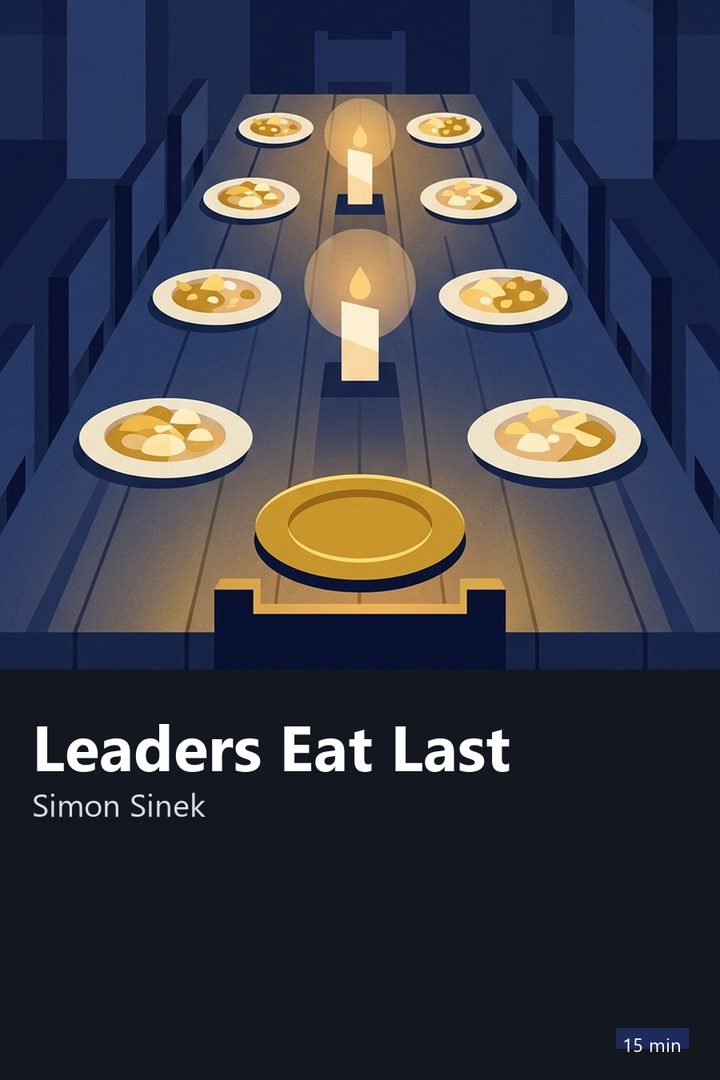
Cover of Leaders Eat Last

Leadership · 15 min

Leaders Eat Last

Simon Sinek · 2014

Who it's for

For anyone who leads a team, even if it's just two or three people, and feels that a paycheck alone won't hold on to good people for long. It's also for anyone who just wants to understand why they perform better in some work environments than in others.

Read it in the app

⚡ Free to download • 🎁 One full book free every day

🎧 Audio coming soon in the app

Narration for the English summaries is on its way. Meanwhile you can read the full summary in the app.

3 ideas to take with you

1

A team only rows against the market out there once it stops spending energy defending itself from threats inside.

2

Trusting first, before the other person has earned it, usually opens more doors than demanding proof of loyalty before any gesture.

3

A company that decides about employees by looking only at a spreadsheet forgets that every number there represents someone with bills to pay at home.

“
Before demanding loyalty, ask yourself whether that person has ever received a gesture of trust from you without having to earn it first.
An idea from Leaders Eat Last, in the words of 15 Minutes

Preview

Start reading now

The mistake of thinking pay solves everything

Plenty of companies believe that paying well is enough to keep good people. Sinek disagrees: money keeps someone from leaving dissatisfied, but it's rarely what makes a person truly buy in and give their best every single day.

The book grows out of a simple question that bothered the author for years: why do people on some teams sacrifice for one another without anyone asking, while on others everyone just looks after their own backyard, even when they're paid well?

Picture an auto repair shop where the owner pays above the going rate in town, but hardly anyone stays more than six months. The problem isn't the paycheck, it's the mood inside the garage, and no raise by itself fixes that as long as the mood stays the same.
The Circle of Safety

The central idea of the book is what Sinek calls the Circle of Safety: an environment where a person feels that, if they make a mistake, they'll be corrected, not humiliated, and that nobody there is hoping to see them trip.

When that circle exists, the team's energy goes outward, to compete with the market, solve the customer's problem, create something new. When it doesn't, the energy turns into infighting, hallway gossip, and people hiding mistakes out of fear of the boss's reaction.

An easy example to recognize: in a store where the manager yells when someone gets the register wrong, employees spend the day more worried about not messing up in front of him than about serving the customer well.

That doesn't mean there's never conflict or disagreement inside the Circle of Safety. It means disagreement happens in a way that doesn't turn into a personal attack, and that once it's resolved, nobody holds a hidden grudge waiting for the next chance to get even.

Why group protection lives in the body, not just in company culture

Sinek turns to an anthropological explanation: for much of human history, leaving the tribe alone meant becoming easy prey. Those protected by the group survived longer, so we learned to associate belonging to a trustworthy group with a feeling of real safety, not just emotional comfort.

That's why being left out of an important meeting or removed from a work group chat hurts as much as it does, even with no physical danger involved: the body reacts as if the group's protection were truly under threat.

In a company this shows up in small things, like who gets called in to decide and who only finds out afterward. An employee who is never consulted, even after working there for years, feels that same ancient signal of being outside the group.

13 more sections and the quiz

Continue in the app

Read the whole summary, finish with the Leaders Eat Last quiz and follow the guided Journeys. No ads in the app.

About Simon Sinek

Simon Sinek is a British-American writer and speaker with a degree in cultural anthropology from Brandeis University, and he spent years in advertising before becoming a leadership consultant. He became known worldwide after a talk about purpose that turned into one of the most-watched videos in the history of the platform that hosted it. Leaders Eat Last was originally published in 2014 and grew out of conversations with United States Marine Corps officers about why soldiers sacrifice themselves for one another. Sinek has also written other books about purpose and leadership, and today he runs a consulting group focused on training leaders at large companies.

Explore

Category:
Leadership
Part of the Journeys:
The Leader Who Inspires