15 Minutes
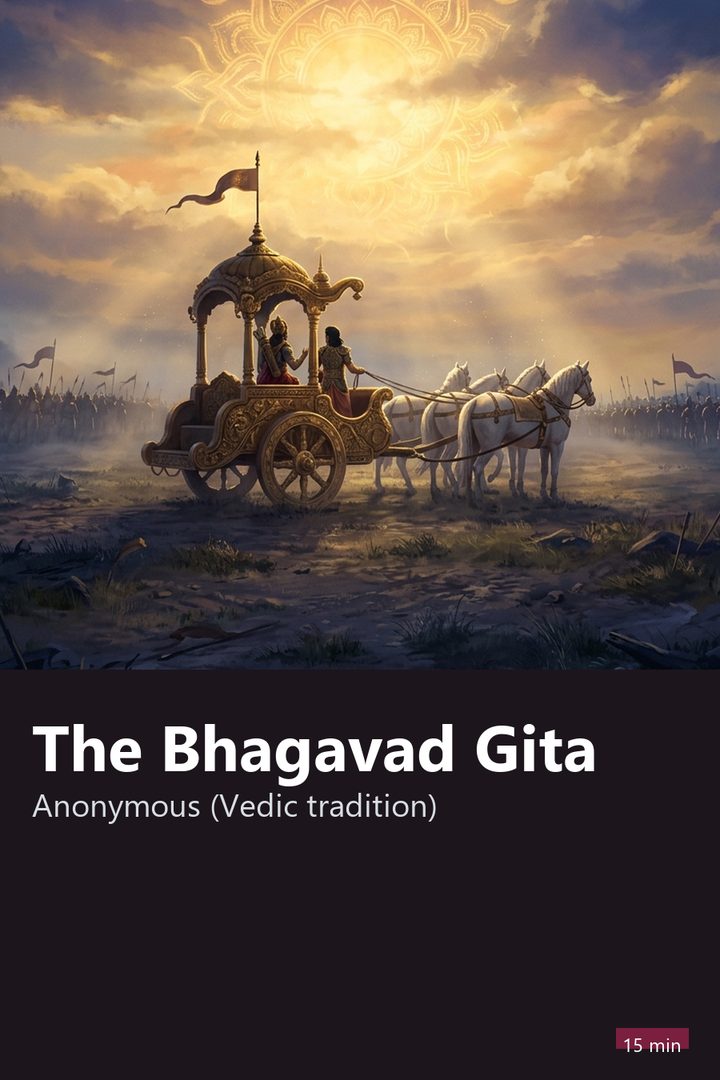
Cover of The Bhagavad Gita

Spirituality · 17 min

The Bhagavad Gita

Anonymous (Vedic tradition) · -400

Who it's for

For anyone who wants to explore a central text of Hinduism and reflect on duty, action, and spiritual life. It does not require religious commitment, only an openness to a different worldview.

Read it in the app

⚡ Free to download • 🎁 One full book free every day

🎧 Audio coming soon in the app

Narration for the English summaries is on its way. Meanwhile you can read the full summary in the app.

3 ideas to take with you

1

A responsibility deserves closer examination when its costs fall on those with the least power to refuse it.

2

Investigating the origin of a desire can reveal that an apparently personal choice actually grew out of comparison.

3

Understanding a tradition becomes much richer when we respect the parts of it that do not fit neatly into our own beliefs.

“
The outcome is part of your story, but it does not have to define your worth.
An idea from The Bhagavad Gita, in the words of 15 Minutes

Preview

Start reading now

1. A conversation when acting seems impossible

The Bhagavad Gita is part of the Mahabharata, a great narrative of the Indian tradition. Its main scene takes place just before a battle between relatives. Arjuna, a respected warrior, looks out over the two armies and recognizes teachers, friends, and family members. The prospect of victory loses its shine when he realizes the suffering it is bound to cause.

Krishna, his charioteer and a divine manifestation, turns this impasse into an inquiry into existence. The conversation moves through duty, knowledge, devotion, and freedom. We are not looking at a modern productivity manual, but at a religious work that asks how to live and act in a world marked by real conflict.

The battlefield also allows for an everyday parallel, as long as the difference in scale is respected. Someone who needs to report wrongdoing at work may face divided loyalties. The difficulty lies not only in figuring out what is convenient, but in recognizing responsibilities when any choice seems to bring losses to someone close.


2. Arjuna's crisis deserves to be heard

Arjuna does not show simple laziness or a lack of courage. His body reacts, his confidence collapses, and his arguments reveal deep concern about family and social consequences. He fears that war will destroy bonds and customs. The text begins by giving space to this discomfort before offering any guidance on how to face it responsibly.

This opening matters because moral conflicts are not solved with uplifting slogans alone. A person can be paralyzed by recognizing incompatible values, such as protecting their income while refusing a dishonest order. Listening to what is at stake helps far more than calling every hesitation weakness or a lack of faith.

The passage describes suffering in religious and narrative language; it does not offer a psychological diagnosis. Compassionate care, proper assessment, and evidence-based treatments belong to another field. When distress, fear, or discouragement disrupt daily life, seeing a psychologist or a doctor is important. Reading can accompany that care, but it neither promises a cure nor replaces professional help.

3. Dharma: responsibility beyond convenience

A central concept here is dharma, a word that brings together meanings such as duty, order, and proper conduct. For Arjuna, the issue involves his position as a warrior and the defense of justice. Krishna argues that abandoning the battle also produces consequences. Refusing to act does not become innocent simply because it avoids immediate discomfort.

This does not mean that every obligation handed to us is morally right. In everyday life, someone might confuse family responsibility with accepting endless exploitation. A careful reading asks which commitments protect people and which ones merely preserve privilege. Duty needs to be examined, especially when the person giving the orders does not bear the costs of the decision.

The practical contribution lies in trading a narrow question for a more demanding one. Instead of thinking only about what brings an advantage, ask who will be affected and what responsibility truly belongs to you. Caring for a relative, delivering honest work, and admitting a mistake can require quiet firmness without any spectacle.

11 more sections and the quiz

Continue in the app

Read the whole summary, finish with the The Bhagavad Gita quiz and follow the guided Journeys. No ads in the app.

About Anonymous (Vedic tradition)

The Bhagavad Gita has no historically identified individual author. Tradition attributes the Mahabharata, the epic poem that contains it, to the sage Vyasa, whose biography cannot be established with certainty. Its composition is the result of traditions passed down and reworked over time. The date of composition is debated, generally placed between the last centuries before the Common Era and the first centuries after it, without a consensus that allows us to pin it down to the exact year of 400 BCE.

Explore

Category:
Spirituality
Part of the Journeys:
Great Texts of Faith