15 Minutes
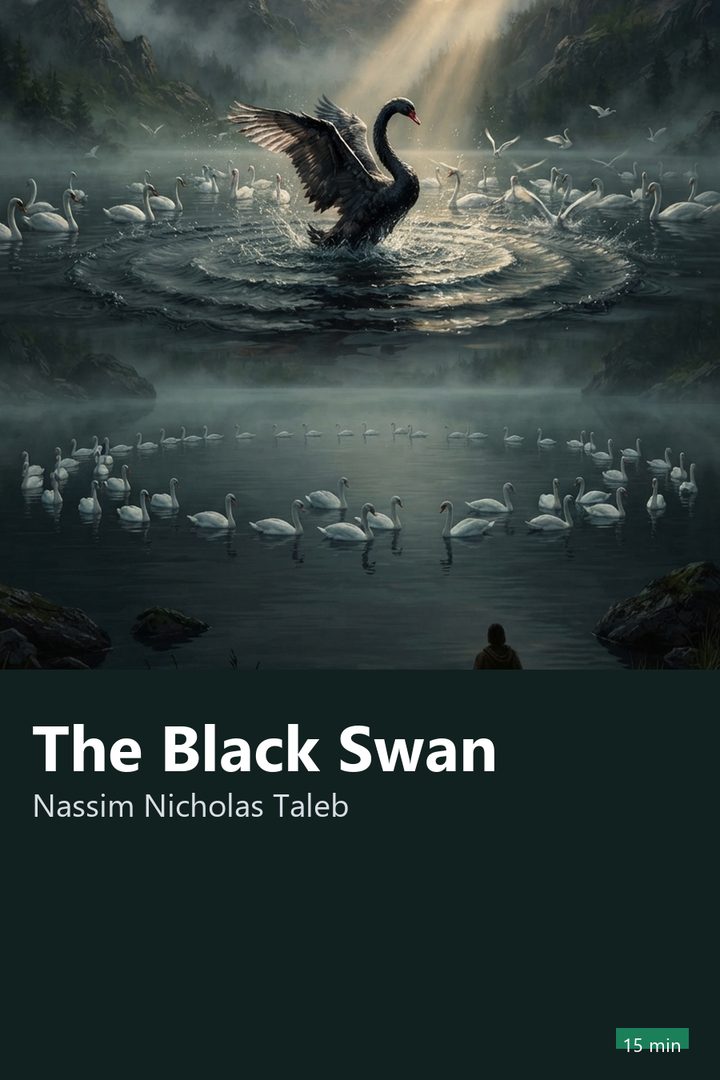
Cover of The Black Swan

Personal Finance · 16 min

The Black Swan

Nassim Nicholas Taleb · 2007

Who it's for

For you if you've ever watched a safe plan fall apart out of nowhere, or if you trust a routine too much just because it has never failed so far. The Black Swan teaches you to see the risk that ordinary numbers don't show, before it knocks on your door.

Read it in the app

⚡ Free to download • 🎁 One full book free every day

🎧 Audio coming soon in the app

Narration for the English summaries is on its way. Meanwhile you can read the full summary in the app.

3 ideas to take with you

1

The more days a routine repeats without failing, the more confident you get, right when the risk behind it has also grown.

2

Your memory edits the past to make it look more predictable than it really was while you were living it.

3

The story of those who made it hides a crowd of people who made the same bet and didn't get the same luck, but nobody interviews the ones who lost.

“
A black swan is the rare event of brutal impact that ordinary models don't see coming.
An idea from The Black Swan, in the words of 15 Minutes

Preview

Start reading now

What a black swan really is

Call something a black swan when an event has three traits together: it is rare, and few people see it coming; it carries an enormous impact, enough to flip the whole table; and, once it happens, everybody comes up with an explanation that makes it look like it could have been predicted. A global financial crisis, a terrorist attack, a pandemic: each of these episodes stayed hidden behind the natural opacity of the future until it happened, and only afterward became obvious to everyone.

The name comes from an old belief in Europe: for centuries, every swan seen there was white, so black swan became an expression for something impossible. Then explorers reached Australia and found real black swans, right there, living normally. A single sighting knocked down a certainty that had stood for centuries.

The idea isn't just about the stock market. It fits the life of anyone on a fixed salary too: the layoff nobody saw coming after years at a steady job, the diagnosis that arrives at a routine checkup, the Zelle scam that empties your account on a Sunday night. Every personal black swan has the same shape: rare, heavy, and obvious only in the rearview mirror.

The Thanksgiving turkey and the routine trap

Taleb tells the story of a turkey that is fed every single day, without fail, for a thousand days in a row. With each meal, the turkey grows more confident that the owner is generous and that tomorrow will be just like today. On day one thousand and one, which happens to fall right before Thanksgiving, the turkey finds out, too late, the reason for all that abundance.

The point isn't about birds: it's about induction, that kind of reasoning that draws a general rule just from seeing the same pattern repeat. The more days without trouble, the more conviction the mind piles up, exactly when the risk was also growing underneath the pattern.

Think of the coworker who has never been late on a payment in fifteen years of steady employment and so keeps no savings at all, or the company that never missed a payroll until the month it did. The confidence that comes only from repetition is exactly the kind of proof that fools us most.

Why we only understand the past after it's already over

After the team misses the playoffs, every fan at the bar swears they knew it back in March. After the company shuts down, the former employee remembers signs that, at the time, seemed like nothing. This habit of rewriting the past as if it had been obvious all along has a name: hindsight bias.

The problem is that this bias fools us twice. First, it makes us think it was easy to predict what has already happened. Second, and worse, it makes us think it will be just as easy to predict what is still to come, just because we have now learned the lesson of the last episode.

Taleb uses this to explain why historians, market analysts, and on-call commentators always have a tidy explanation for the crisis that already passed, but rarely get the next one right. Telling the story backward is easy; writing it forward, in the fog of the present, is another matter.

11 more sections and the quiz

Continue in the app

Read the whole summary, finish with the The Black Swan quiz and follow the guided Journeys. No ads in the app.

About Nassim Nicholas Taleb

Nassim Nicholas Taleb is an essayist, applied mathematician, and former market trader, born in Lebanon in 1960 and based in the United States since the 1980s. He spent more than twenty years trading options contracts on Wall Street and in London before turning to academic research on risk and uncertainty. He is a professor of risk engineering at New York University and had already published, in 2001, the book Fooled by Randomness, about the role of chance in the markets. The Black Swan, from 2007, is the second volume of the series of essays he calls the Incerto, and it drew even more attention after the global financial crisis of 2008 seemed to confirm his warnings.

Explore

Part of the Journeys:
Science Curiosity